

Hill Street Views: The story behind Carlingford's haunted rectory
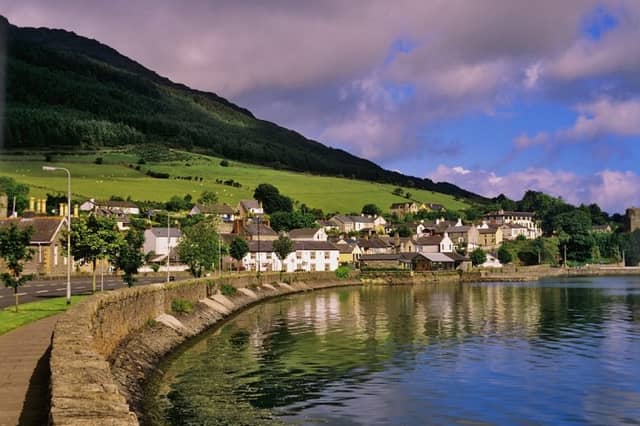

Columnist David Lynch shares the story behind Carlingford’s haunted rectory
It’s not far off 20 years since it vanished from the landscape of north Louth entirely. An empty patch of ground hidden behind a stone wall on a busy street is all that remains today. At one time though, Carlingford Rectory or Old Glebe House, as it was also known, on Dundalk Street in the popular tourist village was of significant religious importance.
But within its walls lay a story of heartbreaking domestic tragedy and, in more recent decades, haunting folkloric tales.
Built in 1813, Glebe House cost nearly £700 to build. It would have been, to locals watching on, a sizeable and important building project for the time.
It would be nearly 25 years later, though before the Barlow family took up residence. In 1837, the Rev William Barlow arrived as the new vicar of Carlingford and took up residence, with his wife Catherine Disney in Glebe House.
According to records, Rev Barlow was born into a prominent legal family in Dublin and educated in Trinity College. He was ordained in 1815. Catherine, meanwhile, was the daughter of Thomas Disney or Rockledge.
The house was described at the time as being “substantial” in scale and surrounded by “gigantic old sycamore” trees; adding some privacy to the 21 acres of grounds surrounding the residence. It was also within sight of the ruins and historic buildings of old medieval Carlingford.
Having married in 1825, the couple would go on to have a large family, with several children born in Carlingford. This was a home full of life, with children and servants and a large staff to run the day-to-day affairs of the family and the vicarage.
Historical research into Catherine's life suggests that the marriage was strongly influenced by her family and the expectations of the society in which she lived.
But prior to meeting Rev Barlow, Catherine appears to have experienced a deep love affair with a William Rowan Hamilton, the future mathematician and astronomer and arguably one of Ireland’s most influential physicists.
The Hamilton Building at Trinity College Dublin is named after him. In his writings Hamilton was heartbroken at losing Catherine, to the point of penning a poem titled ‘The Enthusiast’ to express his true feelings on the affair and its personal toll.
As the years passed in Carlingford though, it became evident that Catherine was deeply unhappy in her marriage to Barlow and in Glebe House. According to biographical research into her life, she despaired to the point of attempting suicide in 1848.
Catherine survived, but this episode would inform later, more haunting, legends attributed to the rectory.
The Barlow family would experience heartbreaking tragedy while living in Glebe House, with several children dying young.
Maxwell Close Barlow, born in 1837, died in infancy the following year.
Most tragically, William Brownlow Barlow, Catherine's third son, died on 26 May 1841, aged ten. He was buried in Dublin.
Then, only three months later, Catherine gave birth to another son, John Lambert Barlow, at the rectory in Carlingford on 16 August 1841. The birth was reported in the Dublin Morning Register.
There would be another terrible loss though, with young John Lambert passing away in 1849, aged just eight.
By the early 1850s, the Barlow family’s time at the rectory was nearing its end and Catherine and Rev Barlow would leave Carlingford for good – their marriage reportedly at an end also. Catherine died shortly afterwards in 1871. Her death notice described her as the wife of the Rev. William Barlow, then Rector of Creggan.
William Barlow lived on for several years before passing in 1871 at the age of 78.
Over the next 100 years the rectory would play host to several clergymen and their families, but it wasn’t until the 1930s that rather odd experiences and encounters started being reported.
The incumbent of the rectory by 1935 was a Canon J.G.L. Meissner who lived at the residence with his family until 1960. It was during this time that unexplained occurrences started to become more prominent. The Meissner family reported hearing footsteps on the stairs in the middle of the night and other nightly disturbances including doors moving or vibrating and the appearance of apparitions.
The family, however, learned to live with these eerie episodes. To them it simply became part of living in a large, older home.
Other accounts state that Meissner himself spoke of seeing the ghost of a sea captain appearing as white mist on summer evenings.
As the 1960s dawned, Glebe House was no longer in use as a rectory, and it was bought by the painter Ernest McDowell. At this stage, the property records describe the building as being a 22-room house. By 1963 local reports also describe the rectory as being in a near derelict state.
It was around this time that McDowell experienced an incident which would foster paranormal fanfare around the property across the northeast and further afield.
Late one evening he saw two figures on the grounds. One appeared to be a young woman in a red velvet dress moving towards the home’s front door. This vision was followed by the sighting of a clergyman, also witnessed entering the property.
McDowell began his own investigation into the vicarage and uncovered the unhappy tales of the Barlow family from over a century beforehand and the Meissner family disturbances of the 1930s and 1940s.
The story of the hauntings at Old Glebe House eventually caught the attention of American paranormal investigator Hans Holzer, who investigated the rectory in the mid-1960s. Prominent British medium Sybil Leek spoke of the apparitions seen by McDowell and the Meissner family as being the remnants of a 19th-century romantic tragedy.
It was through this fevered paranormal publicity that old Glebe House came to be known as one of Ireland’s most famous haunted houses.
The rectory was almost completely destroyed by fire in the late 1970s with the surviving ruins eventually demolished in 2008. To this day the ghost story of the young woman in the red velvet dress lives on. But the real stories of those that lived and died within Carlingford Rectory are just as captivating.