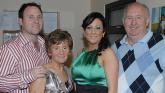
Denis O’Donovan of Ballyryan, Donohill, Co Tipperary
Search


12 Mar 2026

Please allow ads as they help fund our trusted local news content.
Kindly add us to your ad blocker whitelist.
If you want further access to Ireland's best local journalism, consider contributing and/or subscribing to our free daily Newsletter .
Support our mission and join our community now.
To continue reading this article, you can subscribe for as little as €0.50 per week which will also give you access to all of our premium content and archived articles!
Alternatively, you can pay €0.50 per article, capped at €1 per day.
Thank you for supporting Ireland's best local journalism!

Epilepsy Ireland Advocacy & Communications Manager, Paddy McGeoghegan

Epilepsy Ireland has called on communities in Louth to learn how to respond in the event of someone having a seizure.
It said there are an estimated 1,280 in Louth living with epilepsy.
It has coined the phrase TIME,SAFE,STAY to act as a memorable guide to help correctly respond to a seizure.
Epilepsy Ireland has provided this guide in the event of someone having a seizure:
Be aware that there are also types of seizures where the person does not experience convulsions. Instead, they may “zone out” or stare blankly, become confused or agitated, display behaviours like chewing, smacking their lips, fiddling with their clothes, or wandering aimlessly. In this type of seizure, the person’s awareness of their surroundings is affected, and it is important to gently guide the person away from any danger. As with convulsive seizures, NEVER restrict the person’s movements.
Aside from when the seizure goes over 5 minutes, there are other instances where an ambulance should be called:
Read Next: Flood relief scheme open to Louth businesses and community

Subscribe or register today to discover more from DonegalLive.ie
Buy the e-paper of the Donegal Democrat, Donegal People's Press, Donegal Post and Inish Times here for instant access to Donegal's premier news titles.
Keep up with the latest news from Donegal with our daily newsletter featuring the most important stories of the day delivered to your inbox every evening at 5pm.

This publication supports the work of the Press Council of Ireland and Office of the Press Ombudsman, and our staff operate within the Code of Practice of the Press Council. You can obtain a copy of the Code, or contact the Council, at www.presscouncil.ie, Lo-call 1800 208 080 or email: info@presscouncil.ie.