

Dundalk IT-Queen’s partnership plan gets Oireachtas committee backing


Committee also recommended protections for staff, students and the institute
A landmark proposal that would see Dundalk Institute of Technology (DkIT) enter a strategic partnership with Queen's University Belfast (QUB) has received broad backing from an Oireachtas committee, although TDs and Senators have called for stronger protections for students, staff and the institution as the legislation progresses.
The Joint Committee on Further and Higher Education has published its report following pre-legislative scrutiny of the Technological Universities All Island University Group (Amendment) Bill 2026, describing the proposal as legislation with the potential to "shape the future of higher education on this island."
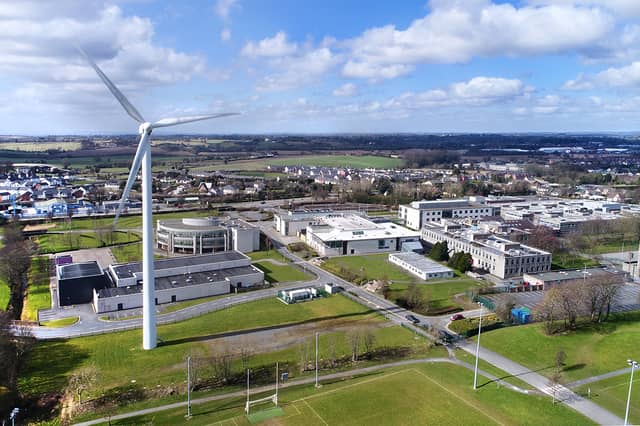
The Bill would provide the legal framework for DkIT to enter into a strategic partnership with Queen's University Belfast and allow the Dundalk institute to be redesignated as a technological university college.
In her foreword to the report, Louth TD and Committee Chair Erin McGreehan said the legislation "will create new dynamic opportunities for students, staff and the entire region of the North East."
She added: "This legislation is first of its kind and I have no doubt that it will lead to lasting changes in how north south cooperation is pursued into the future."
Under the proposed legislation, DkIT would be allowed to deliver programmes validated by Queen's University Belfast, with awards conferred by the Belfast university, while retaining its own institutional autonomy and remaining under the oversight of Ireland's Higher Education Authority.
The committee found there was widespread support for the proposal among those who gave evidence during the scrutiny process.
"It is important to note that both Committee Members and stakeholders expressed broad support for the objectives of the proposed legislation," the report states.
It continues: "The development of an all-island university partnership was widely recognised as a positive and innovative advancement within the Irish higher education landscape."
One of the committee's first recommendations is that the Government should clarify whether the DkIT-Queen's partnership is intended to stand alone or become a blueprint for future cross-border collaborations.
Evidence presented during the hearings suggested the model could have much wider significance.
The Higher Education Authority told the committee the Government should "continue to promote these types of opportunities", while Quality and Qualifications Ireland (QQI) said the project would "give a model, to show what can be done and to stimulate others to follow a similar path."
DkIT itself described the partnership as "a model for future collaboration not only here but across Europe and will be a flagship example of practical North-South co-operation delivering tangible benefits for students, employers and communities."
While welcoming the proposal, the committee identified several areas requiring greater clarity before the legislation is enacted.
The committee recommends that "the clear delineation of roles and responsibilities" be set out in the partnership agreement and that it should specify "how conflicts between these bodies are to be resolved."
It also recommends that student and staff representatives be consulted during the preparation of strategic development plans and that effective student representation be built into governance structures.
The report also addresses concerns raised during submissions by the Teachers' Union of Ireland and DkIT Students' Union regarding the transition to the new structure.
The committee recommends that the legislation "explicitly guarantee continuity of employment for staff during the transition."
It also calls for safeguards to ensure students are protected, recommending that the Bill should "clearly specify how current and incoming students will be treated during the transition and put in place safeguards to ensure that there will be no detriment to students during the transition."
Student accommodation and transport also feature prominently in the report.
The committee noted that DkIT Students' Union highlighted challenges facing commuting students and the shortage of accommodation.
The report records that the Students' Union argued that "with the establishment of Dundalk University College there must be investment in social spaces for commuting students and purpose-built student accommodation."
DkIT representatives told the committee that the institute is a "commuter institution", with approximately 77% of students coming from the North East and surrounding cross-border region.
Consequently, the committee recommended that future strategic development plans specifically address "student accommodation needs, campus infrastructure and facilities and provision for commuting students."
Committee members also concluded that the Minister should establish clear measures to evaluate the success of the partnership, including its impact on research, graduate outcomes, enterprise engagement and regional development.