

Call for immediate Special Protection status for Cu Chulainn's Castle in Dundalk

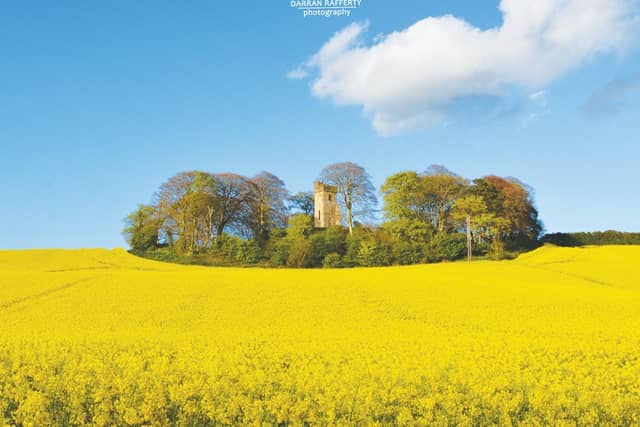

An Taisce calls on Minister for Heritage Christopher O’Sullivan to implement Special Protection Status to the Dún Dealgan, Castletown monuments and historic landscape
An Taisce is calling upon the Minister for Heritage, Christopher O'Sullivan T.D., to immediately grant ‘Special Protection’ status to the Dún Dealgan, Castletown monuments and historic landscape, known locally as Cu Chulainn’s Castle, and enhance their protection from a proposed Large-Scale Residential Development of over 1,000 units in Dundalk.
An Taisce, an authoritative and independent advocate for environmental and heritage issues, and one of Ireland’s oldest and largest environmental charities, said that as proposed, the buffer zones between the development site and monuments would be inadequate to preserve their setting and character, which would be of detriment to our vulnerable archaeological heritage.
While known locally as Cu Chulainn’s Castle, An Taisce says Dún Dealgan is the popular name of the Motte-and-Bailey located at Castletown to the west/northwest of Dundalk. This Norman fortress would have been the operational base of Bertram III de Verdun.
The evidence indicates that the fortification was built on top of an earlier Gaelic-Irish dwelling-place, probably that of a local chieftain. It was a Norman practice to establish themselves at the base of the former local ruler.
The circular steep-sided mound (the Motte) reaches a height of 10m. It would have had a wooden fort on top. The attached enclosure (the Bailey) was originally augmented by a second larger enclosed area to the east.
In mythology, the location is known as the birthplace of the legendary Cú Chulainn. The epic saga of the Táin Bó Cúailgne has long been associated with the general area (the ancient kingdom of Conaille Muirtheimne). (Dún) ‘Delga’ features in the saga as Cú Chulainn’s abode.
There is a Standing Stone adjacent to the castle site known as ‘Lia Lingadon’ (who tended the cows of Dictoire (Deichtine), the mother of Cú Chulainn). The castellated remains on top of the mound may be of late date, but their presence adds to the visual impression of the site. Folklore colourfully associates the ruins to a pirate named Byrne.
An Taisce says that the proximity of the monuments to the development indicates how vulnerable the historic landscape’s hidden assets would be to a large-scale intrusion, and says that a geophysical survey of the entire area under threat would illuminate this factor.
It said that the excavation of specified individual structures would only benefit the historic landscape if they were subsequently preserved-in-situ. Inversely, their removal could not be deemed as beneficial to the historic environment.
The Historic and Archaeological Heritage and Miscellaneous Provisions Act 2023 provides for the protection of these sites. Under this piece of legislation, the Minister is empowered to grant 'Special Protection' to those monuments that qualify on the grounds of 'interest, character, integrity, (and) community or amenity value'.
The monument would be judged on its 'archaeological, architectural, or other historic heritage, taking into account whether the monument is 'of special or particular interest, character, integrity, community or amenity value, whether at a local, national, or international level'.
An Taisce says that, clearly, Dún Dealgan and its environment fits the description perfectly. Therefore it adds, this 'Special Protection' category, as contained in the Act, can provide the monuments under discussion with an enhanced legal status, which can, in turn, be used to safeguard said monuments against any works of a perceived negative nature.
Furthermore, works cannot be carried out within the immediate environs of a monument with 'Special Protection' unless the developer has obtained the relevant licence. In short, according to An Taisce, if you have not been granted the relevant licence by the relevant Minister, you cannot proceed with the works.
An Taisce said that therefore, it is calling on the Minister to “increasingly invoke these special protection powers to secure the future of Ireland’s precious historic monuments in tandem with housing delivery, which are of substantial importance to our culture, history, heritage and mythology”.