Denis O’Donovan of Ballyryan, Donohill, Co Tipperary
Search


12 Mar 2026

Please allow ads as they help fund our trusted local news content.
Kindly add us to your ad blocker whitelist.
If you want further access to Ireland's best local journalism, consider contributing and/or subscribing to our free daily Newsletter .
Support our mission and join our community now.
To continue reading this article, you can subscribe for as little as €0.50 per week which will also give you access to all of our premium content and archived articles!
Alternatively, you can pay €0.50 per article, capped at €1 per day.
Thank you for supporting Ireland's best local journalism!


A hillfort in Co Wicklow has been declared the “largest nucleated settlement in prehistoric Ireland and Britain”.
Researchers at Belfast’s Queen’s University also contend that the site, just south of Dublin, is Ireland’s earliest proto-town.
It is thought to be two millennia older than the Viking towns that were previously believed to be the earliest urban settlements on the island of Ireland.
The hillfort cluster features a “necklace” of up to 13 hilltop forts, including seven major hillforts, as well as other enclosures spanning the early Neolithic to late Bronze Age (c 3700–800 BC), near the town of Baltinglass.
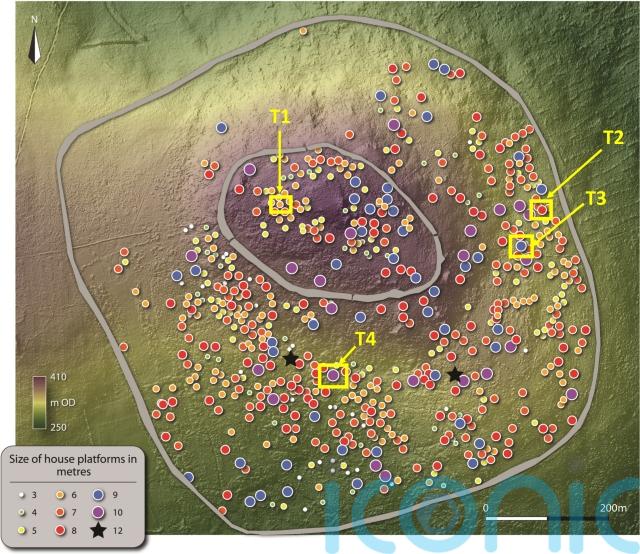
The Queen’s University-led study examined existing archaeological data from Brusselstown Ring, as well as conducting new excavations.
It found that terrestrial survey work carried out within the past decade had detected 288 potential hut sites, but aerial surveys from 2017 and 2022 indicated more than 600 topographical anomalies consistent with prehistoric house platforms.
The existing data have been combined with the results of new ground excavations to locate 98 potential roundhouse footprints within the inner enclosure, with a possible further 509 between the inner and outer enclosing elements.
The team carried out radiocarbon dating, which suggested occupation at Brusselstown Ring during the Late Bronze Age, between c 1210 and 780 BC, with continued use or re-use of some house platforms up to the Early Iron Age (c 750–400 BC).
Dr Dirk Brandherm from Queen’s has argued that even if not every one of the anomalies represented a roundhouse, this would still make it the largest nucleated prehistoric settlement in Ireland and Britain by some distance.
He said only a handful of other sites have more than a few dozen roundhouse footprints and not all of them are enclosed.
Evidence was also uncovered to suggest a boat-shaped topographical anomaly may have been a water cistern, consistent with Iron and Bronze Age cisterns from other parts of Europe.
Fieldwork at Brusselstown remains ongoing.
Dr Brandherm described Brusselstown Ring as a “site of major national and international heritage importance”.
“There has been extensive survey work at the site over the past two decades, but critical questions regarding the date, development and function of both the enclosing elements and the internal settlement remained unanswered, which is why we embarked on this new series of excavations,” he said.
“Our discoveries challenge previous conceptions of prehistoric settlement organisation, showing a level of social complexity, community cohesion and regional importance not fully recognised before.
“Such new evidence considerably enriches our knowledge of how people lived and organised themselves, contributing to broader histories of settlement, social interaction and landscape use.
“I very much hope that this new knowledge will not only add to our knowledge but help us preserve Brusselstown Ring as a site of major national and international heritage importance, connecting us to the island of Ireland’s deep past.
“It also opens avenues for further research into prehistoric societal development, helping to fill gaps in archaeological and historical records.”
The research has won the Prehistoric Society’s James Dyer prize for 2025 and has been published by Cambridge University Press.
It was funded by UK Research and Innovation, the Natural Environment Research Council and the Prehistoric Society.

Subscribe or register today to discover more from DonegalLive.ie
Buy the e-paper of the Donegal Democrat, Donegal People's Press, Donegal Post and Inish Times here for instant access to Donegal's premier news titles.
Keep up with the latest news from Donegal with our daily newsletter featuring the most important stories of the day delivered to your inbox every evening at 5pm.

This publication supports the work of the Press Council of Ireland and Office of the Press Ombudsman, and our staff operate within the Code of Practice of the Press Council. You can obtain a copy of the Code, or contact the Council, at www.presscouncil.ie, Lo-call 1800 208 080 or email: info@presscouncil.ie.