Search


11 Feb 2026
Search
11 Feb 2026

Please allow ads as they help fund our trusted local news content.
Kindly add us to your ad blocker whitelist.
If you want further access to Ireland's best local journalism, consider contributing and/or subscribing to our free daily Newsletter .
Support our mission and join our community now.
To continue reading this article, you can subscribe for as little as €0.50 per week which will also give you access to all of our premium content and archived articles!
Alternatively, you can pay €0.50 per article, capped at €1 per day.
Thank you for supporting Ireland's best local journalism!

The Irish stoat is a subspecies only found on the islands of Ireland and the Isle of Man

The Irish Stoat Citizen Science Survey is entering its final weeks, and researchers need your help! Nearly 700 sightings have been verified across Ireland, but only five from County Louth of this elusive and one of our lesser-known mammals
If you have seen an Irish stoat, alive or dead, please submit your sightings via the National Biodiversity Data Centre website here or scan the QR code below:

The Irish stoat is a subspecies only found on the islands of Ireland and the Isle of Man. Fossil bones of the animal have been found in two caves in County Cork, with one set dating back between 27,000 and 35,000 years and a second set around 10,680 years ago. This means stoats were here before and after the last Ice Age, making it one of our oldest mammal inhabitants.
Stoats are often confused with other small mustelids in Ireland, including ferrets, American mink and the pine marten. Although similar in some ways, stoats are ‘stoatally’ different in others. All four species share the same long, thin body shape and short legs, but stoats differ in their much smaller size (far smaller than a cat), chestnut brown coat with creamy white bib and underside, and the very distinctive black tip to their tail.
The Irish stoat is elusive and one of our lesser-known mammals. They are notoriously hard to monitor, being small, fast and very camera-shy. They leave few field signs such as footprints, fur and obvious scats (carnivore poo), unlike their mustelid relatives, the otter, badger and pine marten.
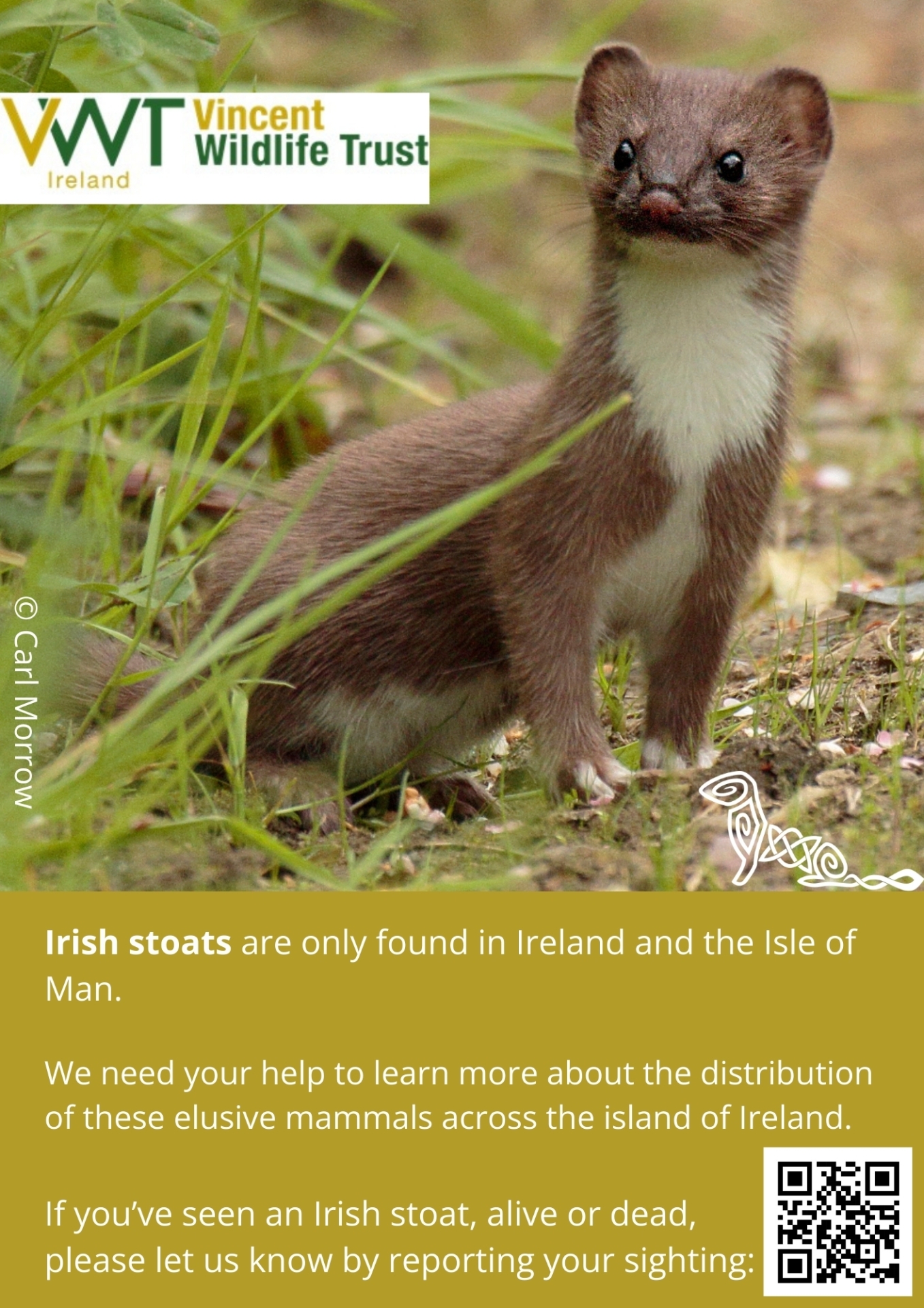
This has led to the species being under-studied. Through the Irish Stoat Citizen Science Survey, which was launched in February 2023 and will run till the end of January 2025, and with the help of citizen scientists sending in their sightings, we hope to learn more about these animals.
Helen Hanratty, Biodiversity Officer with Louth County Council said, “We can all play a part by helping to gather information to improve understanding of the state of nature in our local area. Ad hoc sightings and citizen science recording initiatives like the Irish Stoat Citizen Science Survey provide important biological data that contribute to generating high quality, scientifically robust insights.
"This allows us to track changes in our biodiversity both nationally and locally and helps to inform the action that needs to be taken to protect and enhance our habitats and species. Environmental charities like Vincent Wildlife Trust and organisations like the National Biodiversity Data Centre operate a series of citizen science driven monitoring programmes.
"There are surveys suitable for all levels of knowledge, covering a wide range of interests from garden birds to insects and marine biodiversity. To find out more about how to get involved in biological recording and to submit your own records please visit the National Biodiversity Data Centre website at www.biodiversityireland.ie.”
The Irish Stoat Survey is funded by the National Parks and Wildlife Service and is run by the Vincent Wildlife Trust in partnership with the National Biodiversity Data Centre, the University of Galway, and the Centre for Environmental Data and Recording in Northern Ireland.

Subscribe or register today to discover more from DonegalLive.ie
Buy the e-paper of the Donegal Democrat, Donegal People's Press, Donegal Post and Inish Times here for instant access to Donegal's premier news titles.
Keep up with the latest news from Donegal with our daily newsletter featuring the most important stories of the day delivered to your inbox every evening at 5pm.

This publication supports the work of the Press Council of Ireland and Office of the Press Ombudsman, and our staff operate within the Code of Practice of the Press Council. You can obtain a copy of the Code, or contact the Council, at www.presscouncil.ie, Lo-call 1800 208 080 or email: info@presscouncil.ie.