Search


03 Apr 2026
Search
03 Apr 2026

Please allow ads as they help fund our trusted local news content.
Kindly add us to your ad blocker whitelist.
If you want further access to Ireland's best local journalism, consider contributing and/or subscribing to our free daily Newsletter .
Support our mission and join our community now.
To continue reading this article, you can subscribe for as little as €0.50 per week which will also give you access to all of our premium content and archived articles!
Alternatively, you can pay €0.50 per article, capped at €1 per day.
Thank you for supporting Ireland's best local journalism!

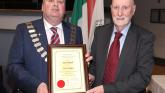
Enda Murray presents the Dundalk Young Irelands Hall of Fame award to Seán Óg Flood (Louth's '57 All Ireland winning goalkeeper). Picture by Arthur Kinahan

One thing Dundalk Young Irelands committee, players and supporters can say with pride is that their club has stood the test of time.
This year marks the club’s 140th birthday, and while over the years there have been lows as well as many glorious highs, the important thing to them is, that the green-and-black continues to fly high.
There are only a few of the clubs competing in Louth football today that can lay claim to have been involved when the first Louth senior championship was played, in 1887.
Dowdallshill, then with the name Gaels appended, went into the hat for the first-round draw, as did Clogherhead Dreadnoughts. Newtown Blues entered the fray that same year, but only after the championship had begun.
As winners of the title, Young Irelands have a special place reserved for them. More than that, they went on to represent Louth in the first All-Ireland championship, and again distinguished themselves, reaching the final in which they were narrowly beaten by Limerick Commercials.
Mention Young Ireland's name to anyone outside of the county, especially quizzers, and they’ll be quick to tell you that Irelands were runners-up when the All-Ireland final was contested for the first time.
The 1887 county win wasn’t a one-off. Irelands retained the title, and were followed as champions by Newtown Blues. Since then, nine other senior titles have come to the club that had at one time its base in the Seatown area of town, but is now playing home games at Páirc Eire Óg at Upper Marshes, known the generations of Dundalk people as “The Merches”.
Senior championship wins followed in 1905 and 1911, with the club providing players to Louth’s All-Ireland-winning teams of 1910 and again two years later. But maybe because of the turmoil the country was experiencing at the time, no teams were entered in 1918 competitions.
This absence continued until the early 1930s, though the club remained in existence. It didn’t take long on return before a mark was made on the field.
The junior championship was won in 1937 and then retained. It can be said with some authority that this was the rock on which a glorious era was built.
In a 13-year period, 1938 to 1950, the green-and-black was carried to victory six times in the senior championships, and included on each team was Jim Cunningham.
Jim’s brother, Seán, was an All-Ireland winner in 1957 along with other Irelanders past and present, Stephen White, Seán Óg Flood, Michael Flood and Jim McArdle.
Add further county stars, Jim and Paddy Quigley, Jimmy Tuft, Frank Fagan and Larry Waller to that list and you have an idea just how strong Irelands were at the time, vying with town arch-rivals, Gaels, and Stabannon Parnells and St Mary’s for top honours.
In 1950, just weeks before beating Drogheda team, St Magdalene’s in the senior final, Irelands won the junior championship, bringing up a double they had achieved two years earlier.
A rare feat which hasn’t been repeated. It’s equivalent today would have a club winning the senior and intermediate titles in the same year.
It must have felt at the time that the good days would go on forever. It didn’t happen. Before adding an eleventh senior title, in 1979, Irelands went through a sticky patch in the mid-sixties, failing to field in any adult championships. Several stalwarts felt there was a need for action – together they put the club back on an even keel.
It came right again on the football field after that. Following the 1977 junior championship – at the time the second grade – the team led by Séamus Haughey stopped Cooley Kickhams in their attempt to win the Joe Ward Cup for the fourth time running.
While the iconic Athletic Grounds was always known as the ‘Islanders’ Field’, the club didn’t actually own it (Maybe if they had, it wouldn’t have been sold.)
The venue was the property of the Dundalk Young Irelands Athletic Grounds Company Ltd, of which the club was an offshoot. Its loss to the GAA in Louth was immeasurable.
Irelands hadn’t to look far for a replacement, however. Influenced, no doubt, by his Marist colleague, Fr John Mulligan – author on the club’s history and the History of the Louth GAA – Fr Eugene Quigley, the Order’s superior, agreed to the club using the college grounds.
While there, plans were hatched for the purchase of land off Hoey’s Lane. After that, the development of the site began, along with the building of a clubhouse. There are now two pitches at Pairc Eire Óg, a testament to the work done by past and present members.
Talk about the green-and-black flying high – it was like that at the 140-year birthday party at the Fairways Hotel last Saturday night.

Subscribe or register today to discover more from DonegalLive.ie
Buy the e-paper of the Donegal Democrat, Donegal People's Press, Donegal Post and Inish Times here for instant access to Donegal's premier news titles.
Keep up with the latest news from Donegal with our daily newsletter featuring the most important stories of the day delivered to your inbox every evening at 5pm.

This publication supports the work of the Press Council of Ireland and Office of the Press Ombudsman, and our staff operate within the Code of Practice of the Press Council. You can obtain a copy of the Code, or contact the Council, at www.presscouncil.ie, Lo-call 1800 208 080 or email: info@presscouncil.ie.