Search


04 Apr 2026
Search
04 Apr 2026

Please allow ads as they help fund our trusted local news content.
Kindly add us to your ad blocker whitelist.
If you want further access to Ireland's best local journalism, consider contributing and/or subscribing to our free daily Newsletter .
Support our mission and join our community now.
To continue reading this article, you can subscribe for as little as €0.50 per week which will also give you access to all of our premium content and archived articles!
Alternatively, you can pay €0.50 per article, capped at €1 per day.
Thank you for supporting Ireland's best local journalism!


An e-mail query came this way over the weekend: “Who was Walter Rickett?”. The writer, John, has been going to Oriel Park for quite a number of years, and while he remembers Richie Blackmore and Steve Williams, the name Rickett meant nothing to him.
All three were mentioned on this page last week. It was said that if Stephen O’Donnell and Brian Ainscough’s search for new signings takes them to England, they’ll be on the right track if they cop any as good as this trio, each of whom began his career on the other side of the Irish Sea.
Blackmore and Williams were goalkeepers, the former making over 400 appearances with Dundalk in League of Ireland competitions and in Europe. He was a league and Cup winner on a number of occasions; Orielites will tell you he was one of the club’s best-ever ‘keepers.
Williams’ career at Oriel was much shorter, 83 outings taking in all of the domestic competitions. Since retiring he has filled the role of goalkeeper coach with a number of outfits, Gaelic as well as soccer.
Back to Rickett. I’ve registered many more years on the clock than John, and am old enough to remember the English man. Admittedly, I was still in short trousers at the time when I crossed the road from McDermott’s Terrace to Oriel each Sunday, taking in ‘B’ as well as senior team games.
There was quite a stir in 1955 when news broke of Rickett’s signing as player-coach. He wasn’t in the first flush of youth, but having played in an FA Cup final, the expectancy was he’d add impetus to what at the time were the team’s flagging fortunes.
Eight years previously, Rickett had lined out with Blackpool at Wembley against Manchester United. He was on the left-wing, and had as colleagues up front Stanley Matthews and Stan Mortenson, the former one of his country’s best, the first to be named European Player of the Year.
Irish International, Johnny Carey, captained the United team that included Johnny Aston and Jack Rowley, both of whom would figure at Oriel a few years later in Johnny Fearon’s benefit match. Rowley was one of the scorers in United’s 4-2 Cup win.
Rickett hit the ground running, his side winning their first five matches in the Shield.
In the 6-1 defeat of Cork side, Evergreen, himself and that great Oriel favourite, Leo McDonagh, came in with a hat-trick apiece, Rickett operating on the wing and McDonagh at half-back. They finished the Shield campaign with five goals apiece, the same as Francie Callan.
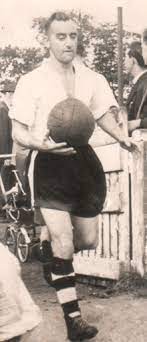
Dundalk made a decent start to the league which followed, benefiting from Joe Martin’s goal-scoring feats at centre-forward. By the time the Cup came around, Rickett’s team were in the top three in the points competition, and having drawn non-league Workmans Club in the first round were expected to make an impression in the Cup.
Disaster at Oriel. With former Dundalk centre-half Mattie Clarke included, the Dublin side fashioned a shock 3-1 win. Rickett was out a month later, but the question was asked: was he pushed or did he go?
There were many at the time – and long after – who contended it was the former. The Board wanted to be involved, and this didn’t rest comfortably with Rickett, iot was said.
This paper, welcoming Rickett’s arrival said: “Having a player-coach is better than a dozen selectors.” When he left? “He had the heart of a lion, who gave every ounce on the club’s behalf.” The latter is not what you’d expect to be written about someone who had just walked away.
It’s not what Rickett achieved, but what he could have.
On his departure, Dundalk plummeted down the table, narrowly avoided relegation but finishing with a slightly better goal difference than Limerick.

Subscribe or register today to discover more from DonegalLive.ie
Buy the e-paper of the Donegal Democrat, Donegal People's Press, Donegal Post and Inish Times here for instant access to Donegal's premier news titles.
Keep up with the latest news from Donegal with our daily newsletter featuring the most important stories of the day delivered to your inbox every evening at 5pm.

This publication supports the work of the Press Council of Ireland and Office of the Press Ombudsman, and our staff operate within the Code of Practice of the Press Council. You can obtain a copy of the Code, or contact the Council, at www.presscouncil.ie, Lo-call 1800 208 080 or email: info@presscouncil.ie.