

Hill Street Views:Frostival shines light on future fixes for Dundalk town centre
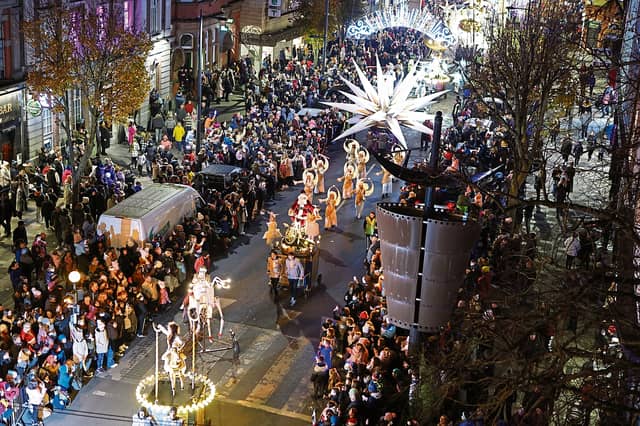

Columnist David Lynch writes about the success of Frostival and future fixes to bring people back to Dundalk town centre
Frostival lit up the town centre over the weekend. And what a tremendous success it has been in terms of drawing crowds to the streets – and businesses – of Dundalk over the years since its inception in 2017.
For many it is now the official kick-off of the Christmas season locally – the very highest of accolades in many respects.
Each year it gets bigger; embedding itself further into the local Christmas tradition.
It also highlights the great work that goes on behind the scenes to bring it back bigger and better each year. It’s work that, for the most part, succeeds thanks to volunteers who have the best interests of the town in their hearts.
Ireland’s town centres are struggling though. This isn’t breaking news to anyone, but Frostival highlights the very real need for both public and private help to ensure their survival.
As of an August 2026 report, Dundalk’s commercial vacancy rate remains relatively high at 19%. This rate is not specific to the town centre but is a Dundalk-wide rate, so while not conclusive it gives a startling insight into the numbers all the same. The national rate lies at 14.6%.
The challenge ultimately is to make Dundalk a destination again, rather than simply a place people pass through to shop elsewhere, or commute from. Bear in mind, this is a problem all town centres are facing. Dundalk is not alone in facing this modern reality.
Within the very success of Frostival lies, perhaps, a way forward.
Increasing and expanding seasonal attractions. The introduction of the Northern Lights to celebrate St Brigid in recent years is an excellent example of how this can work. But March through to November is a long run without another standout seasonal attraction to promote the town centre.
Further shaping of festivals and attractions around the seasons may seem like reinventing the wheel, but it works elsewhere. An Easter market in March-April.
Outdoor concerts at Square in Summer and even evening markets. Then with Autumn comes Halloween and a cultural tie-in to Samhain.
Kells in County Meath has led the way with its Samhain Festival which ran from November 5th to 8th this year. Across the four days there were cooking demonstrations, food and drink tasting, workshops, cultural performances and plenty of family-friendly activities.
And to Kells once more we might be able to snatch another possible idea – a literary festival. During the summer, up and down the country, literary festivals are becoming big business and drawing greater crowds each year.
Borris Festival of Writing and Ideas in Carlow has become the tentpole event in this regard nationally, attracting writers and artistic performers of international renown every summer. And with Hinterland Festival at the end of June, Kells has been making inroads in this regard over the past decade too.
Started back in 2013, the festival has gained traction recently with notable Irish and UK writers - Colm Tóibín, Sebastian Barry, Roddy Doyle, Anne Enright, Joseph O’Connor, John Boyne, John Banville, Liz Nugent, Marion Keyes, Germaine Greer, Jung Chang, Jeremy Paxman, Brian Eno, Ben Okri, Hanif Kureishi, Jeannette Winterson, Louis de Bernières, to name but a few – making regular appearances in that time.
It works well in drawing crowds, and it brings the festival to various locations across the town centre including the local Church of Ireland, the Courthouse, Eureka House and the Kells Printing Works.
Dundalk has many brilliant locations which could fulfil and enhance a literary festival of similar bent and make it uniquely Dundalk.
Would the likes of Luke Cassidy (author of the Dundalk-set hit Iron Annie) be willing to come along to such a festival? Or Jaki McCarrick and Katherine Duffy? Absolutely. Their fondness for Dundalk pops off the page.
Imagine the Green Church, or The County Museum on Jocelyn Street or the Old Gaol hosting such writers and authors of local and national acclaim.
Despite the all-consuming nature of social media and quick-fix digital content, reading remains of upmost importance to parents and families. According to The children and young people’s reading in Ireland report 2026, 76% of parents value reading as an important part of their family life.
The report states that reading “is also seen as a vehicle for quality family time away from screens which are omnipresent in today’s world”.
Dundalk can latch onto this now and push an all-ages literary festival which can grow through the years.
Elsewhere, The Louth Contemporary Music Society has ‘Another Look. Another Listen. Festival’ already in train for June 2027. The likes of Salvatore Sciarrino and the Esposito Quartet are lined up for this, and tickets are on sale already.
The extraordinary range of international talent that descends on Dundalk for these few days is immense – the town is punching way above its weight here. But - there’s always a ‘but’ - more is needed to consistently keep drawing people back to the town centre.
Retail offerings, while still vital and a tenet of any town centre, are no longer expanding to fill vacant space. And, if in certain circumstance they are filling space, it’s predominantly on a short-term basis. New businesses prospering and enduring in a town centre today are a unicorn.
Let’s be real though. And let’s talk money for a moment. Louth County Council, and the excellent BIDS, have a limited supply of it.
There’s only enough funding to cover a select number of annual events. And, in the midst of a very real cost of living crisis, who’s willing to put their hands in their pockets and hand over money for little or no initial commercial return?
The reality is that Dundalk needs its larger business success stories to step in and help fund any shortfall. Perhaps the government can look at better tax breaks for such businesses that reinvest in the future of town centres this way.
The North East Credit Union (formerly Dundalk Credit Union) has been immense in investing in community projects and forging strong partnerships across the area over the decades. But it can’t be expected to do it alone. And it won’t be enough in the future either.
A prosperous, uniquely local cultural scene will lead eventually to commercial success. It may take time and there may be failures along the way, but until someone else comes up with another solution to our town centre crisis, it’s the best path forward.