

Captain defends briefing before convoy in which Dundalk soldier killed
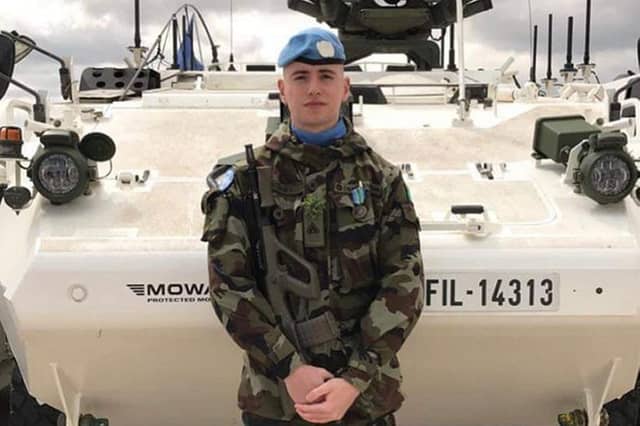

Captain David Kelly has told an inquest that he had given a 10 to 15 minute briefing on the route prior to departure
The commanding officer of a UN peacekeeping convoy in which an Irish soldier was killed has said he was not aware that no one else knew the route they were supposed to take, an inquest has heard.
Captain David Kelly has told an inquest into the death of Private Sean Rooney, who was born in Dundalk, that he had given a 10 to 15 minute briefing on the route prior to departure and that there would have been an expectation that “exceptionally qualified” soldiers would have asked questions if they were unhappy with what they had been told.
He made the remarks after being challenged on evidence given from some of the peacekeepers under his command who said a longer briefing would have been normal.
The inquest has heard evidence about how a convoy of two UN armoured Toyota Land Cruisers became separated on a transport mission between the Irish peacekeeping base, Camp Shamrock, and Beirut Airport on December 14 2022.
The jury has heard that both vehicles were fired at while separated at different locations.
The convoy had a scheduled stop near the city of Tyre at an outpost, known as EP28, that marked the edge of the United Nations Interim Force in Lebanon’s (Unifil) area of operations in south Lebanon.
The inquest has heard that the plan was for the second Land Cruiser, driven by Pte Rooney, to follow the lead vehicle to Beirut Airport – with the commanding officer of the mission, Cpt Kelly, aware of the route.
However, the lead vehicle left EP28 several minutes before the second Land Cruiser which had encountered an apparent issue with a key fob that delayed its departure.
Shortly thereafter, Cpt Kelly’s vehicle took a sharp turnoff onto a highway – but the second Land Cruiser, which had failed to catch up to the leader following the staggered departure and separation, continued past the turn and ended up in a village where it was surrounded, attacked, and ultimately fired upon – with Pte Rooney ultimately being shot dead.
Under questioning on Wednesday, Cpt Kelly told coroner Dr Myra Cullinane he was not aware that no one else in the vehicles had been a part of such a convoy before and was unfamiliar with the route.
The jury has previously heard from some of the troops under his command that they would have expected a briefing of between 45 minutes and one hour to be held in the company office which would also involve physical maps and a back and forth communication.
Cpt Kelly, who said he had done around 40 similar runs in his career, said he did not accept that this should have been their expectation.
He told Sean Guerin SC, the barrister for Pte Rooney’s family, that orders differ on the context of the operation and complexity decides their length.
For example, he said a complex convoy involving a Lebanese Armed Forces contingent may take up to 45 minutes.
Mr Guerin suggested to the witness he would have known the soldiers were unfamiliar with the route if he “briefed them properly” and asked them to repeat it back.
Cpt Kelly rejected this, and said there would not have been an expectation for that to happen – adding that a lot of what was covered was “very routine” and that several of the peacekeepers would have received “exceptional” training and been involved in a quick response team which leaves the base.
He added they would have been aware they can ask questions and that the office-style briefing involving asking them questions about whether they understand was for “when they’re on courses” and “to see if they’re learning”.
It was put to Cpt Kelly that he had essentially given those involved in the convoy a fragmentary order, or Frago, which the jury previously heard is a short update on any changes to an earlier comprehensive briefing.
He said he did not accept this, and added a Frago could be as short as 45 seconds.
Cpt Kelly accepted that most troops in Lebanon do not know the way to Beirut Airport.
Asked for how the other peacekeepers were briefed, Cpt Kelly said he would refer to “markers on the route” that would be familiar to peacekeepers including the old Irish camp, a Bridgestone garage on the highway.
He also told the inquest that the convoy left an hour later than intended, with the jury previously having been provided with information on changes to the vehicles over concerns about equipment.
The purpose of the convoy was to transport two peacekeepers as passengers to Beirut Airport as they had been granted bereavement leave.
Cpt Kelly said the goal of the Land Cruisers in a convoy was to “stay as close as possible” so a third, independent vehicle could not interrupt and get in the middle.
He said it was easier to see the second vehicle in the earlier part of the journey prior to arriving at the EP28 outpost as the route there was better lit.
Asked by Dr Cullinane when he became aware of the separation, Cpt Kelly said he had sought Corporal Josh Phelan’s personal phone number at around 10.45pm so his awareness of the separation may have happened two minutes earlier.
Cpl Phelan was his second in command and a passenger of Pte Rooney.
Cpt Kelly said he had seen the side profile of the car behind them – which turned out to be a civilian vehicle – when they turned onto a highway, and then pulled over.
He said there was no defining marker and the white Toyota Land Cruisers, which although armoured were like other vehicles seen on the road every day.
He contrasted this to the distinguishing feature of a wider Mowag transport vehicle – and added that the UN flags had been taken down at EP28, which the jury heard was normal procedure when leaving the UN area of operations.
Mr Guerin told the witness that logs between the convoy and Tactical Operations Centre at Camp Shamrock had no record of “road clear” being granted up the command chain before leaving EP28 and exiting the Unifil area of operations.
Cpt Kelly said he was “surprised there’s no record of road clear”, adding he was “very sure” it was sought.
He told the inquest this would be routine and would have been expected by multiple personnel.
He said he would not have been able to justify moving the vehicles from EP28 without it.
The inquest continues.