
Ardee St Patrick's Day Parade
Search


19 Mar 2026

Please allow ads as they help fund our trusted local news content.
Kindly add us to your ad blocker whitelist.
If you want further access to Ireland's best local journalism, consider contributing and/or subscribing to our free daily Newsletter .
Support our mission and join our community now.
To continue reading this article, you can subscribe for as little as €0.50 per week which will also give you access to all of our premium content and archived articles!
Alternatively, you can pay €0.50 per article, capped at €1 per day.
Thank you for supporting Ireland's best local journalism!

Blackrock locals clean up after Storm Bram caused Main Street to flood. Pic: Blackrock Tidy Towns Facebook

Louth felt the force of Storm Bram on Tuesday as Dundalk, Blackrock and the Cooley Peninsula in particular were affected by strong winds and high tides in what forecasters called a “multi-hazard” weather event. Ahead of the predicted high tides and storm surges, the council distributed sandbags and activated flood barriers in coastal areas on Monday.
Despite these measures, Louth County Council says upper flood levels were approximately 200mm higher than forecast by flood models.
Road closures were implemented at several locations across the county. These closures remained in place until water had receded and clean-up operations could begin.
High tide on Tuesday afternoon saw flooding around George’s Quay in Dundalk, as rising water levels flooded Dundalk Port and the Spirit Store.
Owner of the Spirit Store, Mark Deary, said the venue had once again been hit hard by tidal flooding: “That’s happened for a third time now since 1999 and it’s always really destructive and it’s gotten more so now because we have the kitchen.”
He praised his staff and the teamwork that helped them get through it all: “The standout for me last night first of all was that we have A91 working in the kitchen; we worked side by side, and I didn’t have to face it on my own this time, which was fantastic. All the staff were amazing. We worked until very late last night, and we were back in this morning, but we’re back in business now, trying to look forward and not backwards. There’ll be a bit more work to do around the fringes, but we’ll get back in again in the morning, and hopefully we won’t have any more big tides this winter.”
Describing the aftermath, he added: “It was messy, we needed dehumidifiers, lots of squeegees and mops and buckets. The fire brigade really made the difference; they were doing some work out on the road, and they saw we were in trouble, so they came in and pumped us out. They gave us a real fighting chance, and we’re open today because of them, so loads of thanks to them and Dundalk Fire Station.”
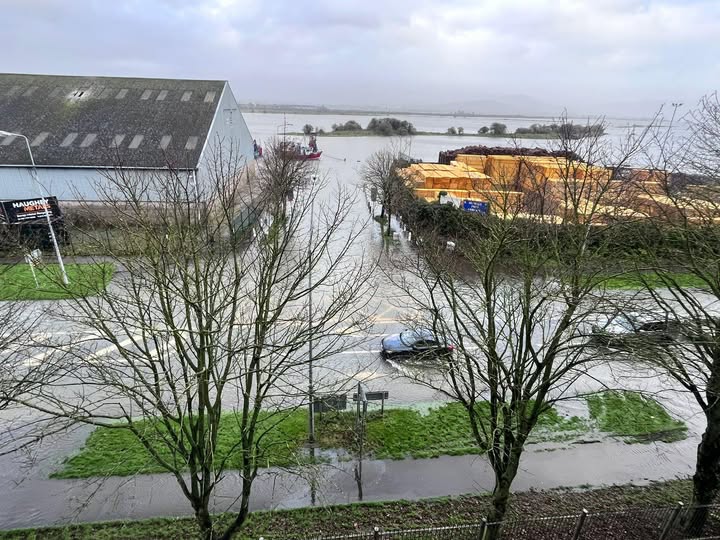
Flooding at George's Quay and the Inner Relief Road
Mark said the ferocity and speed of the tidal surge were unlike anything he had witnessed before: “The speed of it was unbelievable, I don’t ever remember seeing [it]. It wasn’t that high of a tide, it was 5 or 5.1 metres, but to do what it did yesterday it must have gotten to 6.3 or 6.4 metres. For a storm to add over a metre to the tide takes some doing. It doesn’t happen very often, but it happened yesterday, and in a way I hadn’t seen before. By the time it gets to us, it’s got nowhere to go except over the top.”
He also warned that the town needs to prepare for increasingly frequent tidal events: “Dundalk is very vulnerable to these tidal surges. I know the surveying work for the flood defence system is ongoing at the minute; I can see them out there doing the survey work, but yesterday demonstrated that not just for us, but for all low-lying parts of the town, we need to future-proof ourselves for what is inevitably going to be a more frequent occurrence in the future.”
There was also disruption on the nearby Inner Relief Road. Cars struggled to make their way through, with some becoming stranded in the floodwater.
The Fairgreen Road along the Castletown River felt the effects of the storm as water seeped through the wall, leaving the road submerged for a time. The Racecourse Road to Dowdallshill junction, Castle Road, St Mary’s Road, and the old Newry Road all experienced flooding.
Blackrock Main Street was completely flooded as high tides and onshore surge overtopped seawalls and pushed seawater inland, damaging paving stones and parked cars. Local businesses scrambled to pile sandbags, and gale-force winds overturned the Christmas tree at the sundial.
The clean-up operation was well underway in Blackrock this morning, with the local Tidy Towns group and council crews taking part in efforts on the promenade to remove mud left by the receding waves.
Padraig Martin, Marketing & Office Manager with local business Niamh Carter Interiors, recalled heaping up sandbags and using mops alongside his colleague Olive to keep the floodwaters at bay and ensure their stock was kept safe. He described the community effort among neighbouring businesses: “We started to realise it was going to be serious, so we were all just helping and passing sandbags to each other.”
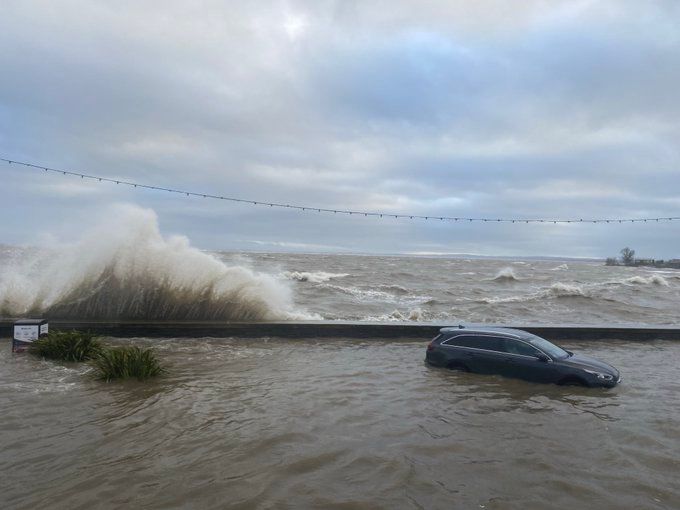
Flooding on Blackrock Main Street. Pic: Louth County Council Facebook
Further north, Cooley and Omeath fared no better, as several roads were rendered impassable. The Shore Road in Ballagan was blocked at multiple locations, and residents were unable to get to their homes. Two pubs in Carlingford were also flooded.
Read Next: Louth County Council's response to damage caused by Storm Bram
Out-of-hours crews worked overnight to clear gravel and seaweed, restoring access for residents who had been blocked from their homes. Crews returned on Wednesday to remove the remaining debris.
Out-of-hours council crews also attended a spillage of clay and mud at Junction 17 of the M1 at 1am on Wednesday, where it had spread to the N53. A fallen tree blocking the Hackballscross to Knockbridge Road was also removed after a three-hour closure.
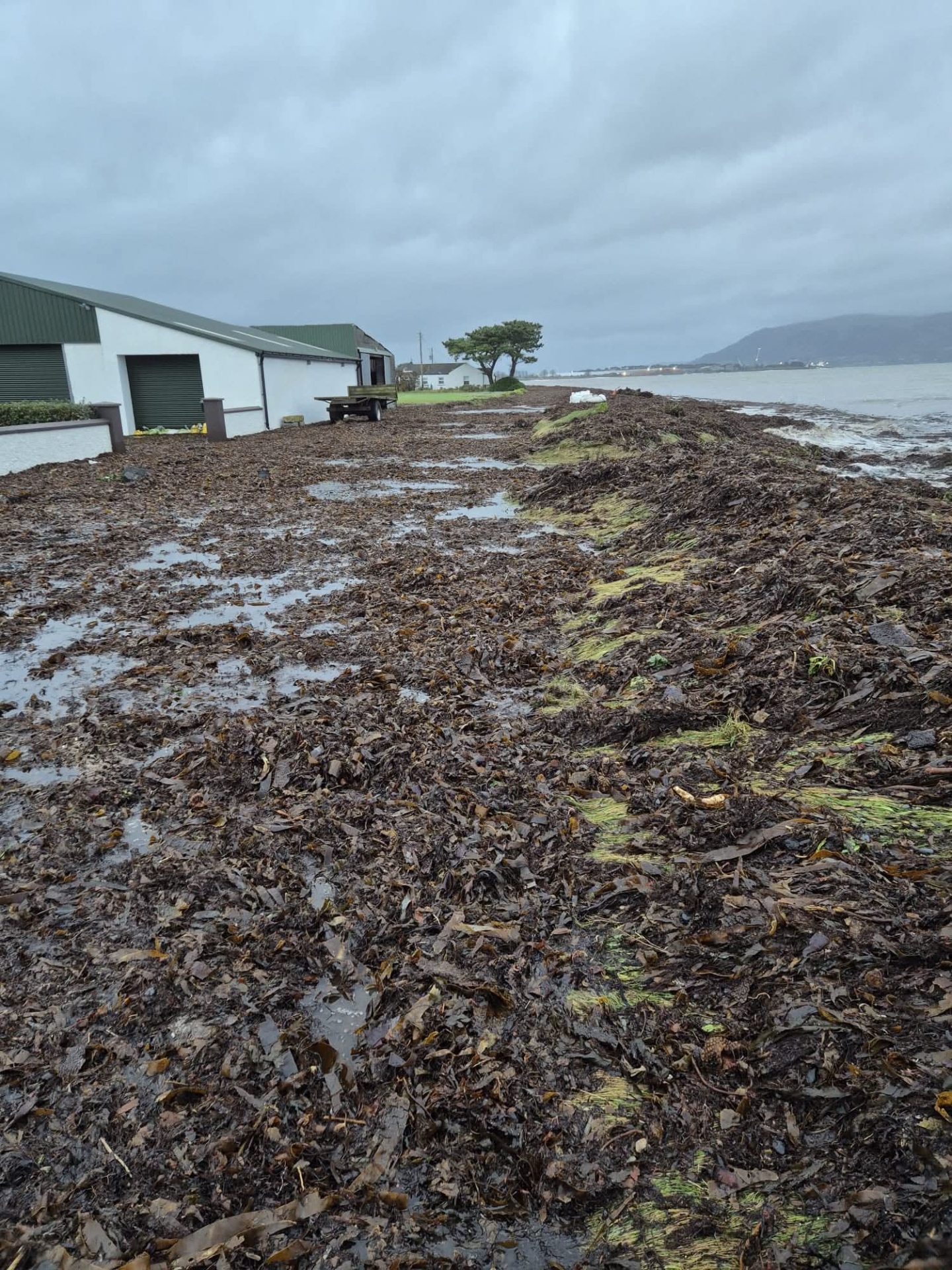
Flooding also caused damage to the Shore Road in Cooley. Pic: LCC Facebook
Louth County Council said it wished to thank residents and businesses for their cooperation and acknowledged the efforts of staff who worked tirelessly to minimise disruption and restore normal conditions.
The council further said its SWAT team will review all aspects of its response to Storm Bram as part of its ongoing review of emergency preparedness.

Subscribe or register today to discover more from DonegalLive.ie
Buy the e-paper of the Donegal Democrat, Donegal People's Press, Donegal Post and Inish Times here for instant access to Donegal's premier news titles.
Keep up with the latest news from Donegal with our daily newsletter featuring the most important stories of the day delivered to your inbox every evening at 5pm.

This publication supports the work of the Press Council of Ireland and Office of the Press Ombudsman, and our staff operate within the Code of Practice of the Press Council. You can obtain a copy of the Code, or contact the Council, at www.presscouncil.ie, Lo-call 1800 208 080 or email: info@presscouncil.ie.