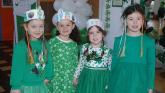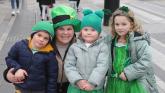
Watching the St Patrick's Day parade in Dundalk. All Photos: Arthur Kinahan
Search


17 Mar 2026

Please allow ads as they help fund our trusted local news content.
Kindly add us to your ad blocker whitelist.
If you want further access to Ireland's best local journalism, consider contributing and/or subscribing to our free daily Newsletter .
Support our mission and join our community now.
To continue reading this article, you can subscribe for as little as €0.50 per week which will also give you access to all of our premium content and archived articles!
Alternatively, you can pay €0.50 per article, capped at €1 per day.
Thank you for supporting Ireland's best local journalism!

Ronnie Delany races to Olympic glory in Melbourne. Photo by Getty

It’s the most famous picture in Irish sports history, the one showing Ronnie Delany, arms outstretched, crossing the line a winner at the 1956 Melbourne Olympics.
The great Wicklow-born runner celebrates his win in the 1500 metres, known as the metric mile, and for many, the Blue Riband of the Games.
READ NEXT: Inside Track: Our Arsenal team played more attractive football than the current league-leaders
At the time, Ireland had just three Golds to celebrate since first competing as a nation in 1924. Dr Pat O’Callaghan won the first in the hammer at the Amsterdam Games in 1928.
The Clonmel doctor retained the title in Los Angeles four years later, with Bob Tisdall making it two Irish wins by leaping to glory in the 400 meters hurdles. Delany was next on to the podium – and there hasn’t been one since celebrating a win in an athletics event.
The great man’s death last week at the age of 91 brought back two memories to me, one relating to how the news of his victory was conveyed, the other, an athletics meeting I attended.
There might have been television at the time, but one thing it wasn’t carrying was pictures from the Olympics. Radio was the only means of getting news to a worldwide audience, though it’s unlikely there was a commentary on the Melbourne 1,500.
And even if there was, with the race taking place when most in this part of the world were in bed, the listening audience would probably only have been confined to enthusiasts.
My father was always first up in our house, and straight away he’d turn on the wireless.
Number one item on the morning of December 1st, 1956, was the story of Delany’s win. Immediately, my father was out to the bottom of the stairs shouting up to us all: “Ronnie Delany has won the Olympic race.” A cheer went up in the back room loud enough to waken those who were still asleep, and maybe even a few neighbours.
(A few years later, my father filled the same role, this time to tell us the result of an election. “Kennedy is the first Catholic to become President of America,” he shouted.)
Delany wasn’t the only Irish medal-winner in Melbourne. The small but select boxing team literally punched about their weight, four of them making it one to the podium. Dublin’s Fred Tiedt won Silver, and there was Bronze for the Drogheda lightweight, Tony ‘Socks’ Byrne, and the Belfast duo, Freddie Gilroy and John Caldwell.
This was a great time for sport in these parts, Louth winning the All-Ireland, Dundalk the FAI Cup, and Dundalk rugby team winning the Provincial Towns Cup. For good measure, Clogherhead’s Philomena Garvey won the British Open.
No surprise then that the McDermott’s Terrace touring team was off to Santry Stadium for a big meeting two years after the Olympics. This was the brainchild of the irrepressible Billy Morton, “Mr Athletics” at the time.
Delany was the big attraction, the Mile race everyone in the crammed enclosures wanted to see. I saw little of the action, but could hear the roar of the crowd.
There were four Australians in the field of 12: Mervyn Lincoln, Murray Halberg, Albie Thomas and the 20-year-old Herb Elliott.
If Elliott was relatively unknown going into the race, he was the name on everyone’s lips afterwards.
He led home the star-studded field, with Lincoln taking second just ahead of Delany, and for good measure, he broke the English runner, Derek Ibbotson’s World record.
But the race had more to it than that. Though it had been four years since Roger Bannister had become first to lower the figures, breaking four minutes for the mile was still regarded as a huge achievement.
On that famous night at the stadium that was later named in Billy Morton’s memory, the first five home broke the barrier. No wonder it became known as the ‘Miracle Mile’.
Two years later, Elliott won 1,500 Gold at the Rome Olympics, and there was also the top award for Halberg in the 5,000 metres.
Ronnie Delany retired in 1961 at the age of 26. By then, he was firmly established among the greatest of Irish sportspeople. He’s still there and will be for many years to come.

Subscribe or register today to discover more from DonegalLive.ie
Buy the e-paper of the Donegal Democrat, Donegal People's Press, Donegal Post and Inish Times here for instant access to Donegal's premier news titles.
Keep up with the latest news from Donegal with our daily newsletter featuring the most important stories of the day delivered to your inbox every evening at 5pm.

This publication supports the work of the Press Council of Ireland and Office of the Press Ombudsman, and our staff operate within the Code of Practice of the Press Council. You can obtain a copy of the Code, or contact the Council, at www.presscouncil.ie, Lo-call 1800 208 080 or email: info@presscouncil.ie.