

HSE approves reimbursement of treatment for patients with rare disorder
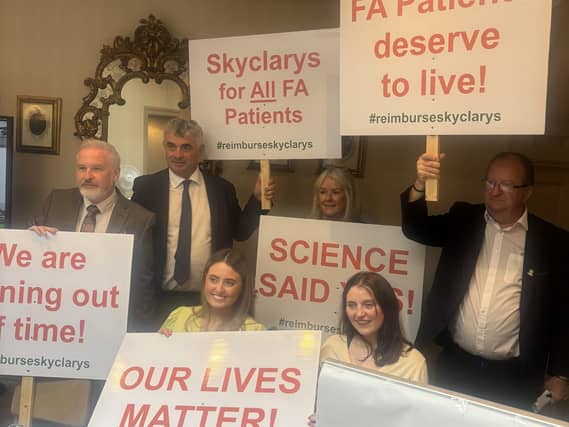

The drug would help to treat people suffering from the neuromuscular condition Friedreich’s ataxia.
The HSE has approved the reimbursement for a treatment for a rare disorder, Friedreich’s ataxia, which will be made available for patients in Ireland.
It comes after a substantially improved financial offer was made in recent days by the company Biogen to the HSE following intensive discussions.
The HSE said Biogen moved substantially from its previous position, and the HSE wants to express its appreciation of the “flexible and constructive approach” shown by the company.
Friedreich’s ataxia is a rare, progressive, neuromuscular condition affecting about 200 people in Ireland.
People with Friedreich’s ataxia, their families, friends and political representatives held a meeting last week and called for the HSE to approve the drug Skyclarys (omaveloxolone).
While it is not a cure, experts and patients say it can slow the progression of Friedreich’s ataxia.
In a statement, a spokesperson for the HSE’s senior management team (SMT) said: “The SMT also considered the limited efficacy that has been shown for the drug, and the high cost that remains despite the improved financial offer.
“It considered some of the potential weaknesses in the clinical evidence and other relevant matters the Drugs Group considered under the Health (Pricing and Supply of Medical Goods) Act 2013.
“However, it also agreed with the observations of the Drugs Group in relation to the substantial unmet need of patients suffering from what is a devastating disease and the absence of any other medicines to treat it.
“Engagements are ongoing with Biogen to finalise the administrative arrangements which will underpin reimbursement.
“The HSE will progress these engagements quickly, and understands that Biogen are also committed to finalising details at an early stage.”
Taoiseach Michael Martin welcomed the decision by the HSE, saying that patients and their families have endured so much.
“I thank them for their engagement and their advocacy,” Mr Martin said in a statement.
“I understand fully their concerns and anxieties in relation to gaining access to this drug, the first treatment of its kind for this condition.
“It has been a very challenging period for the families, and I wish to acknowledge that.
“We appreciate the fact that this decision came on the back of substantive engagement between the HSE and the company Biogen over the past number of days and weeks.
“The outcome will result in strong engagement with Biogen over the coming years in respect of the treatment of Friedreich’s ataxia.
“It was important that the statutory process for approving the drug was brought to its conclusion, and we welcome this decision, first and foremost for those who need access to Skyclarys.
“The Minister for Health and the Government will now work to support implementation of the HSE’s recommendation as quickly as possible.”
Earlier, Tánaiste Simon Harris said said it has been an “extraordinarily difficult and anxious” time for patients, their families and communities.
Speaking before its approval, Mr Harris said the process to approve a drug and make it available to patients in Ireland has to be “independent”.
“It is important that the process is robust, and it’s important because this is the drug today and I say this with full empathy, full respect and with hope for clarity today,” he added.
“This is the drug today and, of course, there’ll be other patients and other new and innovative drugs, and there’ll be need for that, too, so having a robust process in place that gets the best outcome possible, to ensure as many of our citizens as possible can have access to innovative medicine is important.
“I think there’s a broader conversation to be had, not for today, but about, we’re living through a time, which is a really positive thing, of lot of new innovations, lots of new drugs, lots of new medicines, perhaps at a scale we’ve never seen before.
“I think a broader conversation about Ireland and how the European Union, perhaps, funds that and interacts with that, is worth having.”