

Inside Track: What have Ferenc Puskás and Séamus Darby got in common?
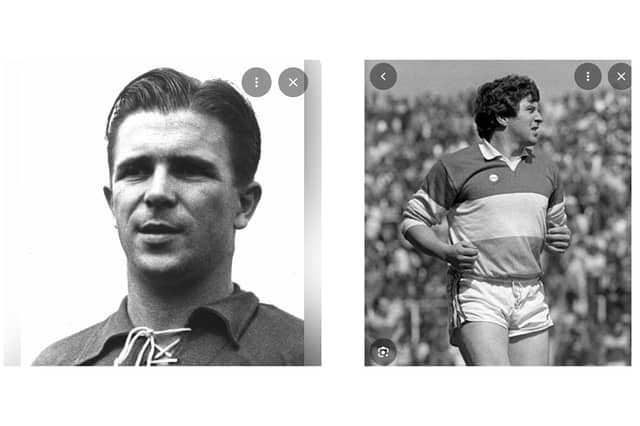

Inside Track with Joe Carroll
First of all, let’s identify them, those two in the headline. The younger generation of readers, or scrollers, might have heard of Darby, but Puskás would be a problem for maybe even a generation before that, especially those who aren’t avid soccer followers. He played soccer, Darby, Gaelic football.
Puskás was born in Hungary, and is rated one of the greatest footballers that country has produced – many, indeed, would have him on their best-ever World XI.
He was a real goalsmith, averaging just shy of a score a game in his 84 outings for his native country, one of which was the 1954 World Cup final won by West Germany.
Soon after the beginning of the 1956 Hungarian Revolution, Puskás defected to Spain, linking with Real Madrid. Manchester United considered signing him in the wake of the Munich Disaster, but because of English League rules at the time dealing with the transfer of foreign players, Matt Busby’s stand-in, Jimmy Murphy, couldn’t pursue the matter.
Puskás hadn’t left his skills around goal in Hungary. He continued to hit the target in the Real colours, forming a lethal partnership up front with Alfredo Di Stefano.
He helped the Madrid club to several La Liga titles as well as a hat-trick of European Cup wins, scoring four goals in one of the finals. He also played for Spain.
It was before then that Puskás had, arguably, his greatest outing in his native country’s colours. It was at Wembley, Hungary playing Billy Wright’s England.
According to reports, they were ridiculed by the home team because of the lightweight boots they were wearing.
The opinion was, that despite Hungary’s run in the years before that – they had won Olympic gold the previous year, 1952 – England wouldn’t be unduly worried. Puskás was considered by some to be overweight.
England should have known better. Just three years earlier, they had competed in the World Cup for the first time. Qualifying for the knock-out stages was a no-brainer, they thought.
Oh, yeah? Unconsidered USA were one of their opponents in the league series, and by losing 1-0, the team, which included all the big names of the day, Stanley Matthews, Stan Morterson, Alf Ramsey and Wright, found themselves in a hole from which they couldn’t find an escape. Well, they did – in time to make it home even before the competition got down to the business end.
There was another surprise for the Three Lions at Wembley. A game which teemed goals ended with Hungary winning 6-3. Puskás grabbed a brace, and created others.
It was said afterwards that this was the first England defeat by a foreign team on home soil. But what about the Republic of Ireland’s 2-0 win over the auld enemy at Goodison Park in 1949?
Dundalk’s Peter Corr, formerly of Seán O’Mahony’s GFC and Louth minors and seniors, but playing with Everton at the time, was on the winning team.
Such was Hungary people’s delight with the Wembley result that they celebrated for months afterwards, Puskás getting his fill of claps on the back and glasses being put up in front of him.
“I tasted my country’s wine in every city and village that I visited, and ate so much I really hate to think of it,” he recalled years later.
Séamus Darby was feted in similar fashion, toasted almost everywhere he went after the All-Ireland final of 1982. And with good reason. He was on the Offaly side that stopped Kerry in their tracks, the Kingdom bidding for an unprecedented five-in-a-row.
On a day when the skies opened, drenching all but those under cover, Kerry were set fair for victory, two points ahead with as many minutes remaining.
There was drama to come, however. Darby wasn’t long on the field when he and Kerry’s Tommy Doyle went in for a ball coming in from the right.
Did Darby give Doyle a nudge in the back? Mayo referee PJ McGrath didn’t think so. Turning for goal, Darby sent a looping shoot way out of Charlie Nelligan’s reach. The three-pointer, scored at the Railway End, sending supporters into raptures.
Offaly were now in front, and they stayed there despite Kerry having a scoring chance in the time that remained.
Darby was acclaimed a hero, not only on the d ay of the match, but for a long time afterwards. His feat, which everyone he met wanted to celebrate with him, was the football equivalent of The Man Who Shot Liberty Valance, except that it wasn’t James Stewart who killed Liberty.
But it was most certainly Darby who ended the Kerry dream, scoring a goal regarded as the most significant in the story of All-Ireland finals.