

Let’s throw impartiality to the wind and tell you about Gaels playing in Sunday’s final
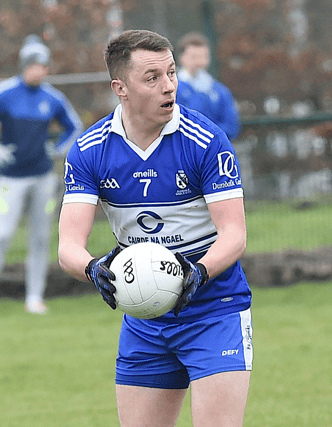

Inside Track | Joe Carroll
There’s a blue-and-white flag flying outside – and indoors, as I piece this story together, I might as well be wearing a same-coloured jersey.
The club to which I’ve been attached since about a decade after World War 2 ended has representatives in the county intermediate championship final on Sunday next, and that, of course, means that whatever degree of impartiality this page has had in the past goes out the window. Not really.
Straight away, apologies to Hunterstown Rovers, the team we are playing at Ardee – hopefully they get a fair shake of the stick in the pages which follow these.
I made great friends with many from Hunterstown club in my years covering the GAA scene for this paper, sticking rigidly, I might say, to the rule which decreed that there should be fair recognition for all.
Syl Levins was always sought out on visits to Páirc Baile Fiach, even though meeting him invariably meant having to buy a Rovers’ lotto ticket; Jim Matthews was always admired as a rock-solid centre-half, and now when I meet him at the races, I’ll remind Kieran Matthews of the game he had at left-full on a winning senior championship team in Stabannon, playing against one of the county’s best at the time. Many years before that, Ollie Reilly was one of the heroes of ’57.
Another clubman, Seán McClean, would love to be tying red-and-white ribbons on the Séamus Flood Cup before making the presentation on Sunday, but if it’s otherwise, don’t expect the County Board chairman to perform his function with anything but good grace.
Back to ‘us’ and ‘we’. This is our – there’s another that deserves a couple of single quotation-marks – sixth IFC final. We have a decent record, four wins – in 1987, ’91, 2003 and ’07 – and one defeat, in 1979. (Percentage-wise, Hunterstown have done better, playing two and winning both, in 1993 and six years later.)
As the league played out in the first half of the season, there were few, if any, down at The Ramparts looking forward to the championship.
Wins were sporadic, not enough of them to keep us in the top half when the divide came along, but worse after that, ending up deep in the relegation mire. We’re still not out of it.
A well-earned draw with Mattock Rangers in the opening round of the preliminaries was the spark that has since turned to a championship flame.
The improvement has come about playing football that bears no recognition to what was practised by the championship-winning teams.
Few, however, were complaining when the crucial tie with Kilkerley Emmets and the rematch with Mattock resulted in narrow wins.
And now the panel’s lineage. Our panel includes a young man whose family links goes back to the club’s foundation, almost a century ago.
Tony McDonnell’s great-granduncle, Tommy McDonnell, was prominent at the first meeting held in Conradh na Gaelige, Seatown Place, in 1928.
Since then, there have been several championship-winners in the family. Tommy’s nephew, Tony, was centre-half on the senior championship team of 1952, and in more recent times, Tony’s sons, Davy and Brian, won junior and intermediate medals.
Now comes one of the fourth generation, Brian’s son, Tony, who, in the semi-final defeat of Mattock, chipped in with three crucial scores.
The Culligans have a three-generational link. Sunday’s goalie, Aaron, is son of Paul who was on the 1991 winning side, and Paul’s dad is no other than Danny, who before joining forces with Gaels, played on a winning St Joseph’s side when junior was the county’s second highest grade.
He later played in a county senior final, and was manager when Gaels won the ’91 intermediate and were beaten the following year in the senior final.
Let’s not forget Danny’s wife, Margaret. She’s an O’Hanrahan, whose three brothers, Harry, Pearse and Mícháel, all wore the Gaels’ jersey.
The McArdle brothers, Éanna and Conall, also belong to a third generation. Both their father, Benny, and grandfather, Vincie, won championships, one of Benny’s, a senior, with Dublin’s Erin’s Hope.
Since this is a piece plastered in blue and white, let’s go further down the family road. Sean McCann’s father, Pat, captained a Macardle Cup-winning team, while his grand-uncle, Peadar McNally, was a colleague of Tony McDonnell’s with the 1952 winners.
Dylan McKeown’s father, Derek, is of sound Roche Emmets stock, but now supports Gaels. Dylan’s mother is sister of David, Andrew and Stephen Coleman, who followed a championship win in 2003 with success at provincial level. Their uncle, Patsy Coleman, was another who lined out in Louth’s All-Ireland year.
Jordan Keating is a nephew of Martin Harvey, who was also on the ‘03 team – while James Stewart’s father, John, played for the club after transferring from Oliver Plunkets. Peter McGinnitty, who has captained winning intermediate and minor teams, is married to Stewart’s sister.
And the O’Connells, Thomas, James and Paddy? I played alongside their grandfather, Oliver Brannigan, and was also on his team when he ‘made a book’ at Dundalk dogs and the races.
Some other ‘sons of’: Seán Lambert (Walter), Liam O’Connor (Packie), Paul McCrave (Robbie) and Liam Coleman (the aforementioned David.)
All of this might make some think Gaels are unique. Far from it. Examine the lineage of any other clubs’ players in the county and, indeed, beyond, and you’ll find that it’s the same there. Long-running family involvements over the year helps make the GAA what it is today – it’s one of its great strengths.