

New rules, new game, new ‘spakes'

Inside Track | Joe Carroll
We’re back to what you might hear – or have heard – before, during or after a football match, mostly those played on a Gaelic pitch.
‘Spakes’ they used to be known as, and as we move into the era of the New Rules, which might, or might not, be in vogue for more than a year, there’s a stab here at a few that might enter a lexicon that has never printed, nor is ever likely to be.
“Lorry it” we were told in days long gone, our mentor wanting us to kick the ball as far up the field as we could. If the ball was on the ground, there were players who used “toe” it, which was kicking the ball with the toe of the boot instead of with the side of it.
And some of those boots, usually made of pigskin, had a steel cap, and you knew it if you even got only a tip of one. Like “Lorry it”, a relic of old indecency is, “Give her wellie”.
“Blarge it” meant the same thing, but that was mostly one for Oriel Park, or the next-door Joe’s Park.
All of the above had currency in a game, but not anymore. For the past few years, there’s been more using the fist (to pass the ball) than you’d see at the Square on a Saturday night.
“Don’t put your hand where your foot will fit.” But sometimes when you did that, you’d have a free given against you. Then you’d plead, “But the ball was there, ref.”
When you “Put it in around the kitchen”, a “schemozzle” could develop, and if a defender made a mistake and a goal resulted, he could be admonished by a colleague, “I told you it was my ball”.
Putting the ball in the square had an onus on the full-forward to try to win it. If he did, a shout could come from the sideline, “Have a ging”.
In other words, try for a score. He’d usually play safe by trying for a point, because he’d almost certainly have been told before the game to “Take your points, the goals will come.”
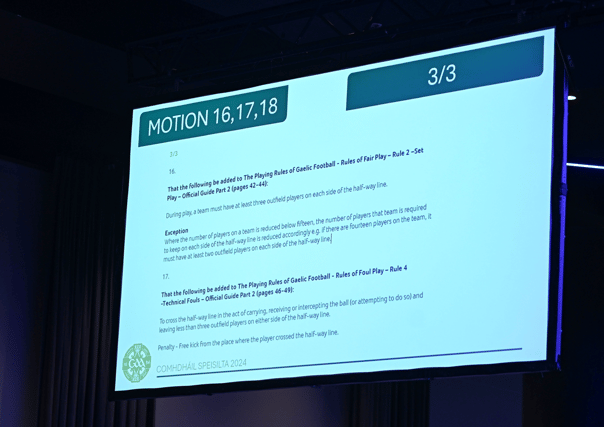
The full-forward graduated to become “The Shooter”. That one has faded, but could make a comeback now that both teams must have at least three players in each half, and you can be sure one of them will be posted around the square.
Another plea to the ref after a free had been awarded, “It was a 50/50 ball.” If there were several frees in the game, it was odds-on to have been a feisty affair, or, to put it another way, they knocked six bells out of each other.
Reports wouldn’t say as much, but when you read that “it wasn’t a game for the fainthearted”, or “having possession was a liability” you got the picture.
All of this was at a time when ladies’ priorities were washing the dishes, polishing the floors and putting the children to bed. Not any more.
The game is no longer male-dominated. There’s a gender balance in most clubs, and that will be the case when ladies get their feet under the big table.
Camogie, along with ladies football, is to come under the wing of Croke Park, and while it mightn’t happen soon, there will some day be a female President of the Association. There is currently two County Boards with a lady filling the top post.
Now that we have explained why it was ‘he’ and ‘him’ throughout the first part of the above trip down memory lane, let’s move on to a little what might be heard when the new rules come into play.
There’ll be “Press” instead of “Get tour tackle in”, and while players were always told “to keep their mouths shut”, not doing so now will carry a greater penalty than ever before.
If even questioned why a free was given, the referee has now the liberty to move the ball 50 yards up the field, and it’s not only those on the field who can be penalised. Mentors – surely a word that has stood the test of time – have also to keep it zipped.
“Go for your point” can be replaced by “Go for a two-pointer”. One of these is scored from a shot beyond the new arc, and will be signalled by an umpire raising an orange flag. His – there’s that word again – cue will come from the ref.
There are now four arcs on the park, making it probable that before long something like, “Nark in the arc has four sent off at Croke Park” will appear in a headline.