

McGuinness hopes Murphy’s return will boost Donegal’s All-Ireland hopes

Inside Track | Joe Carroll
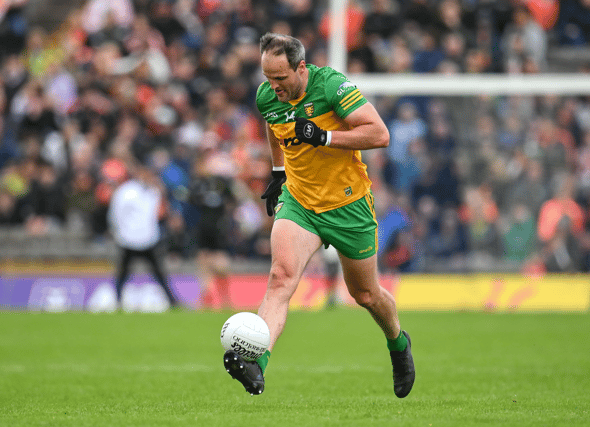
It’s been classed as the greatest comeback ever. No, not Trump reacquainting with the White House, or Oasis getting back on stage; rather, Michael Murphy's attempt to reignite his career with the Donegal footballers.
Murphy’s 35. He captained Donegal in their 2012 All-Ireland triumph, which many believe popularised the game – with managers, not followers – that we have today. Jim McGuinness was in charge then, and is again, his comeback last year maybe not as earth-shattering as this one.
Could it be that Murphy was encouraged the again don the Tir Chonaill colours with the near certainty that next year’s game will be changed from the one we’ve had over the past decade, but still unlikely to be similar to the one our fathers played?
The rules are to be changed – Murphy was on the committee that fashioned them – one of them guaranteeing that over the hour, or 70 minutes, one half of the field can’t be unpopulated. Loitering with intent around the square saw the big No 14 at his most dangerous, and will again in the new year.
The Glenswilly clubman last played county football in 2022. His planned return adds spice to the Ulster championship, which, come to think of it, doesn’t really need anything, or anyone, to strip it of its standing as the most competitive of the four.
Next season it will have the All-Ireland champions among its nine runners, and a whole lot of teams razor-keen to prevent the Applemen from getting their hands on the Anglo-Celt Cup.
There have been a few comebacks in Louth football, some of them bringing reward, others not. Would Louth have won the 1957 All-Ireland football without Tom Conlon or Jimmy McDonnell?
Conlon, who captained the Louth team beaten in the 1950 All-Ireland final, played in the 1956 championship first-round defeat by Kildare, and then took his leave of county football.
A little over twelve months later, he was encouraged to make a return, and lined out for his first game in the knock-out’s quarter-final defeat of Wexford. He was ever-present at full-back after that on the team’s way to All-Ireland glory.
Jimmy McDonnell, who also played in the 1950 final, retired from inter-county a year before Conlon, and came back a game later than the Stabannon Parnells stalwart, in 1957. His return couldn’t have been more spectacular. He scored 3-3 against Kildare in the Leinster semi-final and followed with 2-2 against Dublin.
This was the first of two county team comebacks for the Darver Volunteer. He played on after the All-Ireland, and was in his usual No 14 slot for Louth’s failed attempt to retain their Leinster title, beaten by Dublin in the final played in Navan.
He hung up his inter-county jersey after that, but was inveigled to wear it when Louth qualified for the 1960 provincial final, which saw Offaly win their first-ever title.
The 1958 campaign had Pat Markey on the comeback trail. Like the Jettisoned 6 and Roche’s Mick Brady, who had transferred to his native Cavan in mid-season, the stylish St Mary’s clubman was unlucky not to pick an All-Ireland medal.
Another of the 1950 team, he quit the inter-county scene the year before, but was back for the ’58 campaign, playing in his usual No. 6 berth. It didn’t quite work out for Louth that day; Dublin gained revenge for their year-earlier defeat before advancing to beat Jim McKeever’s Derry team in the All-Ireland final.