

INSIDE TRACK: Two new stadiums to rise from the ashes of Dundalk’s Athletic Grounds

It couldn’t happen at a more appropriate time as Louth boasts a European Champion and resurgent county team
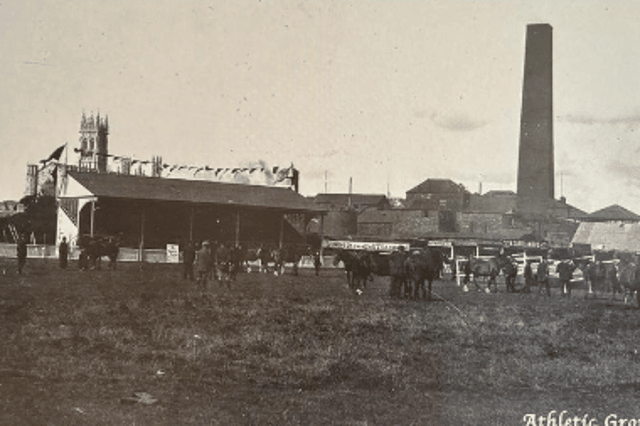
Inside Track has lamented often enough on the closure of Dundalk’s Athletic Grounds, which happened in 1960. It is now covered by industrial buildings. Not among them, however, is the industry which first occupied the site.
Shoe-makers Hallidays, or Clarks as it was also known, was a big employer in town at the time, operating factories on Quay Street and Mulholland Avenue. When it was decided to merge the two, the search was on for a suitable location.
The Athletic Grounds was earmarked. Here was the epicentre of sport, catering for local, county and national events. While primarily a GAA venue, housing club, National League and All-Ireland championship matches, including an All-Ireland semi-final, it also staged Dundalk Rugby Club’s fixtures, and at one time Dundalk FC played home fixtures there, prior to the move to Oriel Park. There was even greyhound racing for a short period.
And it was the venue for the NACA All-Ireland Championships, attracting the very best athletes from around the country.
Many locals were among those who starred there, sprinters Gerry McShane and Ronnie Roche, high jumper Brendan Martin, shot-putter Pat Mulgrew and cyclists Nicky McArdle and Tom Kirk, to name but a handful. The great Peter McArdle, an Olympian, was another competitor, running over the longer distances.
While it was always known as the Irelanders Field, where Young Irelands GFC played their home games, the owner was the Dundalk Young Irelands Athletic Grounds Company Ltd, separate from the football club.
The company had originally informed Louth GAA and the CBS – whose annual sports were a huge attraction – that the grounds were for sale, encouraging them to make a bid. Louth had previously made approaches, but at the time the company wasn’t interested in selling.
When it went on the market, Louth GAA made what was described as a “substantial bid”, and were confident it would succeed. Halliday’s then entered the fray, and as negotiations continued, it threw in a threat that if its bid was unsuccessful there would be a withdrawal of employment from the town.
It was never known if the company’s bid was greater than the GAA’s, but fighting a lone battle in the face of stiff opposition – and threats from many local quarters – the GAA withdrew, leaving the road clear for the shoe company.
The factory was built, and Louth GAA lost what had been its spiritual home. The other sports were also losers, though in due course the rugby club would open its own fields on the Mill Road, having played for a time on the grounds of Ballymascanlon Hotel. But for athletics, there was no other venue in the area capable of staging All-Ireland championships.
Halliday’s belongs to the distant past, as, indeed, does the once-thriving shoe industry in Dundalk.
Is it a coincidence? In the 18 years prior to the venue’s closure, the Louth senior team played in seven Leinster finals, winning five. One of the wins was a stepping stone to an All-Ireland success, while there was another appearance in a final. But after the gates were closed, it took Louth 50 years to make it back to another Leinster final.
So, why is all of this being rehashed? Well, as is well known by now, the Athletic Grounds is about to be replaced by not one, but two, first class venues, one catering for football and hurling, primarily, the other, athletics.
The new GAA stadium on Dundalk’s Inner-Relief Road is due to open next year. Before then the first athletic events are to be held not too far away, on the new running track off Hoey’s Lane.
Many of those who welcomed home Kate O’Connor last Monday evening were seeing the near-completed stadium for the first time. (Floodlights are soon to be erected.)
They couldn’t have been but impressed. It has a natural surround of mature trees, and while it may be far removed from of the venue where Kate O’Connor performed so heroically the previous week, from a performer’s perspective, it lacks absolutely nothing. There’s no reason why ambitions can’t be realised.
The synthetic track itself, 400 metres in circumference, has eight lanes surrounding a lush grass infield, where, no doubt, there’ll be all the room the European champion needs to display her javelin-throwing and high- and long-jumping prowess.
O’Connor promises to be there for the opening. She may not need to have her arm twisted to don her green singlet, perhaps for a lap of the track or a skip over a few hurdles. Or maybe she’ll be togged out in the colours of her beloved St Gerard’s AC, where it all began for her. Her loyalty to the club was remarked upon at her homecoming.
Israel Olatunde and Abbie Sheridan might also wish to be there. Here are two athletes who also competed at the Europeans, Dundalk-born sprinter, Olatunde in the 100m and as a member of the Ireland 4 X 100m relay team, and Ardee’s Sheridan in the 3,000m steeplechase.
There’ll be football on the GAA’s Goodman Park next year, maybe not in time for Louth seniors’ early season National League matches, as had been hoped. While the grandstand is in place and floodlights erected, the all-important playing sod has to be given time to bed in. It’s for certain, however, the gates will open in 2027.
So, here we have it, two venues, both, in a way, rising from the ashes of the old Athletic Grounds. It couldn’t happen at a more appropriate time. There’s a European champion to grace one of them, and the Louth team, coming off the back of two memorable seasons, ready to display their skills on the other.