

Inside Track: Louth’s new stadium to carry the Goodman name

Inside Track with Joe Carroll
Maintaining a family link with Louth GAA that extends back to the very foundation of the GAA, the Goodman Foundation has claimed the naming rights to the new county stadium.
Due to house its first games next year, the venue will carry the name of the Edward Goodman Park. Phase one of the €37 million project is nearing completion.
It will have an initial capacity of 5,000, a figure that will grow to 14,000 when phase two, incorporating a covered terrace, is completed.
The Goodman Foundation contribution will help Louth County Board meet its financial commitment to the project. The work on phase one is estimated to cost €25 million.
Of this, in the region of €11 million will come from the IIP fund, over €5 million from Louth County Board, and the rest from Croke Park.
The driving force behind the project is a committee chaired by former GAA President, John Horan, and includes Louth County Board officers, chief among them chairman, Seán McClean.
Essential to phase two work being started is a Government grant. The issue has been raised in the Dáil, and there’s the hope that there’ll be a positive outcome to a request for funding.
This is not the first time the Goodman name has been linked with Louth GAA. Aside from Edward and his brother Larry’s contribution to the Young Irelands club in its early days, the Goodman organisation was first to sponsor the Louth senior team through its AIBP wing.
Indeed, jerseys with AIBP emblazoned on them are still being worn on big match days, many of them seen at Louth’s recent All-Ireland semi-final with Mayo.
Another football connection is provided by Larry Goodman, a Young Irelands player who was centrefield on the Louth team that won the 1978 Leinster under-21 championship and then went so close to beating a star-studded Kerry side in the All-Ireland semi-final.
Had it not been for the injuries to Goodman and Eugene Judge at crucial stages, Louth might well have beaten Kerry, who had several senior All-Ireland winners in the line-up, Jack O’Shea, Sean Walsh and Eoin Liston among them.
The injury Goodman sustained was more serious than first thought. It did, indeed, bring an end to his career, causing him to miss Young Irelands’ senior championship win in 1979 and an appearance in the final the following year.
Larry’s brother, Seán, lined out with Naomh Finbarra. He was part of the Togher club’s teams that had a fine spell in the 1980s, winning a number of league titles.
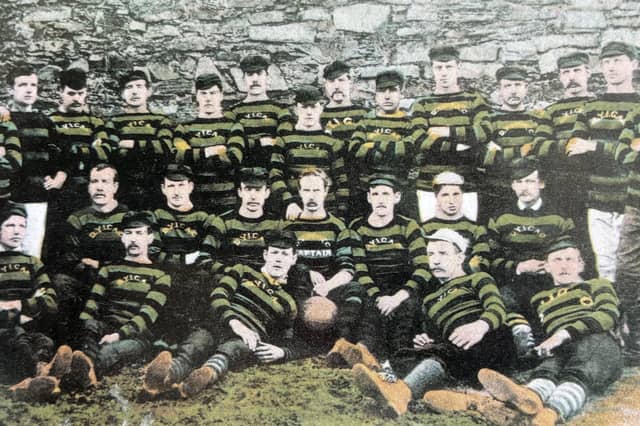
When Louth GAA was beginning to find its feet, back in the late 1800s, Edward Goodman figured prominently. He was an administrator and footballer, playing a leading role in the formation of the Dundalk Young Ireland Society, which was the forerunner of Young Irelands GFC.
He was on the Young Irelands team that won the first Louth senior championships, in 1887. Victory qualified the wearers of the famous green-and-black colours to represent Louth in the first All-Ireland championship.
Louth reached the final after beating Waterford’s Ballyduff Lower and the Wexford representatives, Castlebridge. The final, played in Donnybrook, Dublin, was a close affair, but in the end, Louth had to concede to Limerick Commercials. Edward Goodman played in all three games.
Because of its status, the first final of a competition that has been played every year since, the 1887 encounter fills a very special place in the annals of the GAA.
Edward Goodman won a second Louth senior medal in 1888, while his brother, Larry, figured on the Irelands team that regained the title in 1905.
Recalling Edward’s contribution to the Young Irelands club, Fr John Mulligan wrote in his book, An Historical Record Of The Green And Blacks:
“In September, 1901, at the AGM of the Dundalk Young Irelands Society, Edward was one of the members appointed to make the necessary arrangements for the re-establishment of Young Irelands GFC. He immediately set aside a field he owned at Castletown for training purposes, before a well-attended general meeting in October elected him chairman of the club.”
Edward’s involvement in other sports were also recorded by Fr Mulligan. “He took a keen interest in coursing, and his famous trotting mare, Molly G, took cups and prizes at every show in which she competed.
“With his brother, Laurence, he also won scores of prizes for pure-bred cattle at the local shows, including the successful Dundalk Show, of which he was a founding member.
“A man of many talents, Edward was an elected member of Dundalk Urban Council before his election to Louth County Council in 1905. He was frequently elected to the Harbour Board and the Louth Infirmary Board and other public bodies in the Dundalk area.”
Edward died in 1916, and in a tribute, Fr Mulligan wrote: “A kind-hearted man, generous and loyal person, the large funeral of local residents and many from all parts of Ireland that followed the hearse from his residence, 7, Faughart Terrace, St Mary’s Road to Castletown Cemetery was proof of his widespread popularity. The chief mourner was Peter Goodman, his son.”
In a way, it’s appropriate that the new stadium should have a Young Irelands connection. For years, prior to its closure in 1960, Dundalk’s Athletic Grounds was the home of Louth football.
It was owned by the Young Irelands Society, and to many was known as the ‘Irelanders’ Field’.