

Dermot Keely is one of the all-time greats in League of Ireland football
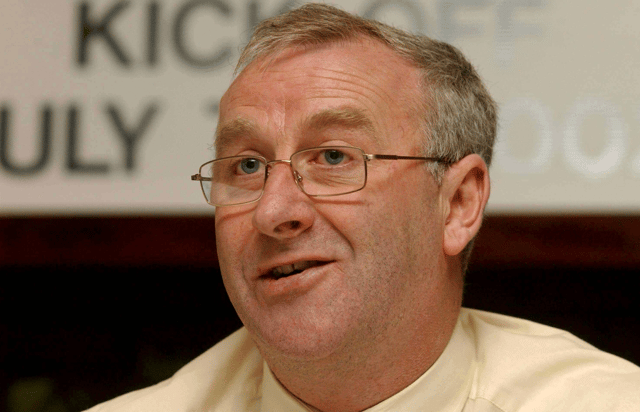

The Commentary Box | The Gerry Malone Column
NB. Please note, this is an interview I did with former Dundalk manager and player Dermot Keely. I did the interview as there is a book being launched on Dermot and his life at Oriel Park on Friday, 19th September. The book has been written by Neil O'Riordan, senior soccer writer with the Irish Sun Newspaper.
One of the all-time greats in League of Ireland football, Dermot Keely will launch a book of his life story called ''Behind the Ball'' in Oriel Park on Friday, September 19th. The book has been written by Neil O'Riordan, of the Irish Sun newspaper.
Dermot now lives on the Canary Island of Lanzarote with his family. He owns Paddy's Bar in the Puerto Del Carmen area of the island. Dermot is 70 now.
He has a huge link with many clubs around the country. One of course is Dundalk, who he led to great success on the field as a player in the late 1970's and early 1980's.
Dermot was back in Dundalk two and a half weeks ago with the passing of the man he regarded as his football father, Jim McLaughlin. Dermot spoke of how close he was to the great man.
"I had a whole football life that I would never have had because of Jim. He was like my football Dad. That's true, that's true. If there had been no Jim McLaughlin there would never have been a Dermot Keely. It's as simple as that.
"I first met Jim McLaughlin in January 1975 when I was playing for Home Farm. We met Dundalk in the first round of the FAI Cup at Tolka Park. Jim McLaughlin was the player-manager of Dundalk. We beat them one nil and went on to win the FAI Cup as an all-amateur side.
"Jim McLaughlin was a different man then, from the one we all knew to love later in life. He was a fullback on that famous day against Home Farm at Tolka. That day Jim was running around like a lunatic, knocking people over. At the end, he finished up playing centre forward.
"Jim was much different as a player than he was as a manager. He never raised his voice as manager of the team. As a manager, he was never one to interfere in what players felt they could contribute to the team. Maybe the madness he showed as a player would attract him to signing me.
"He might well have seen some of that in me. As a manager, Jim never raised his voice. Any man that could manage Dermot Keely, Pop Flanagan and Tommy McConville on one team deserves a medal.
"Jim was never afraid to sign players who had an opinion. He was able to let people do what they could for the team without interfering with them Everywhere Jim went he could see something in a team and had success.
"In June 1978 he went to Pats and signed myself, Sean Byrne and Pop Flanagan for a pittance, after he got huge money from selling youngsters Derek Carroll, Synan Braddish and Brian Duff to Liverpool. Jim saw something in Sean Byrne and God he was some player as was Pop.
"Pats at that stage were playing in the lower part of the league for much of the time. Jim was able to see things in us that we did not see ourselves. I came from a team that was usually bottom three in the league.
"Jim showed such football intelligence that saw something in players that others did not. Nobody could ever say that we did not repay the money Dundalk paid for us.
"I never would have thought that that great double side would come so close to qualifying for the quarter-finals of the European Cup. I also do not think Jim did either. The story of League of Ireland football was at that time, that we did do really well in Europe.
"We played Linfield in the preliminary round of the European Cup in August 1979. One incident that stood out for me from that game was the Linfield fan getting up a pole and taking the tricolour down; the Linfield fans then burned the flag.
"The Dundalk crowd kept throwing stones at this Linfield fan, as he kept going up and down the pole as he attempted to get the flag. It was surreal. We were supposed to be playing a football match and we were playing a game where there was trouble all around us.
"That game should have been called off. It was ridiculous. The two teams were playing on only two-thirds of a pitch. We were playing and all we could see was the Gardai in front of chasing hooligans.
"Jimmy Dainty came on as a sub and refused to go down the side where all the trouble was. There was nothing but stones being pelted onto the pitch that side. I said to Jimmy to go down the side of the pitch where most of the trouble was. We called Jimmy, Lilly the Brit.
"I told him he had nothing to fear as he was one of them," Jimmy was in fact from Birmingham, but certainly had no connection with the Linfield fans who caused so much of the violence."
Dermot says he remembered going up to the referee asking him to call the game off as Oriel Park was a war zone. Any sane person would have called the game off. The Linfield fans wrecked the place. It was crazy what was going on. We went on to draw the game one a piece.
Then we had to play in another surreal atmosphere behind closed doors against Linfield in Harlem in Holland. We edged out a 2-0 win with Cathal Muckian getting both goals. Our next game was against Hibernian of Malta who we beat in the first round proper of the European Cup.
Then we were on to Celtic in Round 2. There were only 16 teams left in the competition. We played our first game in Parkhead. We played very high up the pitch and we played square. We should have been four down within the first twenty minutes of the game.
Richie Blackmore put in the best goalkeeping performance I have ever seen that night. At one stage with about 25 minutes gone, Jim McLaughlin ran onto the pitch for a distance of around 25 yards with a bottle of water, when someone went down injured.
He just threw the water on the injured player. Jim never cursed. He really had lost his temper. It was at all of us. He looked up at me. He said that if I slipped up again that he would kill me. I looked up at him. Jim was just not the usual Jim at this stage of the game.
He was always a very mellow man. He told myself and Paddy Dunning to just go back to the edge of the box. This was so that we could stabilise things and start to cut out their attacks. Prior to the game, Celtic had watched us a number of times. They had done their homework.
But from the bottle of water incident, we all completed properly. Jim was such a quiet man. I was never threatened by him. I was always fighting with him. He never fought with me. Jim always just let things go. He was non-confrontational. He just let you know his point.
If he was unhappy with something with you, he would have a quiet word the following Tuesday. Jim was never in for confrontation. But that night when he came onto the Parkhead pitch he really, really had lost his temper.
"Jim was a tough man. He had to be. Look at what he was managing. Nobody could manage me, Tommy McConville or even Pop Flanagan. Jim just never fought with people. He would let it go with players like me. Jim was never afraid to sign people who could be difficult.
"It did not bother him. There was nobody too big for him to manage, in our team he had three difficult players to manage. The three of us always thought nobody could manage us.
"He knew he could play anybody in a team and be successful. Anyway, we got the dream result at Parkhead. We were able to come back home with the tie still very much alive at three goals to two.
"There were 22,000 people at Oriel Park for the game. It was way beyond the capacity of the ground. Supporters were seated right onto the perimeter of the pitch. The game finished scoreless.
"We just missed out on a dream quarter-final place with Real Madrid when Tommy Mac had a shot go agonisingly wide of the post at the Dundalk end of the ground. There were just 8 minutes remaining. A dream quarter-final with Real Madrid was narrowly missed out on.
"In my third year with Dundalk, we went on to win the cup. I remember Tommy had to have his head heavily bandaged after colliding with me. John Archibald and Mick Fairclough got the goals that won the cup for us. It was a fantastic win over Sligo.
"I left Dundalk after that for Glentoran. I had a row with Jim. Jim did not have a row with me. I said he was not signing good players. I told him we would never win the league again with the players we were bringing in. I had recommended Jim to bring big Hilary Carlyle in and he did.
"That was one of the best signings made for the double team. Anyway after the cup final, I also told Jim that he was afraid of the board. But Jim proved me wrong. The next year he won a league with Dundalk and I won a cup with Glentoran.
"Even though I was supposed to be a thinking man, Jim just let it go what I told him about signing for Glentodan. He just said that's fine. Jim never fell out with me over this. He never lost touch.
"He would come up to the Oval in Belfast and watch me playing for Glentoran. Jim knew what he was doing at Oriel was right. He was never going to let anybody dictate to him. And he was right.
"Although Jim was a very quiet man, you could never abuse him. He would just let you go. But Jim has done it all. I can count the number of players who left Oriel.
"But there were no arguments and no rows. When a player was done at Oriel you were done. Jim would let you go. But there were never any disagreements. There was never any badness."
Dermot came south again and joined UCD for just three months in 1983. "Doctor Tony O'Neill came and told me that there was no money for players. That was not good enough for me. Jim was with Shamrock Rovers.
They had plenty of money. Dermot went on to win four leagues and three cups between 1983 to 1987. In the season 1987 Dermot was manager at Rovers and won the double in his own right. I did not even apply for the job.
Jim's great Rovers team was the first real-time he had big money to manage a team. One thing is, that it is really difficult to win trophies.. During that great league and cup run, UCD did beat us in the FAI Cup final. We battered UCD and should have won."
But Jim won three leagues and three cups at Rovers. Those doubles he won I just do not think it will ever be done again. The man could manage in Dundalk with literally no money. Then he goes to Rovers who had money and does the same thing again.
He did 100 times better in many ways at Rovers as he had the big money. In 1987 Jim then left Rovers for Derry and within a couple of seasons, he goes and wins the treble. He took most of the Rovers team with him.
They did that in 1988-89 a year after Dundalk had done the double under Turlough O'Connor. But that treble that Jim did with Derry is simply legendary. It was a great way for Jim to show how good a manager he was.
But he had that inner strength to look forward to achieving more and not back at what had already been achieved. He did the double with Dundalk with tough players.
He did it at Rovers with good players. Then he goes and does it all again with Derry taking the players that he likes. He built the Derry team around Felix Healy.
Dermot finished his career as a player at Sligo where he got a bad knee injury. "I loved Sligo. I had a great rapport with the supporters and the club. I just loved Sligo.
"It reminded me about how I felt about Dundalk as a town, team and as a player. Having said that, I just love Dundalk. If I was ever asked where I am from I say Dundalk, even though I am a Dub."
At the end of September 1993, Turlough O'Connor, the third most-ever successful manager at Oriel departed. There were just two candidates in for the job. It was Jim McLaughlin and Dermot Keely. The interview committee was split down the middle.
The chairman Eamonn Hiney had the casting vote and gave the job to Dermot. "I have heard the story about the interview committee being split. I just don't know why they picked me. For me, it should have been a one-horse race with Jim going for the job.
"But look, maybe he was on the decline as well. Look at Turlough O'Connor. He knew when the time was right to leave Oriel. His career was also on the way down when he left Dundalk. All managers get to the same thought when they know their time in football is running out.
"Maybe Jim was the same. I simply do not know. He did move on to Drogheda after failing to get the Dundalk job. Jim should have got out of football then. He would never have been able to improve on his football record at that stage.
"But I was delighted to get the manager's job in Dundalk. I did not think it was going to happen. I actually did not even apply for the Dundalk job in 1993. Tommy McConville applied for the job with my name on the form.
"I can not repeat what I said to Tommy, what I told him when I heard what he had done. Anyway, I was not exactly going into the job with a great team. The club was on the slippery slope downwards when I took over.
"The club had no money. Every single week you would go to the board meeting and it was always the same. They would say that they had no money. I was told continuously to reduce the budget. But then I liked the town.
"I had been living in Dundalk long before I even got the manager's job. I just fell in love with the town of Dundalk. If I am ever asked where I'm from. I always say Dundalk. In 1995 we climbed up the table. We just hung on and hung on and somehow won the league.
"We had a tough, tough team. We did have some great players. Tom McNulty was just sensational. Tom and Mick Doohan got the goals on the last day of the season at Oriel for us to snatch the league. Derry only had to beat already relegated Athlone to win the league.
"But the midlanders did not read the script and beat the league leaders. Shelbourne also messed up on that last day of the season. We had to win and hope results went our way. They did and I simply could not believe it. It was a fantastic achievement.
"In the middle of the season that Dundalk won the league, the company that owned the club became insolvent. It was rescued by long-serving director Enda McGuill who put together a new consortium. It stabilised things at Oriel for a while and allowed us to go on and win the league.
"But we were not the best team in the league that season. It was sheer grit and determination that won it for us. It was a throwback to the double team of 1978-79.
"They were so tough. Mick Doohan was unbelievable in the 1995 team. There was also a great atmosphere in the dressing room. I have always been lucky in football.
Tom McNulty was a special player. He always got the important goals. Dermot left Dundalk at the end of season 1996. Dundalk's European Cup game at home in 1995 had to be played in United Park Drogheda as Oriel Park was having a new drainage scheme installed on the pitch.
Dermot managed Shelbourne from 1998 to 2002. He had great success at Tolka. "It was easy to get success there. We had plenty of money. They had great players. We won two leagues and a couple of cups.
Dermot went back to Shelbourne in 2007. They had no money just like Dundalk had none in 1995. However, they were just minutes away from promotion back to the premier division in 2007 when Limerick scored a late equaliser. That promoted Dundalk back to the Premier Division as they hammered Kildare County the same night. Dermot left Shels in 2010.
"As a player, I won the Player of the Year award from the PFAI from 1983 to 1986. I also won the Soccer Writers Award for Player of the Year in 1985. I was playing with the great Shamrock Rovers side. Jim McLaughlin obviously saw something to take me to Rovers as well.
"But I am sure when he went home to Dundalk he would often bang his head off the wall in frustration with me. He never let that frustration interfere with our relationship.
"In fact, I was to find out that in a farewell to Jim McLoughlin, I was named as his number one player by the great man", Dermot also had a short spell managing Derry.
He says he simply could just not do the job. He was only there for 63 days in 2003. "I loved Derry. I loved the people of Derry. But in Derry at that time all they wanted was for me to have the side playing nice football.
"At Dundalk and Shamrock Rovers, we played nice football, but we won as well. I just could not do it at Derry whatever it was. So I decided to leave."
Dermot says he decided to live in Dundalk because his gut told him that it was for him. "It's like when you meet somebody and you know that they are the right person for you. My love for Dundalk was reciprocal from the people of the town.
"When I was playing, the fans loved me from day one. I loved the town of Dundalk from Day one. When I arrived in Dundalk it was El Paso. At that time it was not exactly a place where most people would decide to settle.
"I think the big factor was Tommy McConville taking me under his wing. He was number one. So when I went out on the town with Tommy, I met real people. It was great. Dundalk was small. It was not big.
"Everybody knew me because I was with Tommy McConville. I moved up there and my family also moved up there. I simply do not know why I loved Dundalk so much.
"Tommy McConville was a very special friend. When he passed it was a huge blow. When I went to Dundalk first I was very raw. I just could not keep my mouth shut. Tommy saw something in me and took me under his wing. I stayed in his house when I first arrived in 1978.
"I just matured under his guidance. Tommy let me into his world, which was Dundalk. People got to know me as Keely the person, not the footballer. It just clicked."
Dermot lost his son Alan in 2021 aged 38. It was a sudden death. It happened during the Covid pandemic. ''You never get over the death of a son. Your father should not go before your son".
In typical humour, Dermot said he would like to put it on record that he was not a better player than him. He said Alan was a better footballer. I had told Dermot I remember meeting Alan once when he was delivering letters to local secondary school Coláiste Rís.
School caretaker Aiden Greene was slagging Aiden that Dermot was the best player. Alan said he was the best. Alan sadly left behind him a heartbroken wife and young children. His dad Dermot will always be heartbroken.
Dermot would visit Jim McLaughlin as his health deteriorated. When Jim used to see Dermot in the early stages of his illness he would shout repeatedly at Dermot not to give him the ball. On Jim's death, Dermot said that he was better off.
He had suffered so much for years. He had lost touch with reality for so many years as a result of his illness. "As human beings, we are made to live.
"The condition Jim had to endure through his long illness gave me a better understanding why many people are looking for euthanasia for people who have no chance of recovering from their illness and are suffering so much. Jim was also hit by a stroke during his illness.
"The way Jim died was not the way to go. For a man like Jim who was so successful, so big and such a personality to go through all he went through, it was shocking. I loved Jim, but yes you have to think it was time for him to go.
"Since the stroke, it has been really difficult for his family. As much as I miss him and loved him to bits I can say he is better off now having passed away."
Speaking from the Canary Islands Dermot said his lovely wife was just putting away his clothes. "I have beautiful weather here all the time and can go swimming as well. I have a great life.
"I have a beautiful woman looking after me. I could not ask for anything more. I will not be returning to Dundalk to live as much as I love the town. I will spend the rest of my days in the sun.
"With all the rain there is in Ireland, I could just never return to live. But I will be home in about two weeks' time for the launching of the book. That of course will take place in Oriel Park in Dundalk."
Have a great week. Take care of yourselves and please be careful out there.