

The true origins of MacSwiney Street in Dundalk

Dundalk History
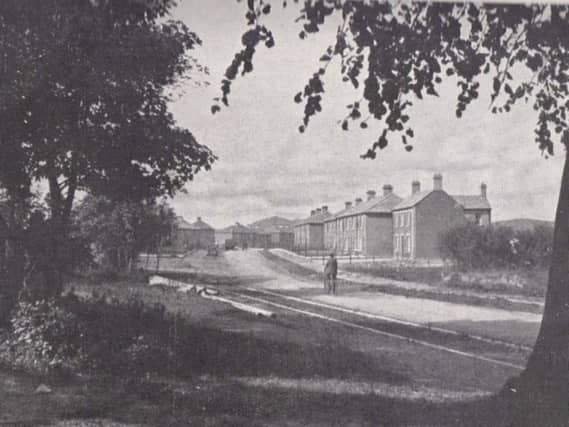
How many Dundalk people know the origins of the name of the row of houses along the Demesne Road, called MacSwiney Street, in the Heart of Town? Well, I was born there a long time ago and lived as a child in one of those houses for about three years and I grew up thinking that it was 'McSweeney Street' and often wondered who it was named after!
Even a good and much admired friend of mine, the late Canice O'Mahony who was an assistant and later Town Surveyor for about twenty years, also got it wrong; as he names it as 'McSweeney Street' in his excellent book about Council developments in Dundalk in the twentieth century and other local history!
Canice records, in his section on 'U.D.C. Housing', that the 70 houses built there were --- 'First in the Demesne, named after the 1919 hunger striker'. I got to learn, when working the Dundalk Democrat many years later, that it was named after the famous Lord Mayor of Cork, Terence MacSwiney (MacSuibhne in Irish) whose death in Brixton Prison on October 25, 1920 after a 73 day long hunger strike had a profound effect on opinion in the United States. His death and subsequent huge funeral in Cork on October 31, 1920 was one of the factors which forced the British Government to agree to a Truce in July 1921 and to negotiate with the representatives of Dáil Éireann on the terms of a Treaty.
Canice knew a lot about the old Jail at the Crescent because his grandfather had come from Cork in the nineteenth century to serve there as a Warder. The O'Mahony family lived in the Jail and, in another strange connection with the present day, Canice used to relate how an aunt of his had died in the great 'Flu pandemic of 1918, aged just 19 --- the same age as my own aunt who was one of the first civilian casualties of the Civil War, when accidentally shot in a street in Buncrana, during a bank raid on May 4, 1922.
In Dundalk Jail
What I did not learn until just last week was that MacSwiney spent about five months in Dundalk Jail at the Crescent between November 1917 and March 1918 when he was returned to Belfast Jail where he had been sent originally after his arrest and sentence to a year's imprisonment for a 'Breach of the Realm Regulations', for involvement in unlawful assembly by drilling and wearing uniform, in Cork in September 1917. The record shows that he was aged 38 at the time he arrived in Dundalk and that his occupation was 'teacher'.
I discovered all this, and much more, when I accidentally came across a Louth County Council site on my computer which gives a list List of Prisoners transcript for Dundalk Jail from June 1917 to September 1920. Names from the year 1919 are missing as they are 'short in the original register'. This site gives details of over 100 prisoners lodged in Dundalk Jail during that period and includes that of the equally famous Austin Stack from Tralee who died in 1929 aged 49, as a result of being on hunger strike in Mountjoy Jail during the Civil War.
I had been looking for the name of another person when this list came up on my computer and I spotted many local names of people who had been actively involved in the War of Independence. For instance I saw James and John McGuill of Bridge Street, who were listed as being-- James, aged 29, publican and his brother John, aged 24, a motor mechanic. Both were actively involved in training volunteers and John, who became a local funeral undertaker at Mill Street, was a leading figure in the 4th Northern Division I.R.A. under Frank Aiken.
Another name that I noticed was that of Patrick 'Packy' Flynn from Quay Street, who is described as a 'painter'. Packy had been arrested by the R.I.C. in Dundalk March 1918 for 'unlawfully assembly by drilling' and released in May 1918 after serving a 'full term of two months' for the alleged offence. He was later awarded a rare 1916 Rising Medal for being one of about 100 Dundalk men who had marched from Dundalk at Easter of that year to take part in the Rising in Dublin but had failed to reach the Capital. He was a very pleasant and unassuming man whom I knew well as he was a lifelong member of Fr. Eddie Jones Redemptorist Choir and had also been awarded a Papa Medal for services to St. Joseph's Church.
To return to the story of MacSwiney Street, the houses had been erected for the Council in 1933 by local builder Eric MacDonald of Castle Road and the tenancies were awarded by the Urban Council members about the end of that year. Three other schemes of houses, a total of 49, were erected by the Council in the same period at – Dublin Street, Market Street (Most for families of men who served with the Fire Brigade) and Oliver Plunkett Park (also in the Demesne).
Incidentally, Harry Tempest, in his Annual, for 1934 got the name of the Cork Lord Mayor correct but he was wrong about the occupant of No. 24 as he has it down as 'P. Kavanagh'; my father's name was Edward and my mother's Roseleen --- or was it that he had a premonition of my arrival there?
How the street came to be named in 1933 is probably recorded in the files of the Democrat but I have not come across that record. However, I suspect that it might have had something to do with the fact that the Chairman of the Council at that time was Paddy Hughes, Park Street, who was one of the leaders of that March at Easter I916 in which Packy Flynn took part! The Vice-Chairman was Thomas Gosling from Dublin Street and both he and Hughes were representatives of the South Ward on the Council. Other members of that Council was the Editor of the Democrat at the time Thomas F. McGahon, who topped the poll in the Seatown Ward at the 1928 local elections and Dáil Deputy for Louth James Coburn from Mary's Road, also representing Seatown. There is no mention of political affiliations in Tempest's Annual but I know that they had taken different sides (or none) during the Civil War. However, none of them seems to have had any difficulties in honouring Terence MacSwiney!
Perhaps, when this present pandemic has passed the present local authority members might get together again in friendship to remember the centenary of the death of the famous Lord Mayor of Cork and his connection with Dundalk. Or is that asking too much?