

The search for the elusive pine marten in north Louth
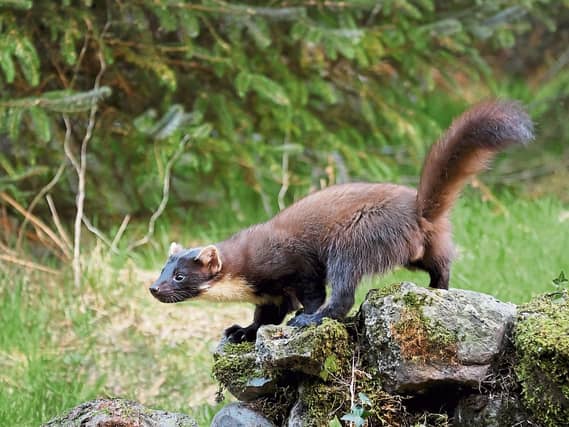

It was on the July 27, 2015, when I saw and photographed my first pine marten. My heart skipped a beat, and to say I was excited is an understatement. I managed to get a few shots of it before it ran off, as startled as I was.
My search had begun two years earlier.
I made an early 5.30am start on a Saturday morning in March 2013, a very cold and frosty day. With flask filled with hot soup and sambos wrapped in foil, I was all set to go.
The important stuff was done the night before, charging batteries, checking my camera and memory cards; packing warm clothes, hat, gloves and boots for what turned out to be a long and extremely cold day in the Cooley Mountains in County Louth.
I was meeting a friend and fellow nature photographer, Dom Reddin, who had invited me to go along with him to meet Enda Flynn, who had been setting up wildlife hides in the Cooley Mountains. Dom had been there before and had captured some beautiful red squirrel photos.
We set off with the hope of also seeing jays and, if luck was on our side, maybe even the elusive pine marten. Dom had seen one on his last trip, but it was late in the day and too far away in fading light to photograph.
On the way up, we talked about all things photographers talk about – equipment, light, techniques – and of course we created the perfect photo in our minds. Like a child, I was imagining and seeing in my mind’s eye squirrels, jays and the pine marten, all in perfect light on perches with clean backgrounds. Thank God for imagination; as my late mother would say, ‘you may as well dream here as in bed.’
The reality was very different. We met Enda at his place, transferred to his van and headed for the mountain. Half an hour later we pulled in to the side of the road and unloaded our gear and followed Enda as he headed into the woods. Carrying a lot of gear made the walk difficult.
We arrived at a small clearing, hides were erected, perches were put up and feeders hung; we were all set. Enda wished us luck and went off.
Because of all the walking, I had forgotten momentarily how cold it was, but as soon as I was settled in with my camera on its tripod and ass in chair, I got very cold very quickly.
Three hours passed with no luck … only small birds showed. I took out my flask of soup and poured myself a cup; it was stone cold. It got that cold I had to take my boots off and massage my feet.
At last, a squirrel arrived. I got off a couple of shots, happily. We heard jays screeching nearby and caught glimpses of them, but they never landed in front of our hides.
It got so cold we texted Enda to come for us; it was snowing heavily when we left.
The next day, I was thinking about our Cooley Mountains trip and thought what a long way it was to go from where I lived in Mountmellick, Co Laois, to photograph native wildlife. This set me thinking about my local bogs and woodlands, of which I had an intimate knowledge. I had spent my teenage years on the rivers fishing and, as a young man, on the bog saving turf. I knew there were deer, foxes, hares, many bird species and lots of insect life all around me. I had often seen jays, albeit usually just a flash of white rump. So the seed was set and I set myself the challenge of photographing a jay.
In December 2014 I started looking for a good location for setting up a hide from where I could try to photograph a jay. Having spent over thirty years saving turf on the bog, I had walked most of it, so I soon found a clearing in the middle of a mixed forest of ash and pine trees and set about making my hide. It was very makeshift, but was quite effective. I selected two big pine trees that had a gap of four feet between them. I put up a large garden umbrella between the trees, and put a black ground cover sheet behind it, and hung camouflage netting in front of my fold-up chair.
I then put up bird feeders filled with peanuts and cracked sunflower seeds and checked them every day for signs that birds were feeding. It took about a week before I noticed any sign that birds were feeding. I then sat in my hide to see what birds were in the area. Coal tits and great tits were at the peanut feeder, and chaffinches were at the cracked sunflower seeds. But still no sign of jay.
Incredibly, it took me until April to get my first decent photograph of a jay … that was almost four months. They are incredibly shy birds, wary and also intelligent. If you give yourself away they will be gone for the day; they can detect the slightest movement. And they work as a team.
Photographing jays was a great learning curve for me, especially in the art of stealth and camouflage. The lessons I learned were invaluable and were the reason I was so successful later with pine martens.
After nearly a year I started to see what I thought were pine marten scats (poo); I had been researching pine martens and I was fairly sure that’s what they were. I took some photos to compare them with online ones, and sure enough, they were indeed pine marten scats. This was very exciting as I now knew that at least one marten was visiting the site.
I imagine that it must have come across the site while hunting in its territory and came upon the peanuts that I had left out for the jays. Like all animals, pine martens are creatures of habit and remember where they have found food.
I then started sitting for longer periods and on a more frequent basis. I found more fresh scats around the area but had no physical sighting of a marten yet.
It was summer now and the growth was at its height, with long grasses, thick briars and tall bracken … plenty of cover for the marten. During May and June, I was on the bog every day, saving turf, and would drop by the site to leave out nuts and also dried fruits. During this time, I only had time to sit once a week, but I was sure the marten was still visiting regularly as the scat evidence was there to see.
My research into this found that martens marked the edges of their territory with scats, so my thinking was that my spot was of high value to the visiting marten and needed to be defended by it. Pine martens are solitary mammals, and males and females live separate lives, defending their own territory from each other. They only tolerate each other during the mating season in late summer, and these meetings are known to be very aggressive. After mating, they then revert back to being solitary, with the female rearing the young on her own.
It was now about the second week of July and the turf was safely in the shed, ready for the coming winter, which was still a long way off. I now had more time for sitting in my hide.
The days were still long, so I had plenty of daylight hours to devote to my hide and the marten. I was concentrating on just one prop that was there naturally: a grassy log. I would go there up to three times a week and, as I was not working at the time, sometimes twice in the one day.
And then, one fateful day in July, at 6.00pm I was sitting in my hide, having put out some raisins and peanuts. Some small birds and jays dropped by and I got off a few shots. I then checked my settings and waited. I was getting tired and uncomfortable and was thinking about going home when, suddenly, I saw grass moving behind the grassy log. I watched with bated breath as a pine marten, the most elusive of Irish native mammals, appeared before my eyes.
After that, I spent most of my time on the bog in all weathers, thinking the marten would turn up again on cue. But we are dealing with a wild animal here, and wild animals have other agendas. I was always measured in my approach to leaving out food for pine martens, as I wanted to bring them in as close as possible so I could get a photo. I would leave out very small bits to tempt them in; they would then have to forage for more food and hopefully wander closer to the hide.
I continued to visit and sit in the hide, spending hours, days and sometimes weeks without seeing the marten. The days when he, or she, would turn up made all the blank days worthwhile. I then noticed that I was building up a collection of photos from different seasons and different parts of the marten’s life cycle. So I then put together a panel of my pine marten photos to apply for an associateship award from the Irish Photographic Federation. You can see a selection of these photos on these pages.
[Note: the Irish Photographic Federation awards distinctions on three levels – Licentiate, Associate and Fellow – in ascending order. The associateship is the second of these levels and requires a panel of fifteen images to be presented for assessment. The photos should sit together as a cohesive body of work and demonstrate the applicant’s individuality and sustained ability in photography. Successful applicants are entitled to use the letters AIPF after their name.]
Thankfully, my application was accepted.
The days, months and years of sitting and waiting in all weathers, in the rain and cold, enduring the boredom of many long hours when nothing showed … it was all suddenly worthwhile when Bob Morrison of the Irish Photographic Federation called out my name, announcing I had been successful in my application and was being awarded an associateship of the Irish Photographic Federation.