

The history of big storms over Dundalk
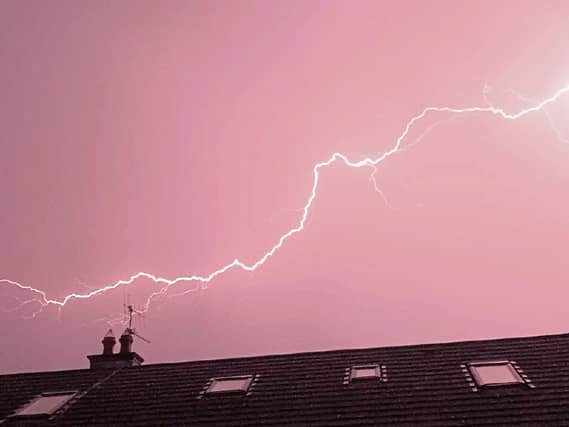

Over the past week or more there have been several reports of severe thunder and lightning storms over mainland Britain, due to warm air flooding in from the continent colliding with cooler air coming from the north. This 'turbulent air' as it is called in meteorological reports has also caused flash floods on many places and there have been several warnings that we might expect such conditions over Dundalk but, so far, apart from a few rumblings of thunder heard in the distance, it has all come to nothing!
This does not mean we are going to escape entirely as I would remind my older readers that many bad storms that hit Dundalk in such conditions have come very late in the autumn season. Interestingly, there is a report that Edward Bruce was hampered in the displacement of his troops before the Battle of Faughart in October 1318 by a heavy rain storm over North Louth on the night before the battle. That was a long time ago, however, and any decent historian will warn you that such reports are very unreliable and may have been concocted at a later date. There is a report, however, of a storm that did a lot of damage in this area at that same time of year in much more recent times which comes from a more reliable source – The Dundalk Democrat. This report appears in Canice O'Mahony's book ,'An Engineer Remembers', his section on the history of the Dundalk Water Supply. In it Canice writes ---
'On the 12th October, 1939 a violent storm swept away the entire Annaverna headworks (in the Cooley Mountains) and swept away large sections of the supply pipe (feeding the Aughnaskeagh Storage Reservoir). The Democrat described the events as follows “North Louth had its worst storm for fifty years at Ravensdale where a cloudburst caused much damage. Following two hours of thunder and lightning there was a terrific rainfall. An immense flood rushed down the mountainside, bursting the banks of the Annaverna River and carrying everything in its path. Ricks of corn were swept away, walls smashed, farm gates carried half a mile to the lowlands and a twelve inch pipe carrying water to the UDC storage reservoir was burst, apparently by large boulders swept down the hills by the torrent. It was reported that a considerable stretch of the pipes has been torn up and smashed and that the head-weir on the mountain has been destroyed.”
'Quantities of fish were swept down the pipeline as far as the storage reservoir.
The damage, estimated at £6,000, had to be repaired in the following year by raising a bank loan, the Department refusing any grant assistance'.
Fortunately, there does not appear to have been any loss of human life or even injuries but I have read elsewhere that livestock was drowned and that farm buildings were damaged. Indeed, a considerable number of years after the storm, people from the area could recall the terrifying event.
It is surprising, however, that the newspaper report refers to the event as 'the worst storm for fifty years' because I can recall that my own family was affected by a thunder and lightning storm that hit the Town in August of 1932. It happened before I was born but I recall my mother often telling that she had been bathing her twin children in a tin bath tub in the kitchen of our home in Patrick Street when there was a terrifying crash and she witness 'ball lightning' running down the electric wiring in the house and causing all the lights to go out.
It was on that same night that a lightning bolt struck the spire of St. Nicholas Church off Church Street, setting off a fire in the porch which caused such damage that the entire spire had to be replaced at considerable cost. I do not know if it was the same lightning strike that hit our house but it seems that my brother and sister were extremely lucky to escape injury. My mother was very shocked by the experience and would not allow any of the family to look out of a window when a lightning storm was in progress. She was also in the habit of running around the house and covering mirrors with sheets to prevent the lightning getting into the house. I wonder do any of my readers have any similar memories of this sort behaviour by their parents or grandparents during thunder and lightning storms?
Personally, I used to love watching lighting and knew all the different types of lightning, from 'forked to ball lightning' and even 'sheet lightning'. The 'forked' type was the most common to witness and I think that I only ever saw the 'ball' kind on one or two occasions. The 'sheet lighting', of course was only the reflecting of the strikes on clouds and had been a long distance off. We even learned to tell how far off the lightning strokes were by counting the seconds between seeing the lightning and the sound of the thunder by allowing for the time lapse caused by the difference between speed of light and the speed of sound.
All those experiences have caused me to reflect that it seems a long time since I have witnessed a 'humdinger' of a storm breaking over Dundalk. Is it just that my memories are faulty or are there really fewer of them around these days than used to occur?
One of the reasons that bad storms seem less frequent, as a friend of mine recently pointed out to me, when there was any lightning about the power supply used to fail more frequently . He claims that this is due to the fact that the E.S.B now has a better protection for their transformers which don't get knocked out as easily as they used to!
At any rate, it seems to me that we are due a really big storm over Dundalk fairly soon, with flash flooding to add to the problems of the Town! I wonder if it could happen this year to add Nature's 'light show' to an already memorable year?