

REPORT: 'Collaboration' key to future of Dundalk town centre planning

‘Health check’
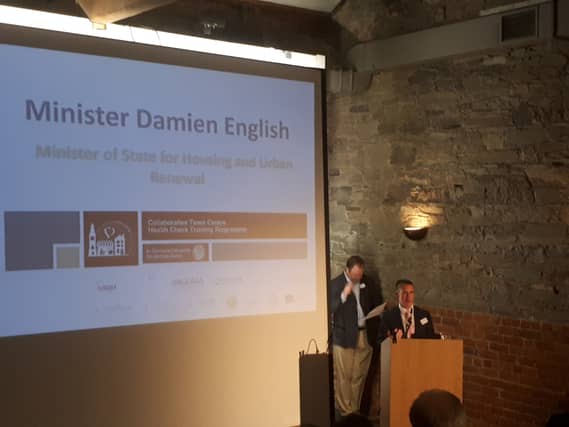
Minister of State for Housing and Urban Planning, Damien English officially launched the summary report of the key findings of a major ‘health check’ which looked into the strengths and opportunities of Dundalk’s historic town Centre today at the county museum in Dundalk.
The 15-Step Health Check process measures people’s perceptions of the town’s commercial and cultural choices along with transport, parking and entertainment facilities.
Speaking at the launch, Minister of State for Housing and Urban Development, Mr. Damien English T.D. outlined the commitment of Project 2014 to regenerate urban areas.
“Town centres are more than bricks and mortar – they are the traditional heart and lifeblood of urban areas and their surrounding rural catchments. Project 2040 is committed to regenerating these special places in order that they will survive and thrive for current and future generations”.
Virginia Teehan, Chief Executive of the Heritage Council emphasised the importance of culture and heritage in any future urban planning for Dundalk.
Ireland’s Town Centres are steeped in history. The collaborative health check process, which has been championed by the Heritage Council and its partners, enables us to understand our unique historic environments so that we can plan effectively for their future.”
Martin McElligott, Dundalk Town Centre Commercial Manager, Dundalk BIDS, spoke about the vital role of collaboration in achieving their targets.
“The partnerships that have been forged through this collaborative health check process have been hugely rewarding, helping generate a collective movement within all of the partners. For the first time in my role as Town Centre Commercial Manager, I can see true long-lasting change that is possible with the CTCHC Training Programme”.
Dundalk Collaborative Town Centre Health Check Report 2019 focuses on the survey results of a number of key indicators of the overall health of the town centre including: level of town centre activities, land use/commercial/cultural mix, pedestrian footfall patterns and business operators and consumers’ perceptions of the quality of the environment of the historic town.
The health check showed that:
- 58% of respondents were in Dundalk Town Centre to shop on the day the survey was undertaken
- 30% of respondents shop online at least once per month with 59% purchasing mostly clothing and accessories
- 41% would like to see extended opening hours in the historic town centre to 7pm every evening and 19% would like to see extended opening hours on a Friday evening until 9pm
- 81% think there is a good standard of service in shops in the town centre and 75% think there is a good range of events in the town centre
- Footfall in the town centre was 10% busier on a Friday than on a Saturday
- Just under two thirds of consumers believe that Brexit will have a negative impact on Dundalk Town Centre.
74% of the business respondents in Dundalk Town Centre feel that shopping, banks and businesses are the main thing that attracts people to the town centre. 50% expect trading to improve over the next two years and 50% think Brexit will have a negative impact on town centre businesses. 77% of business owners in the historic town centre do not currently sell online.
Ali Harvey, the Collaborative TCHC Training Programme Co-ordinator with the Heritage Council added that the data gleaned can help correct decision making for the future.
“The Dundalk project demonstrates the importance of having agreed, robust baseline data to inform decision-making and investment proposals for town centre renewal and revitalisation, particularly in relation to Border Towns that are facing an uncertain time. The collaborative efforts of the Project Partners, along with the wonderful ideas produced by the DkIT students, have been very rewarding. The innovative partnerships created and nurtured through the project bode well for the future of this wonderful historic, border town.”
Welcoming the Dundalk Collaborative Town Centre Health Check Report 2019, Frank Pentony, Director of Services, Louth County Council said the report was a positive and constructive basis on which Dundalk Town Centre can be further enhanced and promoted.
“This was a truly unique baseline survey involving the town’s key strategic partners that provides us with a great framework for taking stock of Dundalk’s many assets. We must be equipped with this sort of data to build for the future. As a border town, Dundalk is facing unchartered territory but has so much to offer, and this collaborative health check report will help us to enhance and maximise the quality of life for everyone in the town,” he said.
Dr Michael Mulvey, President of Dundalk Institute of Technology reaffirmed DkIT’s commitment to Dundalk.
DkIT looks forward to continued collaboration with all the stakeholders involved in this innovative project to maximise the opportunities for this historic trading town, ensuring it continues to prosper and grow for the benefit of Dundalk and the wider region.”
Billy Doyle, CEO Dundalk Credit Union said that the report provides useful signposts for the future.
“A healthy and vibrant historic town centre is important for everyone who lives, works and visits Dundalk.”
Brian Walsh, Heritage Council Board Member highlight the role of the Heritage Council in any future planning.
“This collaborative process is fundamentally about how a town centre’s heritage informs our sense of identity, this is why the Heritage Council’s role is so pivotal. It reminds us of how important our town is in who we are, it is as important and as simple as that.”