

Remembering the old windmills of Dundalk

Peter Kavanagh
Just over fifty years ago a song called 'Windmills of Your Mind' became popular when it was recorded as part of the soundtrack of the movie 'The Thomas Crown Affair', sung by Noel Harrison, son of the famous actor Rex Harrison. The film was released in 1968 and the song won the Academy Award (better known as The Oscar) for Best Song in the following year. The song became even more famous when a version was recorded by Dusty Springfield and became a worldwide hit.
The song was originally composed by Frenchman Michel Legrand who only died in January of this year, aged 86, who wrote over 200 songs for films. It has remained 'making circles in my mind' for the past fifty years and, for some reason that I cannot fully explain, I have forever associated it with dreams and memories of the past.
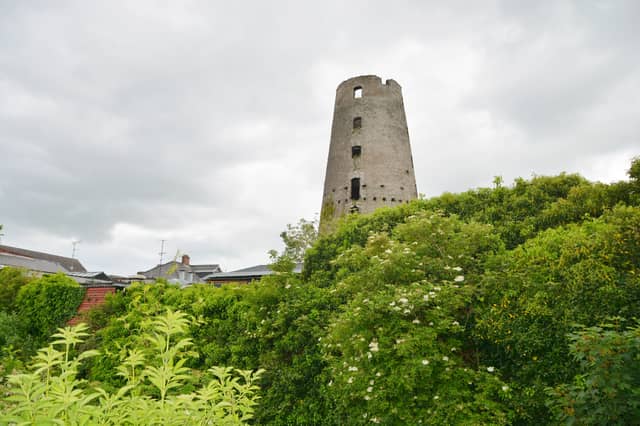
Maybe this was because I have associated it with the outline the Seatown Windmill which became engraved against the summer skyline as I crossed the Redemptorists Hill on my way to school. Or, maybe, it was just because I have lived along 'The Windmill Road' for most of my life! I have often wondered do many Dundalk exiles have the same vision of the Seatown Windmill as the make their way to work in some foreign place like London or New York?
Ironically, this old windmill building is probably not the same as relics of Dundalk's past which gave the original name to the road now known as St. Alphonsus Road. I have come across an old map of Dundalk and its environs which shows no less than three windmills placed along the sea side of this road. I have often wondered what those old mills might have looked like?
Reading an old copy of the magazine Archaeology Ireland, I came across an excellent article on post-medieval windmills in Ireland, written by Muiris O'Sullivan and Liam Downey, in which the Seatown Windmill is featured. This article details the progress of these mills from wooden structures called post mills, to tower mills and ending with larger cylindrical, tapered towers, of which the Seatown Mill is a fine example.
At a guess, I think those three early Dundalk mills might have been wooden, supported on a vertical pole, around which the structure could be rotated by means of a tail-pole to face the sails to the wind. The reason I think this is because there never has been any sign of a masonry structure in these fields between Barrack Street and the Blackwater Stream which marked the boundary of the town before 1946.
There were, however, some clues as to where those old windmills might have stood. I can recall a small mound in the middle of the old Railway Goods Depot, covered by small trees and scrubs, which could have been the base of one of them. This mound was levelled when the Swimming Pool was constructed but I had visions, when crossing the old Railway Hill, of seeing the ghost of a miller coming out of a doorway, shaking chaff and flour from his large apron, after tending to his grinding stones.
There are also one or two low mounds in what was known as the Convent Field, now covered by the Belfrey private housing estate. Perhaps these were the sites of the two other small windmills?
It is strange that a modern feature overlooking St. Alphonsus Road now could well favour the idea of changing the name of the link road between the Long Avenue and Barrack Street to the original name. This is the high, three propeller, wind turbine which, along with the Crowne Plaza Hotel, dominates the southern skyline of the Town.
The County Council have seen fit to include these two features as a symbol of modern Dundalk in a sign along the Link Road near the Xerox complex. Another strange feature of the wind turbine is, that when one turns the corner at the Seatown-Quay Street junction, this structure seems to be located at the end of the present St. Alphonsus Road, overlooking Sloan's Corner. It is, however, about as far again away in the grounds of the Dundalk Industrial College!
There is no name plate on the present road roundabout along St. Alphonsus Road and I would suggest that Council could consider naming it 'The Windmill Road Roundabout'. It might be a good idea also to consider putting the outline of a small windmill on top this roundabout. This sort of feature has become a very pleasant feature of some other Irish towns like the approach to Letterkenny in County Donegal?