

Remembering ‘May Day’ in Dundalk Sixty Years Ago

Peter Kavanagh
Looking out the window and seeing the sun shining on May Day of 2019 I reflect that Dundalk of sixty years ago was a very different place from it is today! In May 1959, a great change was coming over Ireland that I had known in my school days. By that date, many Dundalk homes already had television sets and transistor radios were becoming a prize acquisition for the teenagers of those far off days. It must be difficult for young people of the present day to comprehend the impact those means of communication were to have on the Ireland of the Sixties-era!
Up to that time, ordinary people of Dundalk had to depend on the cinema and, maybe, one wireless broadcasting to everybody including neighbours in the family home! Now there were 'Sputniks' (as Russian launched satellites were called) in the sky above us and news that had taken days and even weeks to reach us previously was becoming instantaneous! That changed everything; and also changed our ideas about the world outside Ireland!
Looking back it seems to me that the weather appeared to be different to what it is in 2019 but that probably just an illusion! You must remember that we had no 'five day weather forecasts' then and had to rely on newspaper and radio reports to guess what it might be like during the week ahead. Nevertheless May Day was a significant date on the calendar when we realised that summer days and nights were just around the corner. More significantly, however, for children it was a sign that the School Holidays were not far off!
Back in 1959 religion played a huge part in everyday life in Dundalk and what you could do or not do depended to a great deal on what was said from the pulpit. That is not intended as a criticism of the practice of religion of the time but it was a fact of life and you obeyed the rules or suffered the consequences and many emigrated for that reason, as much as a result of economic circumstances.
Old pagan superstitions, however, did linger and, at times of year like May Day or ('Bealtaine' as it had been known in ancient Ireland), those old beliefs did break through the fabric of ordinary life. I recall that in parts of rural Ireland it still the custom throw May blossoms on the roofs of houses, I think to bring good luck for the coming summer but it may have had something to do with an old belief in the fairies. These beliefs varied in various parts of Ireland. For instance, my wife tells me, that when she was a child, it was the custom in Armagh to place yellow flowers on the doorsteps of houses so that the inhabitants would have butter to spread on your bread all the year round! Perhaps another reminder of the World War 11 food shortages?
Strangely the colour of the flowers and blossoms seems to have had something to do with the effect of these 'spells' (for want of a better word on my part). I recall that my mother, who came from a rural Donegal background, strongly believed that only people who were born in May were allowed to bring the whitethorn blossoms into a home -- if anyone else did it -- it would be very bad luck! My father, who came from a similar tradition, thought that there was bad luck in bringing yellow broom into a house or sheds where domestic animals were kept!
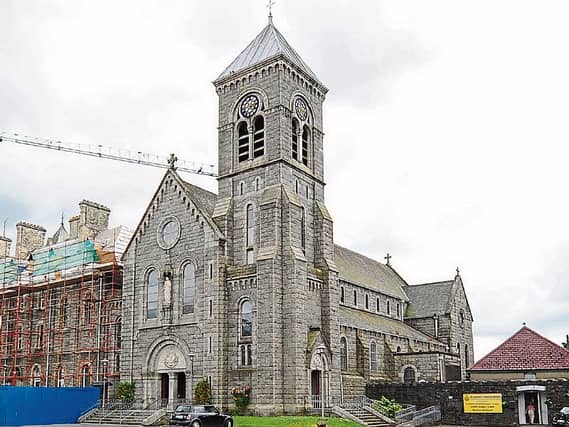
To get back to Dundalk of the period, I recall that the May processions on the Sundays of the month, played a big part in the social life of the town. In St. Joseph's Redemptorists Church, where I was an altar boy, hundreds would attend these ceremonies which wound around the Church, and outside when the weather was fine; the children walking behind the banners of various saints and the statue of the Infant of Prague carried by the altar boys.
The wife of a friend of mine tells me that most homes in Dundalk erected May altars in honour of the Blessed Virgin. She says that it would be kept decked with flowers, kept fresh by the female members of the household for the entire month, with the centrepiece a statue of Our Lady dressed in blue and white.
Things were changing, however, in Dundalk by May 1959. The closure of the G.N.R. Railway Works in October of the previous had meant a great loss of employment and income for local businesses. Many wage earners were forced to emigrate to earn money to keep their families together and new ideas were beginning to reach us from England. Young people were beginning to ask questions, especially about what they could read or wear. The era of 'Beetle Mania' was not far off and 'music was in the air' --- a factor that greatly changed social outlooks and behaviour in Dundalk!