

Remembering ‘Hairy Peter’s’ and Mick Murtagh’s pub in Dundalk
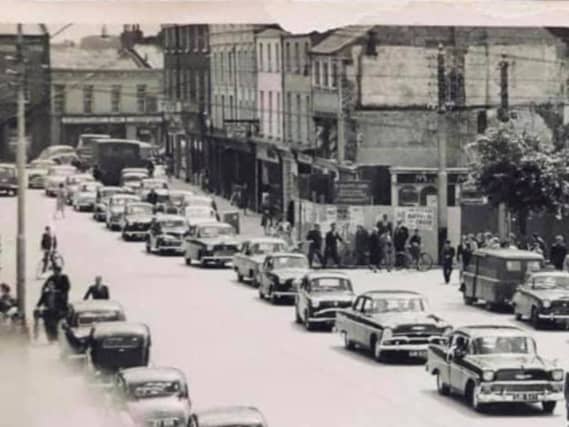

Lookback: How different life was locally back in the 1950s/60s
In the 1940/50’s there was no talk of global warming. The winters were very cold. A great occupation for the young kids was ‘sliding’.
Just to explain ‘sliding’: On cold frosty evenings and nights we would pour water on St. Mary’s Road in Dundalk.
Now there is a slight fall from the Marist wall to the houses on the road. This was ideal because the street lights were on the houses side of the road. So pouring the water on the road it would run down towards the street lighting.
The evenings were very cold from an early hour, thus the water was frozen from about tea time ( in those days dinner was between 1-2pm ). There was no TV, so we were delighted to pass the evenings sliding down the frozen water. In the early forties all shoes had leather soles. So whether our parents were happy with the slides I don’t know.
The slides took their toll on our leather soles. This led to more frequent visits to Mr. Hamill the cobbler in Yorke street.
Girls didn’t participate in sliding and boys wore short trousers until they completed National school. Once in long trousers it wasn’t considered mature to be sliding. Towards the end of the forties rubber soles started to appear. Rubber soles were a major problem to the slides.
They caused the slide to thaw. So rubber soles were banned and this caused major disputes. When a slide started to thaw a little everybody was asked had they got rubber soles. When nobody confessed to having rubber soles an inspection was then carried out.
Now as everybody bent their knee for inspection it wasn’t easy in the street lighting of the day to determine rubber from leather. Age and size came into the equation too. Just remember cars were few and far between on the road.
Football.
A good part of schoolboys' play time during the 1940’s was street football. In St. Mary’s road there were two trees along the footpath at the Marist wall about 35-40 yards apart ( as that was the linear measurement used in those days ). These served as goal posts. Now St. Mary’s road is a cemented road and has two lines of thin tar separating the cement for I think slight expansion purposes. These lines ran parallel to the trees and formed, when jackets were thrown on them opposite the trees the other goal posts. So there were no disputes as to who got which goal.
I can tell you us kids were better footballers than the top ones in England today, well in one aspect. That is in volleying a tennis ball. We used to practice by hitting the Marist wall from the other side of the road. If you hit it too low it hit the kerb of the footpath on the Marist side of the road and skied over the Marist wall.
If you hit too high it just went flying over the Marist wall. So we perfected a faultless volley. The biggest danger to street football was that Garda Gaffney would come round the corner unnoticed on his bike and catch us playing street football.
Comic cuts.
In the days of no TV or World Wide Web comic cuts( as we called them) were a great source of entertainment. I don’t know who organized it or how it was organized but a certain house brought one the British ( there were no Irish ) comic cuts. Another house bought a different one, so that all comic cuts on sale were covered at the minimum cost. The comic cuts came out weekly. After a number of weeks all the comic cuts were brought to a central meeting point, assembled together. An agreed rota was put in place to pass the comic cuts to the gang of young boys. One of the boys had a relation in America. So occasionally we would get American comic cut.
They were on a broadsheet as opposed to the home comic cuts A4/A5 size. The American ones were also different in that they had advertisements in them. One in particular was for the 7up drink. It showed a cheeky happy dancing youngster with a bottle of 7up throwing bubbles of gas in the air. 7up wasn’t on sale in Ireland then, and we thought we would be in seven heaven if we could get a bottle of 7up. The rotation of the comic cuts worked wonderfully on a wet summer night.
You could go to bed early ( it might be needed during the summer holidays for it was a 12 hour day of play ) and enjoy the reading. On winter nights it wasn’t so good, no central heating, table lamps were that usual so it was a central ceiling night with a shade and probably 40 watt bulb all of which didn’t contribute to a happy night’s reading.
Foot Note
In the 1940/50’s large crowds would be on the streets of Dundalk from 7 to 9pm. There were four cinemas with two evening showings at 7pm and 9pm. As there were only a few cars everybody walked to venues. Buses ran late to rural areas.
Eating out was popular before or after the pictures. It may have been a solo ( chips and peas ) if my memory serves me right on tin plates in O’ Hanrahan. Fish and chips in Molocca’s or as the one in Earl street was affectingly known as “hairy Peter’s “.
This name came into being due to the fact that to use the toilet you had to go through the kitchen. Of course the kitchen was very hot and Peter would be stripped down to his vest. Saturday was the main shopping day in Dundalk as Monday was for the washing of clothes. Shops remained open until 8pm on a Saturday. Pound, shilling and pence were in use.
There were 12 pence in a shilling. Crowns weren’t that popular but half crowns were used frequently. A half crown was two shillings and sixpence that is 30 pence. In the late 1950’s a bottle of stout was 10 pence. Three of us used to meet sometimes during the week. So you know if you had a half crown in your pocket you could stand your round. I think around that time Guinness started changing over from wooden barrels to the “ iron lung “. Mick Murtagh, God be good to him, had a pub at top of Earl Street.
He was one of the last to change from the wooden barrel. Now if you went to Mick for a pint you needed patience. Mick would take from 10 to 15 minutes to pull a pint.
The only way I can describe the difference between a pint from a barrel and one from a “ iron lung “ is the difference between eating a fresh cottage loaf and a stale one.