

Recalling 'The Emergency' and rationing in Dundalk

Peter Kavanagh
This time of year, mid-autumn, has often been a time of great upheaval, uncertainty and change in Dundalk – from the start of the Great War in 1914, right up the 'Troubles' of the 1970s – And so it is again today, on the cusp of the U.K.'s 'Brexit' from Europe!
It is not surprising, therefore, that older townsfolk may be looking back to another time of great change for the Town which is just within their memory span; the 'Great Emergency' at the start of World War 11.
I was a very young child when the War was announced over the radio --the quickest means of communication in those far off days! But I can still remember the anxiety of my parents over the news from Europe and I am sure there are still many around Dundalk today who can still recall those upsetting times!
The atmosphere of the time can, possibly, be best described by a comment in an interesting book published by Victor Whitmarsh, originally from Barrack Street, back in 1977. In one of the early pages he wrote ---
'When invasion appeared imminent in 1939 it became compulsory for householders to cover their and shut in the light (in rooms). The streets were without lighting and side lights only were permitted on motor vehicles.
Painted white lines appeared for the first time on major roads. Torch batteries were short supply and, for some late cinema goers or dance enthusiasts, making their way home late night, the blackened town could be a s strange and unreal place.
To be lost in one's own town in a blackout may seem ridiculous today but it actually happened to people in Dundalk. It is reckoned that at least one person left the Rink (a hall at the old Athletic Grounds) after a (roller) skating session and walked straight into the Ramparts River.'
Victor Whitemarsh is a person of my own generation who now lives in retirement in Galway City but still, I am told by his relatives, has a great interest in his native Dundalk.
I have the highest regard for his efforts to bring the importance of local history to the attention of all generations and his several books on the subject deserve to be considered as textbooks for study in classrooms!
In another part of the same book an article, an interview of an anonymous local lady, headed 'A Housewife Remembers the Emergency', states ---
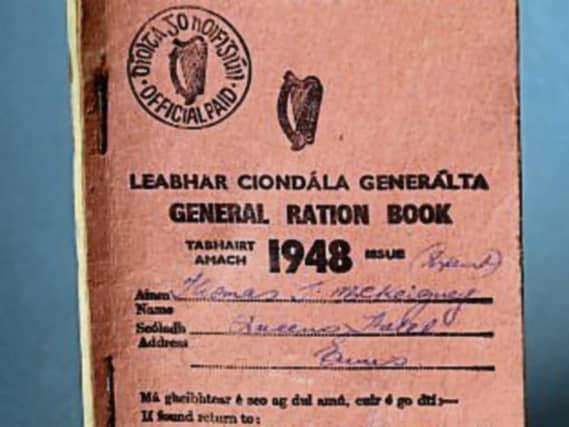
'What do I remember about the Emergency ---Well, I remember many things. I remember the black bread. Of course, it wasn't really black but it wasn't brown either. It was dark in colour and it tasted like sawdust.
Nobody liked it but, sure, what could we do about it? Nothing! We grumbled but we had to eat it. It was impossible to get white bread then or white flour.'
'You had to register with your shopkeeper for bread in order to draw you ration. Tea, sugar, butter, flour and wheatmeal were also rationed and you had to register for them as well.'
The interview goes on to quote a famous jingle, I think first made popular during the shortages experienced by soldiers of the War called 'Bless 'Em All'; supposed to have been sung by the troops serving in France. In this case it was sung by Irish people who had to put up with the shortages at home:
Bless them all; bless them all.
The long and the short and tall
Bless de Valera and Sean McEntee
Bless the brown bread and a half ounce of tea.
The interview goes on --- 'The thing I missed most was cigarettes, they were not rationed but but they were always in short supply!'
The articles shows that what people missed most during the 'Emergency' was the quality of their food --- and also the addiction many had in Dundalk of the time to smoking cigarettes.
While I do not wish to suggest that Dundalk during the coming year, and maybe even longer, will suffer food shortages, the uncertainty of the possible effects of Hard Brexit after the end of this present month must be on the minds of many Dundalk people.
We may not have to eat 'brown bread' but we could certainly have to do without certain exotic luxuries that we have become used to in recent years?