

Questions still remain 50 years on from the murder of Seamus Ludlow
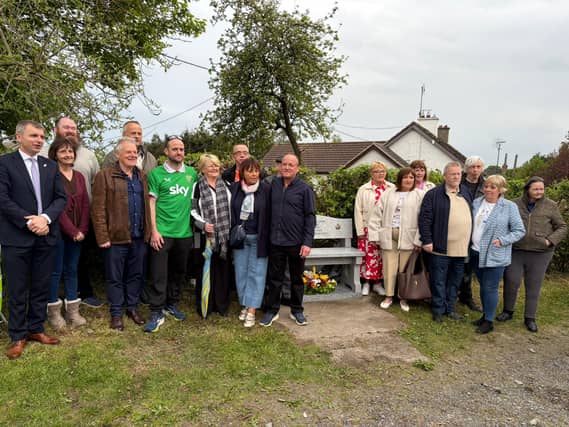

Sinn Féin TD for Dundalk Ruairí Ó Murchú was addressing an event marking the 50th anniversary of the murder of Seamus Ludlow in Dundalk in 1976
Sinn Féin TD for Dundalk Ruairí Ó Murchú has said questions still remain unanswered into the murder of Seamus Ludlow.
Deputy Ó Murchú was addressing an event to mark the 50th anniversary of his death.
Mr Ludlow was found murdered in Dundalk in May 1976 yet no one has ever been charged in connection with his murder.
The Sinn Féin TD questioned why fifty years on "justice has still remained so elusive".
"Seamus Ludlow was not a public figure and was not someone who sought the spotlight or controversy. He was an ordinary man—a forestry worker, a son, a brother and a much-loved uncle living a quiet life. And yet, on a night in May 1976, his life was taken in an act that would come to symbolise something greater than the death of one man.
It would become a story of officialdom’s silence, of state neglect, of institutional failure and of his family’s relentless search for truth," he said.
Deputy Ó Murchú said Mr Ludlow's family were subject to not only grief, but the "added burden of insinuation - that somehow, their loved one has been killed by the IRA".
"Those insinuations were not only totally wrong; they were deeply unjust. They compounded the pain of loss with the cruelty of doubt," he said.
The Sinn Féin TD praised Mr Ludlow's family for their "extraordinary resilience"
"The Ludlow family continued to explore every avenue including a new inquest in 2005, the Barron Commission, the Oireachtas Justice Committee which recommended a new dedicated Garda investigation.
For the family, it meant revisiting painful memories, confronting institutions, and refusing to accept the narratives shaped by those who wanted to continue to conceal the truth. It meant carrying the weight of injustice for years, even as the world moved on,
In time, their efforts began to bear fruit. New information emerged, and a new witness. A clearer picture of what had happened that night began to take shape.
It became evident that Seamus Ludlow had been the victim of a sectarian killing carried out by loyalist paramilitaries who crossed the border. It also became clear that there had been serious failures on both sides of the border in the handling of the case. The question is why.
Why was the original Garda investigation closed three weeks after Seamus’s death. Why did the Gardaí do nothing with the names of those involved when they were given to them by the RUC in 1979? By that stage, those involved and the details of the killings were known to the original investigating Gardaí. It turned out two of them were serving members of the UDR, members of the British Army.
Four men suspected of being involved were arrested in 1998 and questioned at Castlereagh. They were released without charge and the Public Prosecution Service in the North recommended no prosecution," he said.
Deputy Ó Murchú said there was renewed hope for the family in 2020 after Operation Denton/Kenova, an independent review of the Glenanne Gang, a loyalist paramilitary.
"The matter needed to be passed to Gardaí as Kenova believed a prosecution could arise out of the information they obtained.
So there was hope that the new Garda investigation, in 2023, would lead somewhere. A new witness had come forward in 2020 to give detailed and precise information about the sighting of a car relevant to Seamus’s killing.
The new Garda investigation arose after was made aware of that, but the witness was never spoken to.
This was, ultimately, another let down for the family when, just before Christmas last year, the Gardaí said that the DPP had directed no prosecution," he said.
"Fifty years on there is a requirement on the State, not only in the sense of legal responsibility, but in the broader sense of institutional integrity. There is a need for the families who continue to seek answers, to ensure that they are heard, respected, and supported.
The story of Seamus Ludlow challenges us to do better. It challenges institutions to place the pursuit of truth above all other considerations. It challenges us to remain engaged, to ask questions, and to stand in solidarity with those who seek justice.
But it is also important to remember the man himself. Amid the discussions of investigations and reports, of failures and reforms, we must not lose sight of Seamus Ludlow as a person. He was someone who lived, who worked, who had relationships and routines, hopes and plans. His life mattered not because of the circumstances of his death, but because of who he was.
To remember him is to affirm that truth.
Fifty years is a long time. But it is not too late."