

Louth Motors: e-Vitara Suzuki’s first EV in Ireland
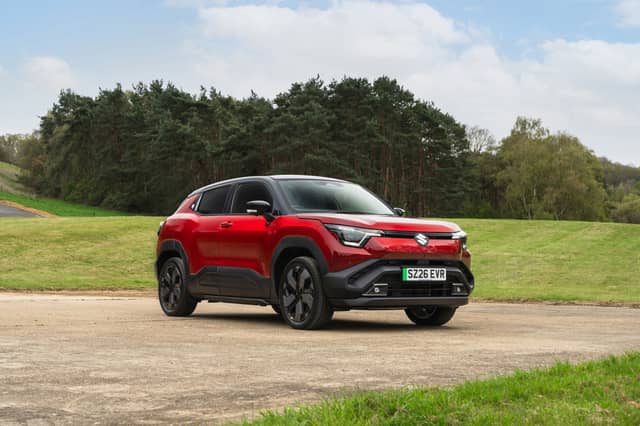

Better Late Than Never: The New e-Vitara Allows Suzuki Finally Join the EV Race
2026 sees the arrival of Suzuki’s first EV in Ireland, its first mass market EV in the guise of the e-Vitara.
Suzuki had a tiny bit of history in the EV space and had a Carry van back in the 70s but in tiny numbers only in Japan. Their electric CV is very slim and, if it were you or me, we’d probably be embarrassed to cite it at all as experience.
I drove my first mass market EV back in 2010 and remember the Nissan Leaf debuted in 2009 so they've been around quite a while. So Suzuki are either very slow or a predictor of the future. I’m saying they are a bit of both.
Everyone has an electric offering now and be it consumer demand or policy persuasion, EVs are just other cars that happen to use electricity - so why did it take Suzuki so long?
Now that it looks like EVs are here to stay they have decided to launch a product to an accepting and mature market. And in doing so, with one of their popular models the Vitara, it gives them enhanced credibility.
Let's start with the looks. It has tough, rugged, Star Wars inspired looks that befits a crossover with 4WD ability. Suzuki are not relying on any retro looking styling here to attract you. It’s bang up to date and modern.
There are muscular wheel arches with black protection, it looks taller than it actually is, the functional grille gets a huge proud Suzuki badge and thankfully Suzuki has resisted the trend of full-width light bars across the front and back so synonymous with all-electric cars.
It doesn't scream all-electric, it’s just a normal car with normal car looks. It is built on a dedicated new platform that will be used for other cars from Toyota and Suzuki as it was a joint venture.
Inside there is a huge leap forward in terms of material quality. There’s also a sophistication not seen before in recent Suzukis and the cabin is a lovely place to be. It builds on the car theme here because Suzuki has resisted the worshiping at the touchscreen altar and given you proper, physical air-con and radio controls.
You get a touchscreen as well and the best welcome graphic I’ve seen in a car to date that gives you a 360 surround view of the car before you set off - impressive and practical.
There's lots of internal passenger space and it feels quite roomy. Suzuki has between the two trims available really kitted this car out with everything you’d expect and made the purchasing choice very simple.
On the road the e-Vitara shines. That interior sophistication is now matched by sophisticated road manners. It's quiet, comfortable and composed. Previous Suzuki models could get out of sorts on undulating R Roads but the e-Vitara absorbed these comfortably.
The inherent physical properties you get with an EV with low centre of gravity obviously plays a big part in delivering this and body roll is very minimal. You get three drive modes and one-pedal driving, which in town is a godsend, and all models, to reflect its off-road DNA, get Snow mode that moderates torque delivery to help reduce wheel slippage.
That 4WD capability is available on the Ultra Trim model with the 61kWh battery only. There's also a Motion trim with a 49kWh batteried entry version that starts at €32,995. For 4WD and that bigger battery that’ll cost you €10k more.
For a lot of urban and city dwellers the Motion, 2WD, 49kWh battery model, that’s good for a claimed 344 kms, will prove the more tempting and practical. The catch is the boot: at 244 litres, it's small for the class.
The smaller boot is a product of giving the back passengers as much space as possible and those rear seats can slide for added capacity - 310 litres with them fully forward. It’s still quite small though.
I didn't get to use it in the wild myself this time but at the initial launch at a dedicated off-road track in Powerscourt where I did drive it, the ability is undeniable. That shouldn't be a surprise because Suzuki has incredible off-road expertise and all it is doing is applying it in a car that uses an electric motor to move it.
In waiting you’d have thought they would have got some things right from the off like charging speed and range. The max charging power on the 400-volt architecture/platform is 70kW peak meaning it will take 45 mins to get from 10% to 80%, which is relatively long for a new EV in 2026, and that’ll give you 202km of additional range. With max intake capacities rising and rising Suzuki could have done better.
It’ll take 9hrs using your 7kW home charger to get from 10% to 100%. Now, range. It has a claimed range of 426km but with my consumption of 18.5kWh/100km that worked out for me to 323kms. I was dismayed that heated seats, steering wheel and mirrors are only fitted on the higher Ultra trim model.
To avoid having to heat the car using valuable battery resources one trick many EV owners have learned is to just heat the seat and steering wheel and these features should be on the lower Motion trim model. Finally, there is no V2L or V2H ability either which is increasingly common and valued.
It’s hard to describe the e-Vitara as a first EV effort from Suzuki but essentially it is. Suzuki has nailed the fundamentals - comfort, refinement, equipment, usability, warranty and off-road capability - but has compromised in precisely the areas where EV technology is moving fastest: charging speed and long-distance efficiency.
Those shortcomings, along with that small boot, take some of the shine off the significant strides Suzuki has made in ride quality and interior ambience with the e-Vitara.