

‘Lucky escape:’ Explosive find in Dundalk 120 years ago!

Peter Kavanagh
Charlie McCarthy, Coast Guards' Houses, has sent me a very interesting report which he found in an edition of the 'Dundalk Democrat' dated January 22, 1898.
Under the heading 'A Lucky Escape' it stated: 'There was something of a sensation in Manisty's, Ltd., the other day! It appears that the Foundry was at full blast and into the capacious maw of the furnace the men were pouring old iron by the ton when they came upon a big iron shell. Manisty's buy iron everywhere and the people that collect it for them go even further afield.
'Often enough they get empty ordinance shells and the men were about to pass this one into the furnace when Mr. James Norton, J.P. one of the (firm's) directors chanced to come along. He looked at the shell and, to his horror, saw that it was apparently a "live" one - that is a shell that had never been exploded. He had it removed and sent to the Artillery Barracks where the gunners recognised it at once. It was a live Lyddite shell.
‘A Lyddite Shell is about the most deadly article outside of a volcano. The British used them in South Africa. Had this particular shell gone into Manisty's furnace, it would have ripped the centre out of Dundalk in about two seconds. There would have been a princely job for the undertaker and for the building trade but it is doubtful if any undertaker within 100 yards of the Market Square would have been competent to undertake the job!'
The Democrat report of the incident is probably a bit exaggerated regarding the effects of the shell being detonated in the furnace but it was likely that a number of the workers near the furnace would have been killed instantly! A Lyddite shell was a large high explosive artillery weapon,mainly fired from naval guns. It got its name from a town in Kent where it was tested and was highly unstable. So much so, that it was withdrawn from use by the time of the Great War 1914-18. How it got to Dundalk without being noticed is a mystery?
Mr. James Norton was a local Magistrate who lived at Wellington Place, now St. Mary's Road, and regularly presided at the Dundalk Petty Sessions. Bassett's Guide, published in 1886, lists a J. Norton, Wellington Place, who is described as a 'Foreman'; presumably he had worked in Manisty's in this capacity before being made a director. There also a P. Norton who is described as an 'ss officer Barrack Street' who may have been a relative.
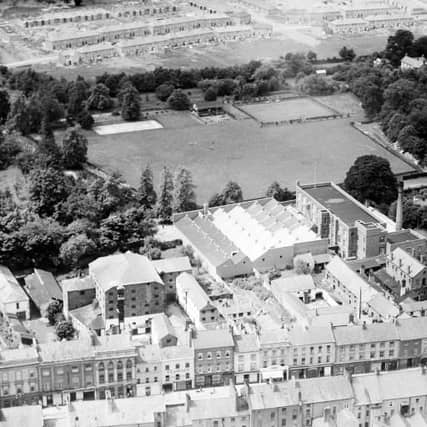
Manisty's Foundry was located off the Market Square, along the Long Walk behind the General Post Office. The main entrance to it was at the side of the old Market House, demolished in the 1960s. A feature of this gateway was an iron plough over the entry which indicated the works manufactured a wide variety of agricultural implements for use all over Ireland in the late 19th and early 20th centuries. It gave much engineering employment in the Town during the period.