

Louth singer Sinead shares her IVF struggles in new song
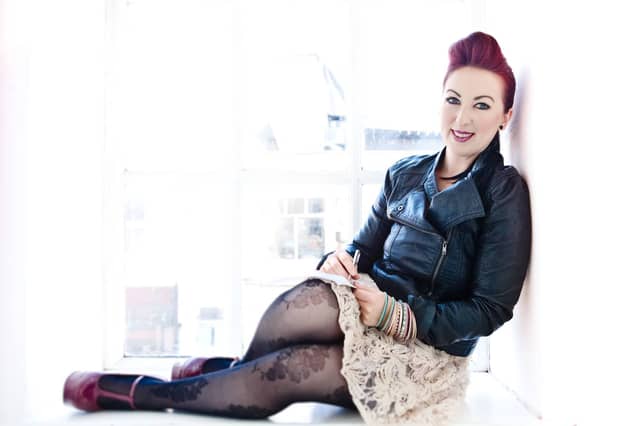

Local singer Sinead McNally has been hitting the headlines of late to talk about her new single “My Silent Night”.
The deeply personal song reveals Sinead’s heartbreak as she and her husband Conor went through five failed rounds of in vitro fertilisation (IVF) over the last four years, attending clinics in Dublin, Hungary and Greece.
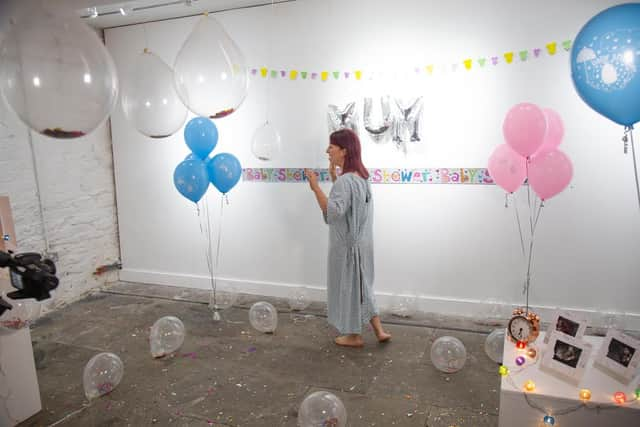
A still from Sinead's video for My Silent Night which was filmed in The Basement Gallery
Speaking to the Dundalk Democrat about her powerful new video filmed in Dundalk’s Basement Gallery, Sinead says:
“It’s very hard to portray what you’re feeling but I think the video director Zoe Kavanagh really got inside my head and was able to tell the story of what I was feeling.
“It’s actually quite simple imagery. I think the song and the visual elements together, like the scans that I had from treatments and all of the needles I had to use, were very effective in getting the message across.
“And then there was the destruction at the end where I used my IVF needles to burst the balloons. That was the whole idea behind the video.”
However, Sinead adds: “There weren’t enough needles to take out all the frustrations I had with IVF! Put it this way, I didn’t have to act in the video.
“But I’m so pleased with how it turned out. I felt like it was such an important subject, I couldn’t do it an injustice.”
The talented singer, who turned 40 this year, is keen to pull the curtain back and talk about one of the last taboo subjects in Ireland - infertility.
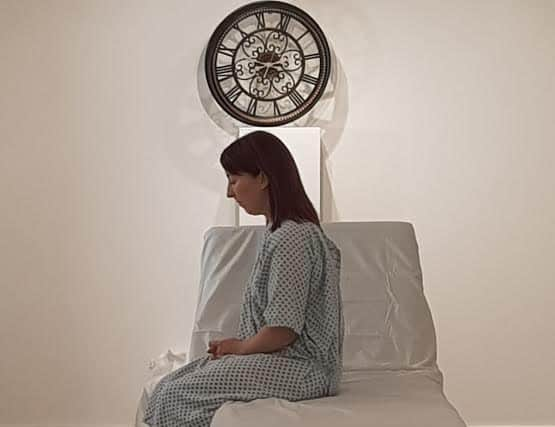
A still from Sinead's video for My Silent Night which portrays how lonely it can be to go through IVF treatments
“My main aim was to normalize IVF and start a conversation around infertility. I think it’s massively important.
“A lot of people are being affected by infertility. Fertility declines in your thirties. We need to make sure that girls are given this information. People presume your fertility is a given here in Ireland. We need to chat more about these issues so that we can make informed choices.”
The primary teacher says she is also “very frustrated” with the lack of services and support provided for women who are going through IVF treatments in Ireland, and their partners.
Currently, Ireland is one of only two EU countries that don’t offer state funding for couples going through IVF treatments.
Whilst a selection of private health insurers provide very limited cover, many Irish couples are left with the added stress of amassing huge piles of debt for IVF and related add-on treatments.
Sinead and her husband Conor have unfortunately had plenty of first-hand experience of these huge IVF bills over the last four years:
“ I’ve had five failed rounds of IVF so far. Some of these treatments have been abroad, in Hungary and Greece. It’s very, very expensive. They tell you it starts at €4,500 but costs soon start to add up with the add-on treatments.
“If you go abroad, even with the flights included in the price, it’s still cheaper than Ireland.
“I found my Irish experience not so positive because of the money aspect. A lot of the treatments that are included abroad are add-on treatments here.”
The Government is making plans to tackle the problem through the Assisted Human Reproduction Bill - however it seems likely due to the complicated matters included in this bill, that Irish couples will be left to struggle without adequate support for years to come.
Sinead feels very strongly about the subject: “I think it’s about educating people and letting people know the details of what happens during IVF. People just don’t understand the process. I’m a primary school teacher, so I just want to help to educate people.
“ The Government is in the process of bringing in the Assisted Human Reproduction Bill, but there are a lot of grey areas.
“I’m aware that this bill will take time to be passed, but I wonder are the Government speaking to people on the ground?
“I’ve written letters to politicians, but I would love an opportunity to sit around in a group, with other people who are going through IVF, and start the conversation. I think if they listened to real stories it would help to make the best bill that we could have for people going through this in the future.”
Sinead also hopes that the AHR bill will help to support women who are experiencing infertility in their workplace:
Watch the video for Sinead McNally's song My Silent Night above
“At the moment, you just have to take unpaid leave from work for all of the appointments. However, employers usually have policies in place for women who are pregnant and need go on GP visits and on maternity leave.
“The hardest thing for me was when my treatments failed and I had to go back into work the next morning as if my whole world wasn’t falling apart. You’re trying to cope but at the same time you need to be in work to earn money for the next cycle of IVF.
“It’s a very stark reminder of the lack of support that is available. IVF is a conveyor belt and companies need to start making allowances for people going through this.”
Despite the struggles, Sinead says she has the energy to continue on with the IVF treatments for another “round or two”.
The singer says she has gained strength through sharing her heartbreak via the medium of her art :
“I had people coming to me saying they hadn’t told anyone about their IVF treatments before and coming up to me and saying ‘Thank you’. The support has been amazing.
“I think with the emotional impact these treatments have on you - it’s a very hard thing to do alone. To open up and speak about it and share my experience, it’s made things a little bit easier.”