

Louth Seniors paired with Kerry in two All-Ireland finals, but only one took place

Inside Track with Joe Carroll
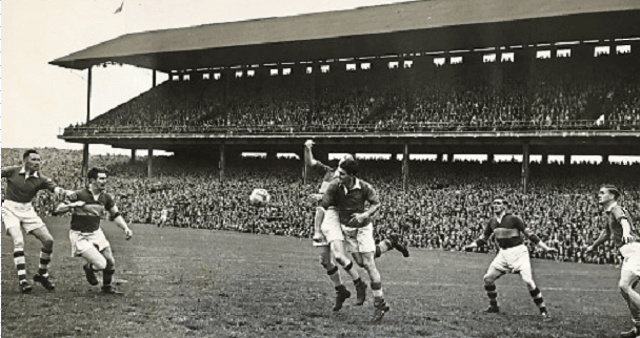
Here we go again, jumping aboard the time machine. This time we’re headed for the 1953 All-Ireland semi-final. The reason?
It’s the last occasion on which Louth and Kerry met in a senior championship tie.
There was a number of meetings before that, along with an intended one that didn’t take place. And in the 70 years since that All-Ireland semi-final the counties have often met in the National League. They renew their rivalry this weekend in the last of the Sam Maguire group 1 matches.
Before concentrating on the ’53 semi-final, let’s take a trip further back to the very early stages of the championship.
For four years after 1887 – the year of the first championship, which ended with Limerick, represented by Commercials, beating Dundalk Young Irelands – teams fielded with 21 players.
The number was then reduced to 17, and that’s how it was until 1913 when the present day 15 was settled upon.
Interestingly, Louth reached an All-Ireland final in each of the three eras, winning it twice with 17, and, in 1957, with 15.
The first meeting of Louth and Kerry took place in the All-Ireland final of 1909. Louth had beaten Kilkenny 2-9 to 0-4 in the Leinster final, and Antrim by 2-13 to 0-15 in the All-Ireland semi-final. Kerry’s win in the penultimate round, by 2-12 to 0-4, came at the expense of Mayo.
The decider was at Jones’s Road (yet to be named Croke Park), and though the crowd of 15,000 was small by today’s standards, it was a record for any code of football in Dublin. Local referee, MF Crowe – who around that time had charge of many Louth senior finals – was the man in the middle.
Drogheda side, Tredaghs, were that year’s Louth champions, and, as such, made up most of the team. But there was also a strong Young Irelands representation, while Ardee and Dundalk Rangers each provided two players.
Kerry won, 1-9 to 0-6, but could there be a final without some kind Louth protest? At the time there were two sets of posts at either end on the field, one through which a point could be scored, the other a goal. Louth claimed Jack Skinner’s shot went through the points posts.
Unlike THAT final of just over a century later, this time the umpires had a say, and were adamant it was a goal.
History repeated itself for the 1910 final; the pairing was the same. Louth were winners over Dublin, 0-3 to no score, in the Leinster final and London after that, while Kerry again overcame Mayo.
This final figures prominently in the record books, for all the wrong reasons – it didn’t take place. A huge crowd was expected, given that it was a repeat of the previous year.
But Kerry got themselves into a tangle with the Great Southern Railway over travel arrangements, seeking the concessions they’d been given twelve months earlier. No, said the GSR, they won’t be so generous.
After GAA general secretary, Luke O’Toole, had got involved, the GSR relented, going some of the way towards meeting Kerry’s demands. But the title-holders wouldn’t budge; they wanted all that had been provided with in 1909, and as a result the game was called off.
What happened over the following weeks showed Louth up in good light. The County Board, led by the man after whom the county’s premier trophy is today named, Joe Ward, said that Louth would be willing to travel to Cork or Tralee to play the game.
And the GAA’s central council also made an offer – they would pay all of Kerry’s expenses.
Kerry had their boots firmly stuck in, and when they continued to refuse to play the game, they were accused of bringing the game into disrepute. A proposal was made at a central council meeting that they be suspended for five years. Joe Ward, however, argued that an effort should be made to get the final played.
It was now into December and at a further meeting of the central council, there was a proposal, supported by Louth, that the game be re-fixed. When Leinster chairman, Dan McCarthy, moved a direct negative, a vote was taken, and this resulted, by seven votes to six, in favour of McCarthy’s amendment.
Joe Ward, who was also a selector with the Louth team, was one of those who abstained. Louth got the walk-over and were declared champions.
Reaching a third All-Ireland final in four years, Louth had a game to play before being declared champions in 1912. It was against Antrim, who had a number of Louth-born players included. Always on top, Louth won by 1-7 to 1-2.
Let’s turn the time machine this way for a while, steering it to 1978. Having beaten Offaly in the Leinster final, Louth under-21s were drawn against a star-studded Kerry team in the All-Ireland semi-final. The game was to be played in Drogheda, but just days prior to the scheduled date, Kerry said they wouldn’t be travelling.
At the time Kerry were preparing for an All-Ireland senior final in which they were due to play out another episode in their epic saga with Dublin.
Because three of their under-21s, Jack O’Shea, Eoin Liston and Sean Walsh, were expected to have a key part to play in that match, they said they wouldn’t be in Drogheda, and wanted the game re-fixed.
County Board chairman, Frank Lynch, who was heavily involved in the preparation of the Louth team, like Joe Ward back in 1910, said Louth would travel to the south to play the game. However, on the Friday night, Croke Park’s central activities committee ruled Kerry out of the competition.
In the strange way that the GAA’s highest order sometimes works, its management committee, while rejecting Kerry’s request for a re-fixture, recommended that the match be played.
The ball was now in Louth’s court; at a special County Board meeting they could vote themselves into the final, or play Kerry at a later date. Taking a lead from their chairman, delegates sportingly chose to have the game played.
October 1st was the date chosen.
Kerry, having beaten Dublin in the senior final in the meantime, brought all their big guns to Drogheda for what materialised as a classic. The crowd was huge – estimates put it at over 12,000 – while gate receipts of £7,941 were a record for the venue.
Louth performed heroically, holding a one-point lead with 10 minutes remaining. It was at this point that both Eugene Judge and Larry Goodman had to retire injured, and this opened the door to Kerry.
Three points for the visitors were followed by a terrific Jack O’Shea goal. Louth claimed three late points to Kerry’s one, not enough to swing the match in their favour. It finished 2-10 to 0-14.