

Joe Carroll chats with Dundalk Cricket Club’s Feargie Boyle
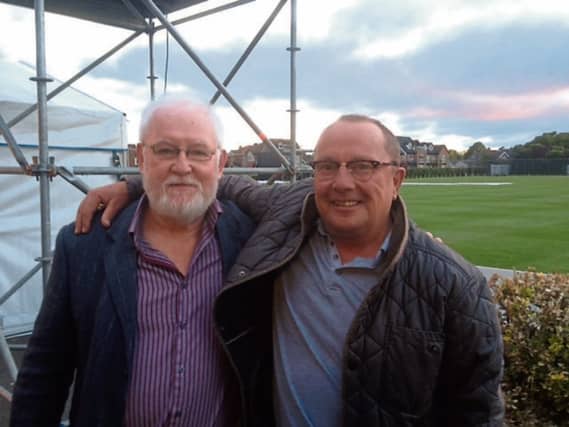

Dundalk and surrounding areas has a rich tradition in cricket-playing, going back to the late 1800s. The current Dundalk club, founded in 2009, has its home ground at Hiney Park on the Carrick Road. It’s vice-chairman, Feargie Boyle, lined out on a number of occasions, but is now fully occupied with his role as an umpire. He answers the questions for us this week.
There was a cricket club in Dundalk as far back at the late 19th century – when did the current one come into existence?
Dundalk CC was formed in the 1860s and the club produced several fine players, including three internationals from the Filgate family from Ardee, one of whom, Charles, also played for Gloucestershire. The other two were Gerard Siggins, known as ‘100 Not Out’, and Eddie Lewis. Two brothers from Mellifont, Collon, Co. Louth, played for Ireland at the end of the 19th century – William Hamilton and Blayney Hamilton. They feature in ’Ireland’s 100 Cricket Greats’. The club in its modern guise was reformed in 2009. It has played in league cricket since 2011 and has won leagues between Division Nine and 11.
Who were the primemovers in setting it up?
Noel Redmond, Louth County Council, was instrumental in organising a meeting in the Sports Centre, Muirhevna Mor, to which he invited people with an interest in cricket. Adrian ‘Adi’ Birrell, Irish Cricket Team Manager, was in attendance. He gave an inspirational address. It was from this meeting that the 2009 club was formed. Pat Kavanagh, President; Gerry Murphy, Chairperson; Brian Morris, Treasurer; and Derek Turner, Secretary, were the main officers. Other committee members included Brendan Watters, Ian McEvoy and Liam ‘Wing Commander’ Gaynor. Andy Williams also played his part on later committees.
Who are now at the helm?
Ian Chong, Chairman; Raheel Qumar, Secretary; Brent Higgenbottom, Fixture Secretary; Andy Pike, Treasurer; Michael Hughes, Children’s Officer; Jiwan Jodhani, Covid Officer; and Michael Mullen, PRO, are the main office-holders. Gerry ‘Ever Clean’ McKeever, Lorcan Kirk and myself form the field committee.
What body do you affiliate to?
Cricket Ireland and Cricket Leinster. There would be up to 100 clubs in the four provinces.
How many nationalities were on your original membership?
We would have had up to 10.
Were they all interested in playing?
Yes, at different levels of cricket.
Was the coursing field at Dromiskin your first venue?
It was indeed.
How did it come about?
The original committee came to an agreement with the Ground Authority.
How many years did you spend there?
Eight.
You’re now at Hiney Park, adjacent to Oriel Park. How does it compare with Dromiskin?
Smaller in size, but it is more accessible to more of our members. The fact that it is in town makes it more appealing to people who might like to give the sport a trial.
How many teams does the club field?
At the moment just one. Though in 2019, Michael Hughes our Children’s Officer, held a very successful Summer Camp with over 20 youngsters, split evenly between girls and boys. Covid has beaten us this year, but Michael has high hopes of having a boys’ team, and perhaps a girls’ team, up and running as early as next year. There seems to be a real interest in the sport, both from locals with no previous connection with the game, and those people now living in the area who come from traditional cricket playing countries. Another Irish victory over England, the current 50 overs ODI World Champions, would stimulate further interest.
In what grade does your play?
Division 11: Leinster Cricket League
What’s the composition of your playing strength?
We have an eclectic mix of nationalities at the moment. We’ve had players from four continents in our club over the years.
How much would it cost a player to fully tog out – sweaters, bat, helmet, etc?
Your term ‘tog out’ brings me back to my childhood years, togging out in the hut at the bottom of the Gaels pitch for Hill Street in those famous games against The Quay, played in the top Gaels pitch. But to answer your question, it would take a couple of hundred euro.
Were you a player yourself?
I played infrequently for a couple of years. I then decided to take up umpiring. It allows me to have the ‘best seat in the house’ – right in middle of the action for up to seven hours.
What fired your interest in the game?
I can remember playing ‘matches’ on the Fair Green organised by Gerry Gover. I can remember getting up at 5am to listen to ‘Ball by Ball’ coverage on BBC radio of England vs Austalia. It was a perfect preparation for a day’s schooling in the CBS.
Would you have travelled for any of the Tests or One-Day Internationals?
I have attended a few of them. The one that stands out is the Ireland vs England August 2013 clash in which Eoin Morgan captained England against Ireland. Another memorable game was The Royal London 50 overs final at Lords, September 2015, in which Gloucestershire surprised Surrey.
Your favourite grounds?
Lords for Tests and The Hills outside Skerries non-Test.
And player?
John Mooney, one of Ireland’s finest. And who couldn’t have admired the great Viv Richards, West Indies?
You’re now an umpire?
I passed my qualifying exam and was given a schedule of games. I am a member LCUSA (Umpires and Scorers), I started in the lower divisions, went through the Boundary Assessment process and was given games in the higher divisions. Each game brings its own pressure and outcomes. After all, they can last for up to seven hours. One game that springs to mind was a midweek game in Rush in which 400 plus runs were scored. Incidentally, my fellow umpire that evening was Michael Mullen, our PRO (cutout). A proud evening for Dundalk CC.
A bit like a poacher turning gamekeeper, would you agree? – you’d have come to some referees’ attention in your days as a Gaelic footballer with Gaels and St. Joseph’s.
Absolutely, but it wasn’t just in Gaelic games that I had that ‘problem’. The upside to getting sent off so often is that there was less wear and tear on my load-bearing hinges for later in life.
Football referees’ decisions are often questioned during play – does that happen in cricket?
Yes, to a certain extent. Players, especially bowlers, will ask you for a reason for your decision. A quiet explanation usually suffices. If it goes any further you can call on the Captain to talk to his player. That works, and if it doesn’t you have Law 42 (Players’ Conduct) to fall back on. This allows you and your colleague to decide if an incident merits a level 1, 2, 3 or 4 sanction. A level 4 is where you call on the Captain to formally send off a player. To my knowledge this has not happened in Ireland. Still, it is nice to have it up your sleeve.
Can you be influenced by these impassioned shouts of ‘Howzat’?
Indeed you can; but, with experience, you learn to wait that fraction of a second and get your reply right, hopefully. No umpire gets it right all the time.
Ireland scored that famous win over England, World Cup 50 overs ODI Champions, four day ago – can you see the national team being in the running for a world title in the near future?
It is possible. It is going to take a huge commitment for that to happen. But Cricket Ireland has invested in the transition that the team is currently going through. Tagann ciall le haois dar ndoigh.
Do you think your game gets a fair crack of the whip from the media in terms of coverage?
We are always delighted to get good positive coverage. It is what our club feeds off.
What other sports interest have you?
Gaelic games have always been high on list of interests. My father, Tom Boyle, was always involved with GAA teams, both in his native Darver and with the county team. He was involved with The Unknowns in 1925, Darver Young Irelands 1938, Darver Volunteers 1956 and St. Joseph’s in 1971. He was part of the background team for Louth in the All-Ireland year of 1957.
Your father’s remembered in verse?
Yes, and it goes: ‘There’s Mussolini, Chamberlin and Hitler of renown,
Though leaders rare they can’t compare with bold Tom from Walterstown,
A power in the Council Hall, his word is law ‘tis said,
He knows the letters of the game from A to Z’
(Darver Young Irelands victory song 1938 Louth Junior Championship)