

Inside Track: Humphrey’s book makes a pitch for the best on Gaelic sport

Treasure Island was the last book I read from front to back. I had no choice – it was part of the school curriculum, and it was a long time ago.
Hardbacks and paperbacks, mostly sports biographies, have been scanned since, but nothing more. Give me a newspaper any day of the week.
That might surprise those who are aware that I co-wrote The History of Dundalk Stadium, published in 2019. Mine was the greyhound part. I’d have read it over and over again, but only when it was on the screen before being sent on to editor Fiona.
I’d be afraid to read it in book form in case I came across errors.
John Kirwan handled the horse racing section, and I often refer to it. John’s records are meticulous, and you can take it for granted all that appears is spot-on.
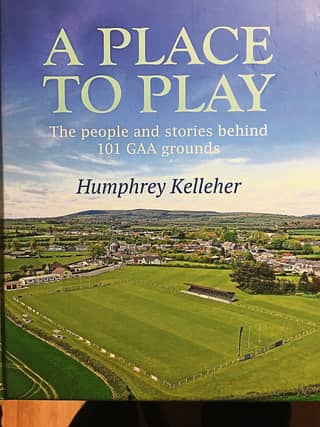
I’m going to break a habit of a near lifetime in the next few weeks by completing the reading of A Place To Play. This is well-known author, Humphrey Kelleher’s latest tome.
It has the background and a picture of 101 GAA grounds in Ireland, along with information on those after whom the grounds are named. There’s also a timeline, telling of the significant years in the history of the ground-owning clubs and their counties.
It’s a beautiful laid-out book, the first-ever on the subject, and is worth every penny of the €25 purchase price. GAA followers who didn’t get it in their Christmas stocking should skip down to the nearest book shop or search online.
There’s an over-view of all the grounds, and speaking in a radio interview, the author said this was achieved by him travelling the length and breadth of the country armed with a drone. Some feat.
I provided some of the information on the three Louth grounds featured in the book, and am listed in the acknowledgements along with Séamus O’Hanlon, Dowdallhill’s Gerry Kerley and long-time hurling enthusiast, Damien Callan.
There’s also a mention for my ‘bricks-and-mortar’, Fiona, who, over the years, has been a genius in getting to the bottom of the problem whenever anything goes wrong with the machine from which these words are spluttering. (To people who only speak ordinary English, let me say that ‘bricks and mortar’ is daughter.)
The three Louth grounds featured are St Brigid’s, St Mary’s in Ardee and the Drogheda Gaelic Grounds. We’re told that the latter was the first to be opened, in 1926; Mary’s Páirc Mhuire came in 1952, and it was seven years after that when the Dowdallshill club opened its gates for the first time.
It’s pleasing to see that the ‘Hill’s legendary figure, Owenie Rogers, appears in a photo along with another club stalwart, Paddy McCourt. The lads are seen inspecting the sod before the opening game, Louth against Cavan.
While on radio, author Kelleher made reference to the Cloone grounds in Leitrim, saying, more or less, it was remotely located, but was beautifully-appointed.
That did it for me. I’m getting to Page 38 to see if there’s any mention of the manner in which the pitch was presented for a game 30 years ago. I didn’t really expect that there would be, but it did say that in 2020, “While (the) ground is closed due to Covid pandemic, silage is saved from the overgrown pitch to sell as ‘top quality feed for winter’.”
At the back of my mind was the day Declan Smyth brought his Louth team to the venue for a crucial Division Two match in the 1993/’94 National League with Leitrim. Louth had beaten Galway (in Tuam) in the opening round, and followed with wins over Laois, Fermanagh and Roscommon, the only defeat in the first five games coming in the Drogheda tie with Meath. The team was going well.
The team was going well; what could go wrong at Cloone, we thought? Well, when did a Louth team ever play a competitive match on a field with rushes growing around the middle of it? It was like that for this 6th round tie.
We don’t know if this discommoded the two Louth players in that part of the pitch, Gerry Curran and Ken Reilly, but in the end Louth were down by four points, beaten 0-9 to 0-5, all of Louth’s scorers coming from Colin Kelly.
(This wasn’t the first time for the then-Newtown Blues clubman to achieve this feat; but rather than say when it had previously happened, Inside Track plans to delve into the subject at a later stage, highlighting exceptional scoring performances by Louth players.)
Can what happened in 1974 be labelled the Conspiracy of Cloone, to be followed years later by the Hold-Up at Headquarters?
When Louth next made to the Wild Rose County (or O’Rourke County, if you like), the game was at Carrick-on-Shannon.
Myself and my mate, PJ, encountered Declan Darcy – one of only two men to captain a Connacht Championship-winning Leitrim senior team and who would later play with Dublin before joining a Jim Gavin management team – and, as they say, got on to him about that day in Cloone.
Was the St Mary’s Park groundsman told to leave the rushes as they were? Had the Leitrim team trained there leading up to the game? One of his county’s best said neither yes nor no, just smiled.
Back to Kelleher’s book: It quotes a sports-writer who said of St Mary’s Park: “A lovely, almost quaint ground”.
All together now, anyone who made that trip to the West: That’s a nice way of putting it.
But let’s be fair to St Mary’s: unlike the three featured Louth grounds it has floodlights. The Leitrim championship came the club’s way in 1972, and team captain was Jim Sheridan, who, two years later, would lead Finn Harps to FAI Cup glory.
To finish, when Humphrey Kelleher took his photo of Dowdallshill’s St Brigid Park, the area between the impressive club centre and the wall behind the road goals was covered in rough gravel.
It’s not like that any more. The place has been given a beautiful coat of tarmac, which shows that while the ‘Hill might not be going so well on the football field, off it the club continues to make steady progress.
There was a recovery after that, with a win in the final match over Cork at Drogheda.