

Heartbroken Dundalk mum looks for answers after son's death


‘You don't know what to do, you don't know who to call’
The photograph is there as you enter Sinead Browne’s kitchen at her home in Toberona. It is perched with care on the sideboard facing the door. It is a picture of her son Ian, who passed away on March 14 this year.
Barely six weeks on from her 25-year-old son’s funeral, the grief is raw and the tears come easily.
Ian died by suicide.
As Sinead sits at the table, she gathers herself and then begins to speak about the events which led up to Ian’s death. In particular, the 48 hours beforehand and how, despite seeking help on two occasions in that two day period, Ian was unable to access the psychiatric help he needed.
“On the Tuesday morning (March 12) he sat here and said he wanted to end his life,” begins Sinead. “He was tired - not physically - he was mentally and emotionally tired.
“He sat here and he said I more or less couldn’t help him - I wasn’t a psychiatrist and I didn't have all the answers.”
Ian departed the house that day to see his father.
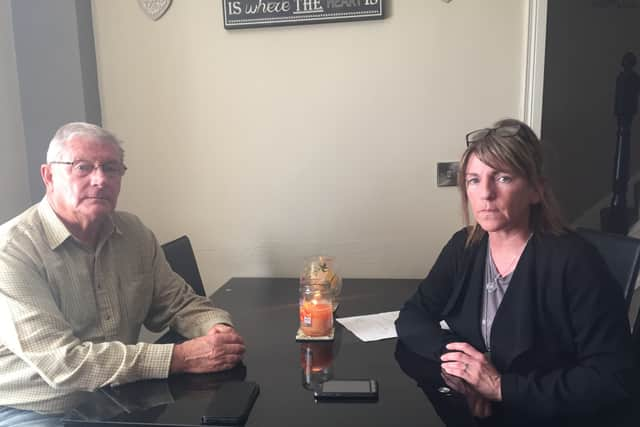
SINEAD BROWNE WITH HER FATHER FRA BROWNE
“He went himself - he didn't want anyone else to go with him. He went through the whole procedure to see a doctor.
“He gave a full statement and was then told that night to go home and come back in three weeks. They said there were traces of benzos (benzodiazepine - an anxiety-reducing sedative) in his system, which, I’m not actually sure, it could have been anything up to a sleeping tablet. They don't deal with that as they put it down as drug misuse.”
The current policy is not to admit a person with mental health issues and who may be suspected of drug or substance misuse.

THE LATE IAN BROWNE
“He just said that it was a waste of time,” Sinead recalls. “He was there the whole day. He said he was going to get up early the next morning, go to the GP, get a letter and go again (to the Lourdes).
“He did”, Sinead nods. “He got up, got showered and left the house at about half eight, went to the GP, got his referral letter which stated everything that he was thinking. Everything was on it.”
Ian’s GP had written on the letter that Ian was “actively suicidal and an imminent threat”, the letter added: “I would be grateful if you could reassess and admit”.
Sinead continues: “He did the procedure again - went back up to Drogheda, back to the Lourdes hospital again to see a different doctor and to be told the same thing again.” Sinead shakes her head.
Once again Ian returned home that evening from Drogheda.
“He said it was a waste of 48 hours. We sat for a wee bit and talked through his day and he went upstairs and just lay on the bed. We were still trying to figure out what to do. Who do you ring?”
The following morning, Sinead says she was still at a profound loss as to what to do next.
“He got up Thursday morning and he was just very calm and he came down had his cup of tea and went back upstairs and had a shower and I just went to walk the dog. I came back and he asked me was I not going to work and I said I'll go in a wee while.
“We still didn’t know what to do, so I left the house. I spoke to him just before I went into work and then I rang his GP after that and see what could I do. The GP said ‘was he not kept?’ and I said ‘no, he was sent back’ and again told to come back in so many weeks.
“I tried contacting him (Ian) a couple of times and couldn’t get him. His dad tired contacting him, so he (his dad) rang me and said he couldn’t get him at all. So I just left (work) and went down the road.
“So as I came in the back door his dog was in the sitting room and the door was closed, which would never happen and I came into the hall and my dog was there I put my bag down and I went to go up the stairs...”
Sinead's voice falters, but does not break, as she talks about then finding Ian’s body.
As she composes herself, Sinead struggles to make sense of it all.
“Not once, but twice, on two full days (he sought help). Going through all that, in the frame of mind he was in and they still didn't take him in.
“You don't know what to do, you don't know who to call. You try looking up things and everything is ‘phone someone’ and Ian did all those things. He told us, he went to a GP, he went to a counsellor, he did everything. What else was he to do? It shouldn't happen.
“All I can say is he wanted to give it the last shot to see who was going to help, because he said he was tired. He said he couldn’t please anybody, or help anybody and he tried to get help for himself and couldn’t get it.”
Ian’s grandfather Fra Browne adds that Ian had made contact with the HSE during that 48 hour period.
“Even at the end of the day he emailed the health board, in his total frustration, to highlight his case and he said ‘thanks for nothing, I’ve done everything you’ve asked me to do, you’ve closed the door on me, I needed help’.”
Fra uses the same words again, which were spoken by the priest during the homily at Ian’s funeral.
“He said the doors were closed (to (Ian), instead of opening them.”
Anyone impacted by these issues can contact The Samaritans on 116 123, Pieta House on 1800 247 247, Aware on 1800 804 848 or Childline on 1800 666 666.