

Europe the aim as Ainscough takes the reins at Dundalk
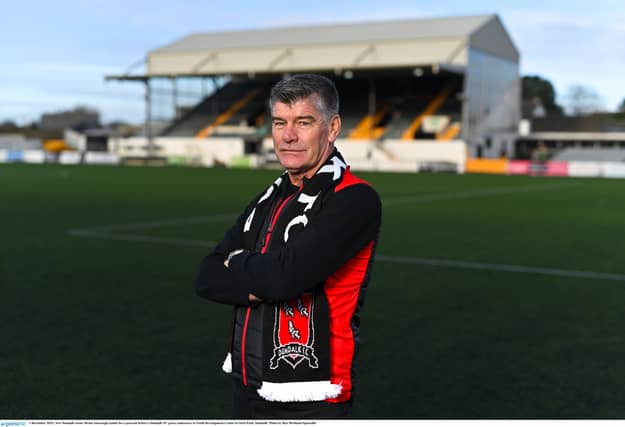

A swift return to the European footballing circuit tops the early agenda for new Dundalk FC owner Brian Ainscough, who last week completed a 100% takeover at Oriel Park.
The ex-Kerry CEO acquired full control of The Lilywhites from Andy Connolly, plus STATSports duo Sean O’Connor and Alan Clarke, who spent the last two years in the boardroom.
A fifth-place finish in the SSE Airtricity League in the season just gone means – for the second time in three years – there will be no European football at Oriel next summer.
Speaking at his unveiling to the media in the Youth Development Centre (YDC) on Friday afternoon, Ainscough stated:
“The first-team is the most important thing right now, and making sure that we get back to Europe, that’s the goal. I think that’s the goal of every fan in Dundalk or anyone that’s associated with Dundalk – they expect that from over the last 10 years.
“That’s where they belong. It’s amazing that they felt like coming fifth is not a great season, which I think is great, because that’s why I’m here, because it’s a good club.
“It’s one of the biggest clubs and that’s why I want to work with it. Beyond that, is to sustain ourselves and be one of the best professional clubs in Ireland. With that goes infrastructure, academy and attracting the best players, best young players to come here.
“I didn’t know exactly that we had three or four kids that are in the first-team squad,” he added. “For me, it’s really important in the community that we do have five or six locals playing in your club on a consistent basis. We got the taste of that in Kerry last year.
“I think we had 18 out of 22 from Kerry, which was amazing. I don’t see the reason that we can’t have one third of our squad being all the way locals – that would be something. There’s no reason to run an academy if you’re not going to have local kids coming through.”
Ainscough confirmed that he has already been speaking with potential shareholders to elevate what promises to be a challenging venture for the Cabra native, who believes a return to European football is very much feasible within the club’s budget constraints.
“It’s definitely (feasible) with the current budget,” he said. “We expect to get to Europe. We talk about infrastructure, there’s a few other things that also have to be taken care of in the club. When we’re talking about the whole picture of the club and you’re talking to your investors, you’re talking about Oriel Park, academy – there’s a couple of different layers. I don’t think all our investment that we seek is going to go into just the first-team.
“I’d imagine that they’d want to see the overall view of what we do. That was my course this week of finding out exactly, more so ideas, so I can go back to my investors and tell them what’s really going on on the ground here. It was an education this whole week.”
Head coach Stephen O’Donnell brought The Lilywhites back into Europe in his first season in charge, but missed out by only two points in his second campaign at Oriel.
“He’s a young guy, has had a terrific career in the short-term,” praised Ainscough.
“It’s a blip that he came in number five in the league. His CV goes up against anybody right now in the sense of a young coach. I think he has a great future. I’ve talked to a lot of people about him, from (Kerry sporting director) Billy Dennehy who knows him and was a player with him and what type of man he is, so I’m delighted that he’s part of Dundalk.”
US-based Ainscough is expected to succeed O’Connor as chairman in the Oriel boardroom, but has visions of hiring a CEO to oversee the club’s day-to-day running.
A lucrative shirt sponsorship has already been secured, with designs for new home and away jerseys – manufactured by Playr-Fit – potentially going on sale before Christmas.
His portfolio also includes youth player development from his time as Boston Bolts CEO, while ground improvements and optimising attendances formed part of his Kerry remit.
“The population is getting bigger over here and you see all the attendances going up. We talk about attendance. Dundalk is what, 40,000 people, and it gets nearly 3,000 people to a game. There’s nobody gets that around the country percentage wise. If Cork had it, they’d have 20,000 people at their games.
“The fan club, that’s what gets me off my seat. You walk down the street, the Dundalk people are fantastic. I walked up here today and I got stopped about six times by people that have been fans of this club for 50 years.”