

Dundalk IT-Queen’s partnership plans examined by Oireachtas committee

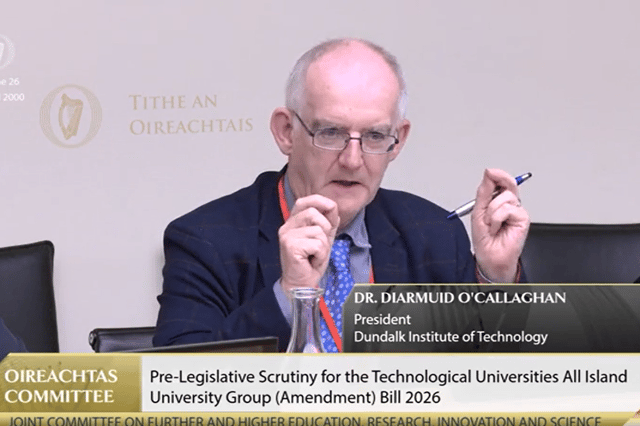

Committee hears details of proposed Dundalk University College partnership
Dundalk Institute of Technology's proposed partnership with Queen’s University Belfast came under scrutiny at an Oireachtas committee hearing last week, as legislators examined draft legislation that would enable the creation of a new university college in Dundalk.
The proposal forms part of plans for an all-island higher education partnership, with DkIT leaders telling the committee the move would support the institute’s future development and strengthen educational and research opportunities across the north-east and border region.
Appearing before the Joint Oireachtas Committee on Further and Higher Education, DkIT President Dr Diarmuid O’Callaghan outlined how proposed legislation would pave the way for the creation of a new university college in Dundalk in strategic partnership with Queen’s University Belfast.
The proposal would see DkIT evolve into a legally independent university college while retaining its regional mission and governance within the State. Under the model, students studying in Dundalk would graduate with Queen’s University degrees while remaining based on the DkIT campus.
Dr O’Callaghan told the committee that DkIT’s ambitions could not be fully realised within its current institute of technology designation.
“DkIT could not realise its ambitions and vision as an institute of technology,” he said. “To continue in this form would consign it to the margins of the cross-Border and shared island agenda as opposed to its rightful place as a central player and major contributor.”
The proposed partnership is expected to have significant implications for the institute’s 6,500 students and the 1,300 graduates who enter the workforce each year.
DkIT leaders argued that university college status would strengthen the institution’s ability to attract students, expand research activity and recruit specialist academic staff, while enhancing opportunities for learners across the north-east and border region.
Department of Further and Higher Education, Research, Innovation and Science officials present before the committee said that students would continue to access Irish supports such as SUSI grants while benefiting from Queen’s internationally recognised academic framework.
The hearing also heard that DkIT’s role in widening participation and access to higher education would remain central to its mission. The institute would retain its own awarding powers in areas including apprenticeships and other programmes aligned with regional skills needs.
Dr O’Callaghan said the proposal had generated widespread enthusiasm since it was first announced last November.
“We have consulted widely with key stakeholders in the region, including our social partners,” he said. “It has captured the imagination of the region – parents, schools, guidance counsellors, employers, public bodies and the general public.”
Vice-President for Strategic Planning, Communications and Development Irene McCausland highlighted DkIT’s deep roots in the border region and its long history of cross-border collaboration.
“This initiative with Queen’s University is a natural fit,” Ms McCausland told TDs.
Committee members repeatedly highlighted the significance of the project for County Louth and the wider north-east.
The partnership would create what supporters describe as a university campus of international standing in Dundalk, strengthening the region’s ability to retain talent and attract investment.
Dr Sheila Flanagan, DkIT’s Vice-President for Academic Affairs and Registrar, warned that many students who leave the region for higher education do not return.
“Our experience shows that once students leave either Northern Ireland or the area around Dundalk and go to, for example, the UK for higher education, they do not come back,” she said.
“This project will provide that opportunity for students to be educated and receive a university degree [within the north-east.]”
Currently around 4% of DkIT students travel daily from Northern Ireland to attend classes in Dundalk, with college leaders believing that figure could grow substantially under the new model.
A major theme throughout the committee hearing was the potential for DkIT to become a leading innovation hub for the island.
Alongside the educational partnership, DkIT and Queen’s have jointly submitted plans under the Shared Island Initiative for a major cross-border innovation programme centred on Dundalk.
The proposal focuses on key growth sectors including artificial intelligence, digital innovation, health technologies, sustainability and climate resilience.
Queen’s University Belfast President Professor Sir Ian Greer described the initiative as an opportunity to create “the first truly integrated all-island university group”.
He said the partnership would combine Queen’s global research reputation with DkIT’s strong regional connections and industry links.
Committee Chair and Louth TD Erin McGreehan praised the collaboration, describing it as a historic development for Dundalk, the north-east and the island as a whole.
“The people I speak to in County Louth and throughout the area understand how big this is for the region and for the island,” she said.