

How Square Restaurant is helping shape Dundalk’s changing food scene

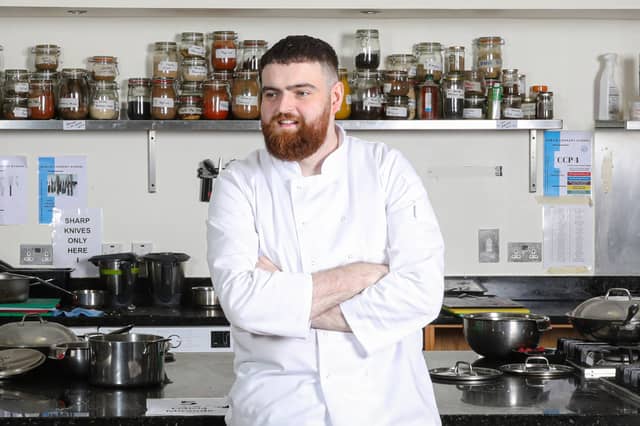

Conor Halpenny of the Square Restaurant in Dundalk spoke of the importance of local ingredients
Dundalk’s food scene has changed dramatically in recent years, according to Square head chef Conor Halpenny, who believes the North East is now home to a growing appetite for adventurous, locally produced food.
Conor says the decision to establish the highly successful restaurant in Dundalk was driven by a sense that the town was already developing into a vibrant destination for people who cared about food and drink.
Six years on, that instinct has been proved right.
“When we opened, you probably wouldn’t have believed that we’d sell tartare and ceviche and woodcock and pheasants and pigeon,” he said.
“But there is a clientele out there for that.”
Square has deliberately developed a menu designed to offer something for different tastes, while still allowing the kitchen to explore more unusual ingredients and dishes.
“We have burgers on, we just do burgers our way. We have fried chicken on, we just do it our way,” Conor explained.
“We try and have a menu that has something for everybody on it, but we can still sell dishes that you wouldn’t believe we’d sell.”
He points to the growth of food and drink groups and events across the region as evidence of an increasingly engaged audience, including the Dundalk Food and Drink Society, the Dundalk Wine Circle and Boyne Valley Flavours.
“There’s a real passion for food in the North East which maybe wasn’t there in previous years,” he said.
That changing attitude is also reflected in the way Square approaches its ingredients.
The restaurant has built relationships with a number of local producers, including Riverside Farm, Ballymakenny Farm and Coole Farm in Ardee, with the availability of seasonal produce often helping to shape what appears on the menu.
Being able to speak directly with growers is an important part of that relationship for Conor.
“I’m planning menus in regards to what people have coming out of the ground in three months’ time,” he said. “And that’s the best way to do it for me.”
He believes chefs can sometimes make their own lives more difficult by ignoring seasonality.
“When chefs use stuff that’s in season, their job is cut in half,” he said.
“We’re getting organic white turnips at the minute, and they’re beautifully sweet and they’re delicious. All I have on them is a bit of salt. I don’t have to do anything else to them.”
By contrast, he says, ingredients that are out of season can require much more work to achieve the same result.
The importance of local ingredients will be highlighted further when Square takes part in Boyne Valley Bites Dining Week, running from October 9 to 18.
Conor says the restaurant already incorporates many of those principles into its normal menu, and has been impressed with the range of local ingredients available.
“There’s incredible producers in the Boyne Valley.
“I'm very blessed to have some amazing growers around us that we can use and sort of change the menu regarding what they have in season and what they have to offer me that week.”
The wider question of what constitutes “Irish food” is one Conor believes is still being answered.
He rejects the old image of Irish cooking as being confined to traditional staples, arguing that the country’s food culture has evolved considerably.
“I think we're very lucky in a sense that we have so many cultural influences from all around the world.
"I couldn't pinpoint what Irish food is because I think that's a question that we could sit here for four hours discussing, but I think it's simple, simple ingredients.
"Really good ingredients cooked simply.
“I think we are definitely finding our feet in what is the definition of that,” he said.
“I think we will eventually go, ‘This is Irish food’, but I think we have a few more years to get there until we get a definite answer to that. But it's exciting to be part of the journey.”
He also believes the country’s food story should not be reduced to Dublin.
While acknowledging the strength of the capital’s restaurant scene, Conor says there is now an opportunity to showcase talent and produce from across the island.
“When I started cooking 16 years ago, I would have had to go to Dublin to learn,” he said.
“But now, a young chef growing up in any corner of the country has an amazing restaurant nearly on the doorstep.”
He describes the current Irish food scene as “super exciting”, with chefs returning from abroad to open restaurants and producers gaining greater recognition.
For independent restaurants, however, the current environment remains challenging.
He says diners may see a €44 steak on a menu and consider it expensive, but, “I think people don't realize the actual hardship of buying that piece of beef to put on your plate when they're looking at a steak at €44 they're like ‘€44 that's very expensive,’ but it could be €16-€17 before I even cook it.
Despite those pressures, he says he is grateful that customers continue to support independent restaurants.
“I feel very grateful for people spending their money with us because I know how hard it is to earn it right now,” he said.
“It’s a lovely privilege for me to be able to feed people with their [producers] food,” he said.
He also warns that the survival of independent restaurants matters to the wider food ecosystem.
“I can’t do my job without them,” he said of the smaller producers and suppliers who underpin his kitchen.
“We don’t want these big corporate companies taking over and these large-scale companies putting all the smaller businesses out.
"We don’t want that, because we will lose our food identity, which we have worked so hard to build up.”