

Donal’s latest book looks at Louth and the revolution era
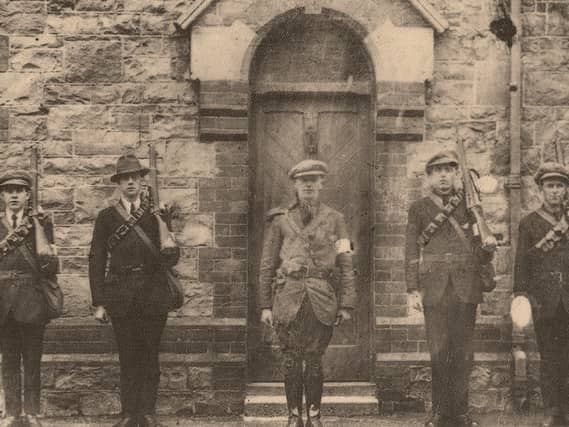

Local historian Donal Hall talks about a remarkable period in history for the area
Louth: The Irish Revolution 1912-23 by local historian and author Donal Hall will be launched in the Town Hall Dundalk this (Wednesday April 3) at 7pm.
The book tells, for the first time, the story of Louth in the years of the Irish Revolution in a single comprehensive narrative.
Donal Hall explains that he has long been fascinated with the period.
“My father’s people were in the republican movement at that time, my mother’s were fighting in the British army in France.
“I grew up with stories from both sides, and never felt conflicted between them. Both sides did their duty as they saw it.”
Donal maintains that an understanding of the Irish Revolution can only be achieved in the context of the Great War.
“At least three thousand men from Co Louth fought in the war, and over eight hundred were killed. During the War of Independence, the IRA’s strength in Louth did not exceed one thousand and of those, seven were killed. The Great War directly affected many more people than the Irish Revolution.”
Drawing on a wide range of sources, the book delves deep into the background of that period, revealing a county with a strong industrial and agricultural base but also with a declining population, large-scale unemployment, extensive poverty and one of the few places on the east coast where the Irish language survived.
The book also reveals that up to 1916, most people in Louth would have been content with a political settlement that maintained a strong connection with Britain.
“Home Rule would have satisfied the overwhelming majority of people. Even Sinn Féin up to 1917 promoted a dual monarchy with Britain.
“When the Home Rule Act Bill got the Royal Assent in September 1914, there were parades and bonfires in celebration all over the county. Separatism, a complete break with Britain, was the dream of an insignificant minority.”
Although Irish Volunteers from Louth mobilised and reached the outskirts of Dublin in 1916, the militancy spurred by aftermath of Easter Rising faded, and during the War of Independence the IRA in Louth was criticised for its apparent inactivity. However, this book shows that IRA activity followed a pattern common to most of the country and was at a level comparable to the neighbouring counties of Meath, Monaghan, Down and Armagh.
“Internal IRA reports and private narratives held in archives reveal the deep frustration of militant activists at the difficulty in organising activities, particularly in south Louth. In 1919/20 there were raids for guns and attacks on trains enforcing the Belfast Boycott. Craig’s shop in Clanbrassil Street, Dundalk was burned in August 1920 in retaliation for attacks on Catholics in the north, and four employees who were living in the shop were killed.
“This was a purely sectarian attack, and local leadership of the IRA disassociated itself from it. By early 1921 there was a marked increase in IRA attacks on people and property, and a flying column had been mobilised in north Louth. Politically, Sinn Féin was firmly in control of Louth, and all local government bodies withdrew recognition of the British administration.”
After the Truce of 1921, there followed the split on the Treaty but Frank Aiken, commanding the 4th Northern Division of the IRA in Dundalk, tried to remain neutral.
“The Dundalk Brigade led by Monaghan man Patrick McKenna openly supported the anti-Treaty side. His presence in Dundalk was a major irritant to Eoin O’Duffy, Chief of Staff of the National Army.
“He ordered Aiken to move against McKenna and when Aiken refused, General Dan Hogan leading the 5th Northern Division from Monaghan invaded Louth. With this, Aiken was forced on to the anti-Treaty side. “
There followed nine months of street-fighting between republicans and government troops for control of Louth; ambushes, assassinations, executions and house burnings were common.”
Anti-treaty
Donal adds: “All deaths in the Civil War were lamentable. In Louth fourteen National Army soldiers were killed in action and fifteen republicans died, six of whom were executed in Dundalk. At the end of the Civil War, the IRA in Louth was broken and the anti-Treaty side had failed to attract the support of the majority of people.
“There was overwhelming support for political parties that were prepared to work the Treaty – this was as true after the Civil War as it was before. Ironically Aiken, the man who was the most reluctant of all to take sides, ended up as Chief of Staff of the anti-Treaty IRA, and with superb political skills that belied his age, he was only 25 in 1923, was able to steer the IRA towards peace without splitting the organisation.”
With peace, Louth emerged from a decade of instability more politically divided than ever, cut off by partition from its natural hinterland in Ulster and facing an uncertain future.