

Daughter of Dundalk Covid-19 victim opens up about her dad's loss, his life and unanswered questions


Interview
Emma Duffy arrived too late.
At 9.10pm on Saturday May 2 her dad, Oliver Crewe - known to many as ‘Ollie’ or ‘the Quiet Man’ - drew his last breath.
A small mercy for Emma is that her sister Elaine was watching from outside the window of their dad’s room at Dealgan House Nursing Home in Toberona at that moment.
He died of Covid-19 after battling it for 16 days in the local nursing home.
For days beforehand Oliver’s family had taken it in turns to stand vigil outside his window at Dealgan House as he gradually slipped away from them. He was 73.
“On the 16th of April Dad was feeling unwell,” begins Emma, speaking to the Democrat just days after her father’s funeral. “We saw him on a Facetime call and mam said ‘he’s not right’. He got tested on the Friday - I think the Friday was the day the RCSI Hospital Group entered the building as well. The tests came back positive on Saturday. And then from that he died exactly two weeks later. He died on the Saturday at around ten past nine at night.”
The last time Emma spent time with her dad was on March 13, her brother Paul was watching Cheltenham with him on the television.
“They were at the funeral (the carers). They were at our house. We’ve talked to them since. We adore the carers. Dad got great care when we were there. It was like a home from home. I really think people need to understand that people are not giving out about the carers.”
But she still has niggling questions. Doubts about it all. They are clearly eating away at her right now.
“And maybe there’s nothing to give out about from management. I don’t know. I wasn’t there. To be honest it’s very surreal at the moment, because he would not have liked to have been in a nursing home. I’m very grateful that his short term memory was such that he didn’t really realise.”
Oliver Crewe only went into Dealgan House on January 26 of this year. He had, in that coldly clinical phrase which has become all-too common these days - ‘underlying conditions’. He had Parkinson’s and Alzheimers.
In September 2019 Oliver had gone into Our Lady of Lourdes Hospital in Drogheda and from there he was moved on to the step down clinic in the Louth Hospital here in Dundalk.
Emma says the family battled to get him into Dealgan House.
“I said to my family, ‘Dad could have 10, 15 more years, who knows’, because 73 is young. So we really wanted to get him into somewhere and it (Dealgan) was the one that everyone spoke so highly of, and I speak highly of it myself and I think some of the commentary about Dealgan at the moment, it’s as if people are giving out about the staff in there and the carers and the nurses, and 100 percent absolutely not, that’s actually quite frustrating for us, because I adore the carers and I can name them by name. I know them.”
One day, a couple of weeks back, as her dad was battling the deadly virus, Emma went across the road from Dealgan House to St Joseph’s Church. The virus had already decimated Dealgan by this stage. She saw two carers on the steps outside the church. She locked eyes with them. They all started crying.
“I think it’s unfair for people to be thinking that there’s any sort of backlash to the carers that are there. The staff numbers weren’t there. We could see it ourselves. We were going up to the window to see Dad and the girls who we knew were off - half of the staff were wiped out. They just didn’t have the numbers there to look after them in normal times and then they were dealing with an outbreak of Covid.”
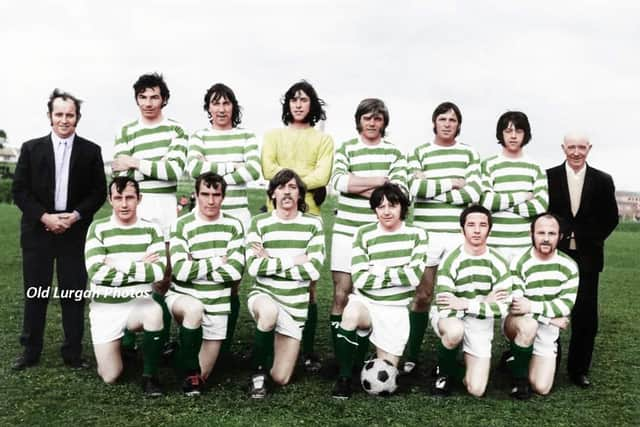
PICTURED: Oliver, back row, third from the left with the "killer sideburns", as Emma says
“I did think that when dad passed, I thought I would be okay. I thought I would say ‘right, well he’s lived his life and he wasn’t independent’. But to go in this way, that has brought a new level of upset, sadness, anger. I’m not an angry person. Because I don’t know if that’s just 23 deaths in Dealgan, or is that 23 including anyone that was transferred to the Lourdes.
“I don’t think that was clarified and there was a number (of residents) transferred to the Lourdes. Because we arrived on the Monday after Dad was diagnosed and it looked like something from a movie. There were six ambulances that were transferring people to the Lourdes.
“So I think there needs to be transparency around that. You know, we put our faith in them. When the lockdown happened we obeyed.”
Communication
Publically, there’s been mixed messages about the level of communication from management at Dealgan House with families during the outbreak. Particularly with families of residents that had Covid-19.
“Communication wasn’t great,” admits Emma, “you know, we felt like we were struggling to get through, But we were like ‘look, they’re very busy, let them at it. It’s okay’, and we assumed that things were being done to protect them. I know of another friend of mine, her dad’s in Castleblayney and they were being kept in their rooms. When I heard that I thought ‘oh God that’s awful’, but maybe that’s what needed to happen.
“We did get an email on the 10th of April to say PPE gear was being stockpiled in March and I’m like ‘why was it being stockpiled in March when we went into lockdown in the middle of March?’ We saw what was happening in Italy in nursing homes. I don’t understand the stockpiling of PPE gear, that was one thing.
“We got a picture of Dad eating his Easter Sunday lunch with everybody at the table,” Emma adds.
“But we didn’t know. We’re not frontline and then when it happened, the first case, it was not in Dad’s area (of the care facility), he was taking all these measures.
“But obviously, at this stage it was just out of control.
“So I do call for an independent investigation. It’s just too rampant in there now and I suppose now I’m torturing myself, because I’m thinking ‘I should have just taken him out’. That’s what’s going through my head.
“And that’s hard to kind of live with and grapple with because he was so quiet, such a quiet man and he was no bother to anybody.”
Despite the grief, Emma lights up when the question of who Oliver Crewe was is posed. During her eulogy at his funeral, Emma described her father as a true gentleman. He was also a renowned footballer in his native Armagh, playing for years with Clan Na Gael in Lurgan, before the family moved to Dundalk in 1978.
“He represented Armagh at minor and senior level and on his debut marked the great Michael Kerins of Sligo,” Emma read out at the funeral. “He did so well that at the end of the game, Kerins remarked ‘I don’t know how you did it, but every time I went to get the ball, you were there before me!’”
Emma also remembers hearing the story of him playing on during a match, despite having ruptured his spleen. Or the time he broke his shin and hobbled on.
Tributes
Tributes poured into the Lurgan club when news of Oliver’s death broke, including one from Lawrence Diamond, captain of the Bellaghy team which beat Clans in the ‘71 Ulster final. He said: “Oliver Crewe, a great player and one hard man!”
The conversation returns to those terrible days in Dealgan after Oliver had been diagnosed with Covid-19. During that time he saw a consultant from the Lourdes twice, Emma says.
Once on the Wednesday and then once on the 14th day (after testing positive), which was the Thursday before he died.
“The impression we got from the call with the doctor on the Wednesday - that first call - was like ‘your Dad will not be transferred to the Lourdes’, but the impression we were given was because you wouldn’t want him on a ventilator, and I know ventilation machines. Dad, he wouldn’t have been fit for it. A friend of mine is a nurse and she said you wouldn’t want to have him on a ventilator.
“But I did not know that other patients were going to the Lourdes simply for treatment, that was never communicated to us. We may have turned around and, you know what, in a hospital where they are dealing with this outbreak all day every day and they know what to do and they know what oxygen levels should be, maybe he would have a better chance. But we were never given that option, but some people were.”
Emma continues: “So, I don’t know why that happens and I suppose again, now I’m frustrated at myself for not educating myself more and pushing the question more, but we just assumed everybody taken to the Lourdes was for ventilation treatment. Now, in the area of the home Dad was in they always only had one nurse for all the residents that were there. That was still only one nurse when they were dealing with it. You know, I question all these things.
“But at the time, we were like ‘at least we can see him through the window and you know, he has the nurse coming in and out to him’. I was convinced Dad was going to survive anyway. He had a strong heart. Yes, he had the Parkinsons and the Alzheimers and he did have a touch of Bronchitis, but he was never sick a day in his life.
“It did hit him hard from day one. He was very, very tired and he got progressively worse. I second guess whether seeing a consultant from the hospital that is dealing with this all the time - twice in 16 days - is good enough. I don’t know if it was.”
Emma also questions the idea that now that the RCSI Hospital Group has gone into Dealgan House that the facility is back to normal.
“I get so annoyed when I see people saying everything is fixed now. Because on the day dad was dying, two residents (were) in Dad’s room, right up at the window with zero PPE. These are residents we know, and I’m not going to mention their names, but we were saying ‘X go out, go out!’ and these are people with Dementia and they were looking at us and at one point I had to say to the lady ‘go and get the nurse’, because they had to feel like they were doing something. So they were coming into the room with zero gear on them into my Dad, who was on his last day.
“These were residents that we’ve come to know and love and care about. We were in with Dad once a day minimum, at least twice a day. We had a rota going that we would always be there with Dad.”
Last Day
On the day of Oliver’s passing the family got a call from Dealgan early that morning. They knew immediately it was getting close.
“We were called that morning at half five and his oxygen levels had dropped and we got over (to Dealgan). There were about six of us there, because we thought that was it and it turned out that it wasn’t, that he didn’t pass until ten past nine that night.
“So we took it in shifts to be at the window, rather than all of us there and my sister was on that last shift.”
During those last 90 minutes, before Oliver passed away, Emma says her sister called her to say she could see through the window that his oxygen mask had slipped off his face. She tried to get someone’s attention by running around to the kitchen window. But she couldn’t see anyone.
Emma says that afterwards they found out that three people were dying of Covid-19 that same night.
“So they were dealing with that. By the time the nurse got into Dad, his blood pressure had fallen and the first thing she did actually was check his blood pressure, which it was normally the other stats they’d check first, and she said ‘get Paul (her brother) down here now’.
“I actually happened to be on loudspeaker at the time so I dropped the phone and rang my brother. I was literally putting my runners on in that space of time and Elaine rang back to say the nurse turned to walk away from Dad and Elaine saw him take his last breath. So we didn’t get to be with him and that’s killing us.”
Emma readily admits she’s angry. She’s dealing with grief. But she hopes some good can come from her family’s loss. Hope for others. That they won’t have to face a similar situation in the near future.
“People are just getting lost in the numbers,” she proffers. “For me it’s about lessons being learned and an investigation into why things happened. Holding people to account is one thing, but how can we learn lessons about how people are going to be treated going forward? And what options are going to be communicated to family.
“Maybe the care might have been better in the Lourdes. Maybe our stress would have been less if we had proper communication protocols in place. Maybe we would have been with Dad at the end of his life. It’s all of these sorts of things that you have to deal with when you’re going through grief.”