

Croagh Patrick: ‘There is an eerie quiet about this unfrequented place in winter’

With ‘Reek Sunday’ at the end of July unlikely to go ahead this year due to Covid-19, local author Don Baldwin takes Democrat readers on a ‘virtual climb’ of Croagh Patrick
Dramatically piercing the western skyline, its pyramidal summit thrust boldly up towards the heavens, Croagh Patrick has long offered up the prayers of the faithful.
As if, the mountain’s conical symmetry was deigned by divine design, to serve as a spiritual conduit to the Gods, a natural high altar from which to offer up the prayers of man: Just as the mountain had done in ancient times, when shamanic Druids had cast different chants up into the laps of their pagan Gods, from this most revered height.
Despite its vaunted reputation however, Croagh Patrick at a commendable 764 meters, cannot claim to be both Mayo’s and Connaught’s highest mountain, that singular honour must go to its rugged brother Mweelrae at 814 m; but the ‘Reek’ (‘Rick’-Hayrick), is still the real royalty in this province. Croagh Patrick’s ravaged trails obvious testimony to its popularity and the fact that in summer, it is the most climbed mountain in Ireland. Until the return of winter restores its prayer blasted slopes to serene silence, an inviting haven once more, for the solitary pilgrim.
Westport is both an ideal and an idyllic place to base yourself for your Croagh Patrick odyssey, a neat and attractive town; it has long catered for the needs of the weary pilgrim. From here, a ten minute coastal journey eight kilometres west on the R335, soon brings you to the little village of Murrisk (‘Muiresc’-Sea Swamp), where a modern well proportioned car park in the shadow of Croagh Patrick, is a clear indication of the enduring legacy of this historic place.
Long before Saint Patrick’s visit here in AD 441, the Reek had been better known by its ancient name ‘Cruachan Aigli’, the (‘Eagle of Cruachan’). Cruachan itself, or Rathcrogan lies ninety kilometres east, near Boyle in County Roscommon. This had been the sacred centre of Celtic Connaught, its royal seat. From here a ceremonial causeway led to ‘Cruachan Aigli’.
This striking mountain was clearly visible from the centre of Cruachan, most especially when ‘Cruachan Aigli’ aligned with the setting sun at Lughnasa, the very time at which the pilgrimage to Croagh Patrick is still carried out today; Reek Sunday -the last Sunday of July.
First glance at Croagh Patrick from the car park and you quickly realise that this is one mountain you will need to treat with the utmost respect.
The U.S. Marine Corp have a useful rule regarding gear selection prior to any hike, which could be well worth bearing in mind before starting this steep challenge; ‘Ounces equal pounds, and pounds equal pain!’. That being said, do consider a walking pole essential, especially for the last scree-strewn section.
Starting at the Visitors Centre, a three hundred metre lane quickly brings you to a set of broad ‘manly steps’ that give you some indication of what lies ahead. These are soon followed by an imposing statue of Saint Patrick, which marks the start of the route proper. One look at the Saint’s stern countenance and you are left in little doubt as to who owns this particular mountain.
Having fasted on its wind scoured summit for forty days and nights, as he battled demons and banished snakes, certainly earned the Apostle every right to claim this coveted site.
Of course, most scholars would agree that Saint Patrick had not really banished snakes from Ireland, as they had never made the land crossing in the first place, but rather, he had expelled paganism, and challenged the elemental demons which had scourged Ireland for centuries.
Whatever the case, a Scottish monk named Jocelyn, who had visited Ireland in AD 1185, stated that, ‘Ireland since its first habitation had been pestered by a triple plague, namely, a great abundance of venomous reptiles, with myriads of demons visibly appearing with a multitude of magicians’. Historic accounts of Saint Patrick’s spiritual battle on this mountain with the forces of darkness certainly seem to confirm that some sort of supernatural conflict had indeed taken place here, and it has a wealth of descriptive place names to prove it.
Left of Saint Patrick’s statue, a rugged path sets off gently up the hill, the soft gurgle of an adjacent stream adding to the peaceful scene. There is not much need for a map and compass on this walk, as you are simply following the best carved mountain trail in Ireland, allowing you ample time to think your thoughts and contemplate your still surroundings.
There is an eerie quiet about this unfrequented place in winter. Unsolicited, visions of a ‘Burning Bush’ are easy to imagine, and hard to dispel, on what is undoubtedly Ireland’s very own Mount Sinai. Hooded Crows pick the place clean, helped no doubt by the human ‘Guardians of the Reek’, and other than the sturdy Black Faced Sheep who dot the slopes, there appears little other life, on these hushed hills.
After a steady, deceptive climb, relieved lungs and grateful legs step out onto the saddle of the mountain, and after a moderate walk you soon arrive at Croagh Patrick’s first official prayer station, ‘Leacht Benain’, named after Saint Patrick’s disciple, Benignus.
Having paid your respects at the little Cairn, you are quickly faced with the daunting prospect of climbing the ‘Cone’ (Cruach). If the first section of the trail forces you to consider your ‘reason’ for doing this walk, and the second stretch affords a little ‘respite’, then the last part will truly test your ‘resolve’. This is only fitting, as an ascent up any ‘stairway to heaven’ should surely entail a little sacrifice. The U.S. Navy Seals employ a sensible approach when they are ‘clearing’ a building, that could be considered equally useful here when tackling ‘Casan Phadraig’ (Patrick’s Path), which is; ‘Slow is steady, and steady is Fast’. In the quiet of winter, it is possible to pick out the makings of a firm trail through the field of shattered stones, but during the peak of the tourist season, it’s a scree-scattering free for all!
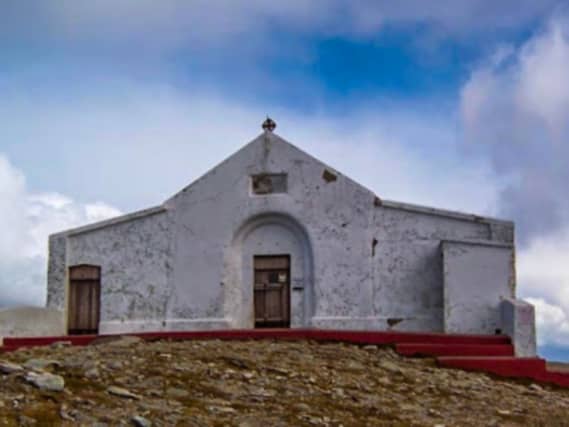
A glimpse of the gable of the little white Chapel finally confirms that you are nearing the top, the structures solid walls, a welcome shelter in this wind harried place. The highest Chapel in Ireland, this quaint building is the centre piece on the summit and only opens during July and August.
Towards the back of this picturesque Church, off to the left, are the buried remains of a monastic cell, strikingly similar in design to the wonderfully crafted Gallarus Oratory, in County Kerry. Opposite this, is ‘Leaba Phadraig’ (Patrick’s Bed), the conclusion of the second station. While the third station, ‘Roilig Mhuire’ (Virgin’s Cemetery) is some distance down on the western side of the mountain. ‘Roilig Mhuire’ is also known as ‘Garrai Mor’ (Big Garden) and is pre-Christian, as is the remains of a massive Rampart which had enclosed a large section of the summit, in Ireland’s distant past.
With my symbolic stages of ‘reason’, ‘respite’ and ‘resolve’ firmly behind me, and my exertions to the summit all but forgotten, I finally took stock of my stunning surrounds. There are few views as spectacular, or so quintessentially Irish, as the panorama which surrounds Croagh Patrick on a crystal clear day; and religion aside, it should be experienced at least once in a lifetime. Beyond Clew Bay, to the north in the hazy distance, rises the Nephin Beg Range, with proud Nephin standing alone and aloof.
At the north east foot of Croagh Patrick lies ‘Lug na nDeamhan’ (Hollow of the Demons), where Saint Patrick finally cast the Demons, which had sorely tormented him during his long vigil on the summit. Stretching off to the east, is ‘Tochar Padraigh’ (Patrick’s Causeway), a very ancient route which extends from ‘Leacht Benain’ to Ballintuber Abbey, and pre-dates Saint Patrick’s visit to the Reek. It is quite possible that this was the Druids ceremonial causeway which spanned from Royal Cruachan in County Roscommon, to the venerated ‘Cruachan Ailgi’, the (Eagle of Cruachan). To the south sits ‘Loch Na Corra’, into which Saint Patrick drove another tempestuous Demon, a female serpent called Corra, so forcefully, that a lake erupted where there had previously been a hollow.
Westward, guarding the entrance to Clew Bay is Clare Island, the old stronghold of the formidable pirate Queen, Grace O’Malley (Grainne Ni Mhaille), monarch of the western waves.
Directly to the north at the base of Croagh Patrick, is the shimmering expanse of Clew Bay: Its ancient archipelago, cluttering the inlet like so many unruly whales, harassing the beautiful Bertra Beach; a rare ‘tombola’, a strip of sand or gravel connecting an offshore Island to the main land.
It takes about two hours to climb Croagh Patrick and another hour and a half to descend, but you could easily spend much longer wandering and reflecting upon its haloed ground, so intoxicating is its spiritual allure.
Climbing Croagh Patrick is not simply a cardiovascular endeavour; it is also a deep indelible experience, a stripping away of the material, and a reconnecting to the spiritual. For God is most readily found ingrained within the pristine folds of his creation. To find him on this Sacred Mountain, we need only heed his soothing words, to ‘Be still, and know that I am God;’ Psalm 46:10.