

Would-be Mosque bombers including Louth man warned of further attacks
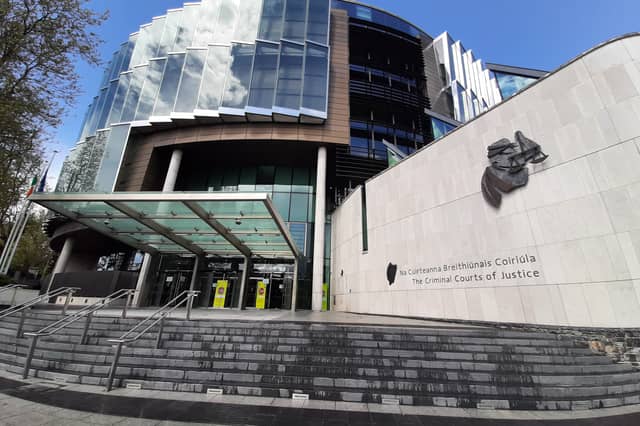

The plan was foiled when a garda drug unit stopped two of the organisation's members in a car
A group styling itself the 'Irish Defence Army' planned to smash the windows of a mosque using sledgehammers and fire pipe bombs inside to make a 'public statement', the Special Criminal Court heard yesterday.
The three-judge court also heard evidence yesterday that the defendants had a Signal group chat called 'Shadows of Eire', in which they shared information on making improvised explosive devices (IEDs) and discussed their plans to attack a mosque.
The plan was foiled when a garda drug unit stopped two of the organisation's members in a car and noted that one of them, Garret Pollack, was evasive, seemed nervous and his leg was shaking.
They searched the car and discovered written oaths, crests and a group manifesto along with materials related to the creation of IEDs.
Further investigations showed that the group had prepared a statement written in the past tense taking responsibility for bombing a mosque in Galway.
They had also filmed a video in which they warned that they would carry out further attacks and that "an eye for an eye is going to be our approach going forward".
They said legitimate targets would include mosques, anyone who facilitated the development of accommodation for international protection applicants and estate agents who "house these thugs ahead of our own".
They said they would not target women or children "unless the woman is a threat to our country or loved ones".
Det Inspector Alan McDevitt yesterday told Edward Doocey BL that the Irish Defence Army formed in October 2025 as a splinter from a larger group known as the Irish Citizens Army.
He described the splinter organisation as a right-wing extremist, terrorist group with an anti-immigration ideology. He said the discovery of explosive and incendiary devices linked to the group indicated a real and imminent attack was planned and that they intended to target minorities.
Karolis Peckauskas (39), with an address at Newfoundwell Road, Drogheda, Co Louth previously pleaded guilty to a charge of attempting to engage in a terrorist activity or a terrorist-linked activity contrary to section 6(1)(a)(ii) and 7(1) of the Criminal Justice (Terrorist Offences) Act 2005.
Darren Gorman (34), of O’Moore Place, Portlaoise Co Laois and Garrett Pollock (36), of Kilhorne Greene, Annalong, Co Down both pleaded guilty to the same offence.
The details of the offence are that between November 4 and 5 2025, the defendants attempted to engage in terrorist activity or terrorist-linked activity by attempting to set fire to the Maryam Mosque at Old Cottages, Monivea Road, Galway, an offence which was aggravated by hatred.
Pollack yesterday pleaded guilty to a further count that on November 4 the same year, inside a Citroen Dispatch van at Newfoundwell Rd, Drogheda, Co Louth, had in his possession an explosive substance giving rise to the suspicion he did not have it for a lawful purpose.
Det Inspector McDevitt said that when gardai stopped Pollack and Peckauskas in a black BMW in Portlaoise on November 4, 2025, they were each carrying knives.
In the car's boot, gardai discovered a tri-colour, cable ties, tactical vests, hatchets, a lump hammer, knives, masks, pipe cap ends and five litres of peroxide, which can be used in manufacturing pipe bombs.
They also discovered the IDA's emblem, gloves, further knives, changes of clothing and knuckle dusters. When gardai asked Pollock to account for what was found, he said: "We've done nothing yet."
When technical experts examined Pollock's phone, they discovered he was using the encrypted messaging app, Signal, to communicate with others regarding the planned terrorist attack.
He had created a group called 'Shadows of Eire'. Pollack had used artificial intelligence to design a manual for making IEDs which he shared with the rest of the group.
Gardai searched Pollack's van, which was parked outside Peckauskas's home in Drogheda, and found a hidden drawer containing four IEDs. The detective said gardai believe that Pollack had previously tested explosives that he had made to ensure they would work.
Peckauskas has no previous convictions. Pollack has 18 convictions for road traffic offences and one for resisting and obstructing police in Northern Ireland. Gorman has six previous convictions for road traffic offences.
Peckauskas's barrister Morgan Shelley SC told the court that his client offers his "sincere remorse and a sincere apology".
He said Peckauskas wants particularly to apologise to the mosque-going community of Ireland who must have found the offence "extremely traumatising".
Mr Shelley said Peckauskas became radicalised after joining various online groups and was affected by conspiracy theories, in particular those he learned from a group run by a former broadsheet journalist.
In a letter written by Peckauskas to the court, he said the offence does not reflect who he is. He said he allowed himself to be drawn in by others and deeply regrets not having the strength to walk away.
Mr Shelley asked the court to consider his client's excellent work record and his status as a model prisoner since going into custody.
Lawyers for Gorman and Pollack will make their pleas in mitigation to the court next Friday.