

Connecting communities in north Louth and south Armagh


Cross-border partnership leaves lasting legacy for language and cultural revival in Oriel region
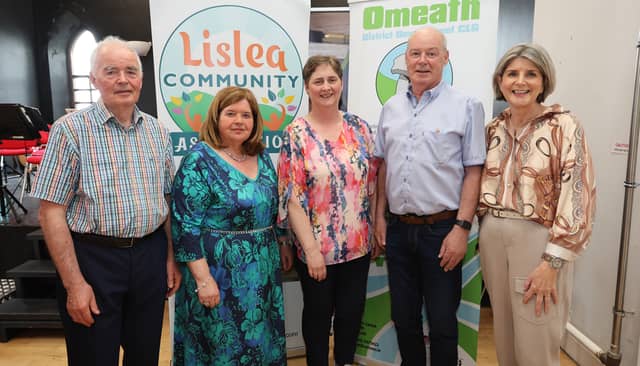
Pictured above: Anthony Clarke, Omeath District Development; Helen Thompson, Manager, Omeath District Development; Kate Quinn, Project Co-Ordinator, Lislea Community Association; Liam Hannaway, Lislea Community Association member & Kathleen O'Brien, Oriel Connects Us - Community Development Worker
The achievements of an 18-month cross-border initiative connecting communities in north Louth and south Armagh were celebrated at a special event held at the Dolmen Centre, Omeath.
The Oriel Connects Us partnership, delivered by Omeath District Development and Lislea Community Association with support from the International Fund for Ireland (IFI), has successfully brought people together to explore, preserve and promote the shared cultural heritage of the Oriel region.
Over the course of the programme, participants engaged in a wide range of activities centred on language, history and tradition, creating new opportunities for collaboration and strengthening relationships across the border.
The initiative placed a particular focus on encouraging participation at community level, supporting shared learning and a strong sense of pride in local identity.
A key outcome of the project has been the renewed focus on the distinctive Oriel dialect and its place within the cultural life of the region. Through the exploration of song, storytelling, placenames and local history, participants have helped to re-establish connections with traditions that had, over time, been diminished or lost.
The closing event provided an opportunity to reflect on both the cultural and historical context of this work, including the legacy of Coláiste Bhríd and its transfer from Omeath to Rann na Feirste. An accompanying exhibition of archival material illustrated how the dialect and traditions of the area have been preserved and recorded for future generations.
Addressing those in attendance, guest speaker Séamus Mac Dhaibhéid offered an overview of the development and eventual transfer of Coláiste Bhríde Óméith to Rann na Feirste, reflecting on the changes that took place over its 16-year lifespan.
He also highlighted the central role of Rev. Fr. Lorcán Ó Muireadhaigh in leading that transition and the wider significance of this period in the history of Irish language education in the region.
The main guest speaker, Breandán Ó Dufaigh (Muineachán), outlined the lessons Fr. Murray carried forward from the Omeath experience as he shifted his focus from County Louth to Rann na Feirste.
Breandán considered the location options available to Fr. Murray in the Donegal Gaeltacht and highlighted the pivotal contribution of his colleague Seán Ó Maoláin in shaping events. He also noted the advantages of Rannafast, including its strong Irish-speaking community and the absence of a public house and dance hall.
At the same time, he outlined the challenges Fr. Murray faced, particularly regarding the building programme and the difficulty in securing suitable accommodation for the first groups of adult students.
The event concluded with a musical performance by the Oriel Traditional Orchestra, featuring Caol Uisce by Philip McGuinness, inspired by the nearby Narrow Water landscape.
Speaking ahead of the event, Janet Mc Conkey board member, the International Fund for Ireland said: “This initiative demonstrates the real value of community partnership in building meaningful and lasting connections. By engaging with shared heritage and identity, both communities have created a strong platform for continued collaboration and understanding into the future.”
Speaking at the event, Helen Thompson, Omeath District Development CLG, said: “The strength of this project has been in bringing people together around a shared sense of place and heritage. It has sparked a renewed interest in the traditions of the Oriel region and created connections that we hope will continue to grow.”
Also speaking at the event, Liam Hannaway, Lislea Community Association said: “This partnership has re-established important links between our communities and provided a space for people to reconnect with a shared cultural identity. The relationships built over the past 18 months will endure well beyond the life of the project.”