

A&E in Louth: ‘The clock ticked away as she sat slumped alongside worried family members’
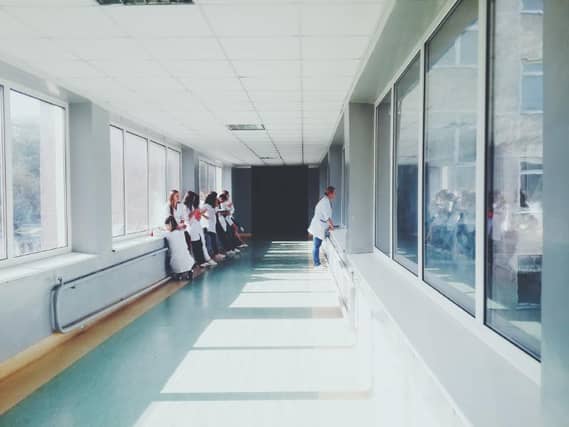

Megan Grimes writes about her recent local A&E experience
I have been relatively lucky when it comes to my health, so far. Broken bones and general clumsiness have brought me to the doors of the Minor Injuries Unit here in Dundalk just a few times. However, that quickly changed last week.
A severe pain and a visit to my GP later, and off I went to the Accident and Emergency Department of Our Lady of Lourdes Hospital in Drogheda.
I had two separate experiences of the department, both worlds apart, but in reality, were only within 28 hours of each other. The first experience was on Thursday night.
The waiting room was relatively busy. Two extremely caring triage nurses were trying their hardest to work through the lengthy list of patients. The uncomfortable wait on the black plastic chairs began as I sat in excruciating pain.
The first time I presented to the hospital, I only had to wait around four hours. My condition was evaluated by doctors and the decision to admit me was made by the team.
Although being on a trolley for fourteen hours was to follow, the care and affection that was projected throughout this time by every medical professional was exceptional.
After tests and examinations, I was shipped home on pain medication the next day.
The hopes for eventual recovery were high. Unfortunately, I was hurried back up, again, suffering a new wave of pain just a number of hours later.
Back I was again, on the cold, uninviting, chairs facing a long-ish waiting time, or so I believed - ten hours followed, in severe discomfort in a crowded waiting area.
It took a further six hours to even be evaluated by a triage nurse, who was solely responsible for monitoring an entire waiting room full of cranky, unwell people; completely sleep-deprived herself, on a packed Saturday night.
Patients who end up in this emergency department may think they’re on the home straight once a doctor calls them, however, this is an invitation into a whole new level of chaos better known as the Medical Assessment Unit.
Doctors and nurses frantically dashed around the tight space which was packed to capacity.
A glance around the room presented a grim sight - trolleys lined up along the hallway, full to breaking point.
Reports published by the Irish Nurses and Midwives Association (INMO) prove that it was not just this particular emergency department that is in crisis, of course. 760 patients are without a bed in hospitals nationwide.
“The longer this level of overcrowding continues, the greater the threats to patient safety,” said Phil Ní Sheaghdha, General Secretary of the INMO.
I struck up a conversation with my neighbour on another set of hard seats. She had been rushed in by ambulance, numb on her entire left side, yet, left on the set of chairs for five hours without seeing a doctor. As we all know, early intervention for conditions such as a suspected stroke (F.A.S.T.) is vital. According to the National Stroke Register Report in 2018, 239 patients presented to Our Lady of Lourdes Hospital in Drogheda suffering a stroke.
Being a first-hand observer to this situation, it allowed me to put my condition into perspective.
Right in front of my very eyes was a woman who was in a critical window that could prove not just life-altering but possibly fatal to. The clock ticked away as she sat slumped alongside worried family members.
Allowing patients to sit in a questionable waiting area, sitting shoulder to shoulder on a row of chairs with the majority hooked up to a drip of some sort is truly unacceptable. Staff are working tirelessly to attempt to care for the overwhelming crowds of people that present themselves to the hospital. The blame cannot be put on the staff of this hospital. But how did we allow the conditions to come to this?
The Irish Nurses’ and Midwives’ Organisation (INMO) have reported that nearly 120,000 patients requiring admission nationwide were forced to wait in emergency department. In 2019, which was the worst on record for overcrowding, 18,367 patients went without hospital beds, a 9 per cent increase on 2018.
Staff struggle as they are overworked and underpaid for the level of care and responsibility expected. A newly-qualified staff nurse or midwife, which is a nurse who has recently finished college, but has yet to be registered under the Nursing and Midwifery Board of Ireland (NMBI), would start on an annual salary of around €24,850 before tax and around €21,700 after tax. This rate of salary is completely inadequate considering the vast amount of hours that they are expected to work every week.
The fact that we have a previously fully-functioning hospital on our doorstep which has been minimised to a ‘Minor Injuries Unit’ and ‘Respite Care’ is wasteful, to put it lightly.
The overcrowding issue would be dramatically decreased in Drogheda if the hospital here in Dundalk was brought back into frontline use. Patients have to suffer at the hands of our broken health system which is run by overworked and underappreciated people who try their best to meet unrealistic expectations as medical professionals in this environment.