

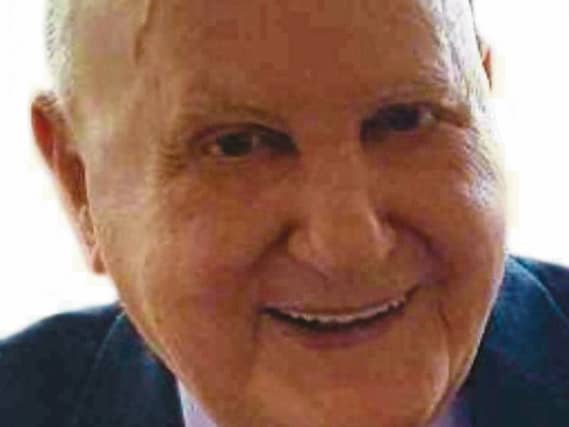
A fond farewell to Dundalk printer Frank 'Gus' Boland

Peter Kavanagh
Readers of last week's Democrat will have noticed an excellent obituary written by a former Editor Joe Carroll on the recent death of an old Dundalk printer Frank Boland. I could not improve on Joe's article but I would just like to comment that I also was present at his funeral mass in St. Joseph's and that the occasion brought memories flooding back of the old Democrat printing works at 3, Earl Street and the people who had worked in it.
Joe knew Frank a lot better than I did but the one thing he failed to mention about him was that he was known to all who worked in the Democrat as simply 'Gus'. I do not know where this nickname originated but I do recall that all the old printers in Dundalk had nicknames and that this was probably true of most other places of employment in the Town of the last century. Do many of my readers have fond memories of old work colleagues which were remembered by those names? If so, maybe you could make a list and forward them to the Democrat!
The nicknames at the Democrat were many and varied and some did not mind at all when their colleagues called them by such a sobriquet while others did not want to hear them used at all. One of the most unusual that I can recall that that for an old 'machine man' who was known as 'Frinks', the origins of which I cannot even guess! Even the journalist staff had nicknames. My own first Editor was known to the printers as 'The Colonel', probably because he had taken part in the March of the Dundalk Volunteers that left the Town at Easter 1916 to take part in the Rising. One of the stories the old printers used to tell about Necy was that he had tackled a Black and Tan in Chapel Street during the War of Independence, wielding a ancient sword and put the auxiliary policeman to flight! How true the story was cannot be verified; he never mentioned the incident himself but the printers believed it and respected him for it!
Frank Boland, being a very genial person, never seemed to mind being called 'Gus' b y his co-workers. The most outstanding feature of his long life is that he was always very helpful to all who came in contact with him. He once told me that he had joined the Democrat printing staff at the start of World War 11 in 1939 and that, shortly after he commenced work as an apprentice the number of pages in in the Democrat had been reduced from 12 to six, because of the shortage of newsprint, and often the printing staff would be sent home early because there was no work for them. The Thomas Roe Company who ran the Democrat did not cut wages as a result but other Dundalk employers may had done so. This wage cutting practice must have been a common enough experience in Dundalk of the period and some large families had to survive on reduced wages.
Frank had got married in the year after I joined the Democrat and I recall that he had introduced me to his wife to be, Anna Loughlin, at a dance in the old Hibernian Hall at Jocelyn Street shortly after I started. Always helpful, Frank had suggested that I should be on the look out for a suitable girl at the dance to consider dating but I was 'fancy free' in those days and it was to be many years before I got 'hitched' myself.
Printing practices
Frank's funeral was the occasion when I recalled the many customs and practices of the printing industry. One of the things that an old printer had taught me that it was a prime rule was that 'You should follow the copy, even if it flies out the window'. This was a very important principle when setting type as mistakes were frequent when typing or even handwriting copy and it was the duty of proof readers to make sure that they did not get into print. There were many stories about mistakes in print and one of the most famous was the one about Queen Victoria 'passing over Westminster Bridge' – you may be able to guess the error that was supposed to be printed.
The most amusing misprint in my time in the Democrat office was when Frank Necy wrote an extravagant editorial about the Big Fair Day in old Dundalk. Frank was given to using old fashioned words and wrote of the Parade of Stallions for service through the main streets that he missed the times 'when the gaily caparisoned horses paraded the main streets'. Unfortunately, when the editorial appeared in the paper the 's' was missing from the word horses. Never mind that you also needed a 'w' to spell the word correctly, the readers all thought that Frank was referring the colourful 'Ladies of the Town' of his youth and not to a bunch of stallions.
Frank was livid as he believed that it had been a mischievous printer who had changed the print but it turned it was due to his own bad handwriting. Which just goes to show that even the best can make mistakes and you never laugh at another's error as it could be your turn next! So, be careful when you are sending your next email or phone text!