

O’Neill accused of ‘gross contempt’ for Assembly after protest question no-show
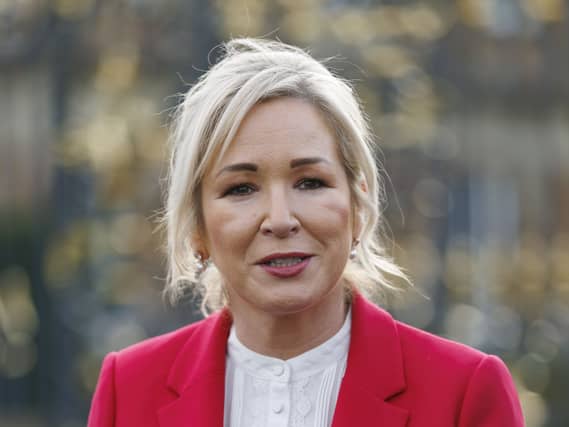

The First Minister declined to appear before the House to answer an urgent oral question on her attendance at the unlawful protest in Portadown.
Northern Ireland’s First Minister has been accused of showing “gross contempt” to the Stormont Assembly after she refused to answer an urgent question on her participation in an unlawful protest against a controversial parade.
Speaker Edwin Poots said Michelle O’Neill’s no-show was “unprecedented” and DUP deputy First Minister Emma Little-Pengelly accused her co-leader of “running away from scrutiny”.
DUP MLA Phillip Brett had tabled the urgent oral question asking Ms O’Neill to explain how her attendance at the protest on the Garvaghy Road in Portadown on Sunday was in keeping with her pledge of office.
Mr Brett accused her of going “on the run”.
Ms O’Neill and other senior colleagues were among a large crowd that blockaded the road in the predominantly nationalist area of Portadown to prevent a contentious Orange Order parade from passing the route.
Under parading laws in Northern Ireland, protests must be notified to, and approved by, the Parades Commission adjudication body.
Police confirmed on Monday the protest was unnotified to the commission and therefore unlawful.
Ms O’Neill defended her attendance in a personal statement to the Assembly from the backbenches earlier on Monday, but she later declined to appear before the dispatch box to answer Mr Brett’s question.
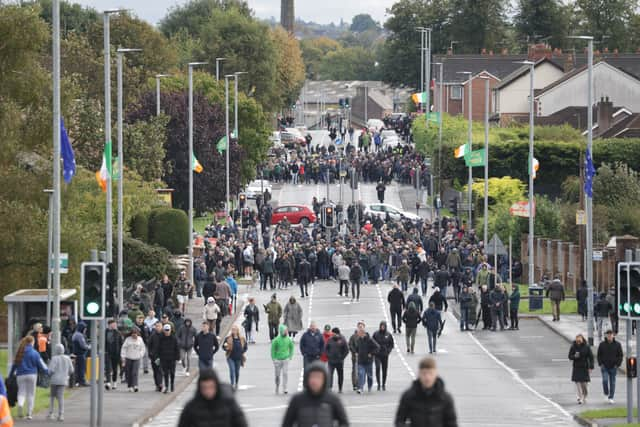
Away from Stormont, Northern Ireland Secretary Sir Chris Bryant held crunch talks at Hillsborough Castle on Monday with Orangemen and nationalist residents in a bid to resolve the intensifying dispute over the controversial parade in Portadown.
Sir Chris had separate meetings with representatives from both the Orange Order and the Garvaghy Road Residents’ Coalition. He also held talks with senior politicians.
Afterwards, Sir Chris described the exchanges as positive.
“I’m trying to find a solution that really works for everybody so that everybody can hold their head up high – and it’s tantalisingly just a bit far away at the moment, but we’re working on it,” he said.
Loyal order members remained at Drumcree in Portadown on Monday after a weekend of tension in the Co Armagh town, after their planned parade was stopped by police, as officers were concerned about the scale of a mass protest on part of the proposed route – the predominantly nationalist Garvaghy Road.
Orangemen attempted to begin their parade on several occasions, including in the early hours of Monday, but police halted them on each occasion.
Senior Orangemen in the Portadown district have called on PSNI Chief Constable Jon Boutcher to resign, for failing to clear the road and facilitate the parade.
The PSNI has defended its approach, and Assistant Chief Constable Ryan Henderson said the use of force to move protesters off the Garvaghy Road risked people getting “seriously hurt”.
The Drumcree parading dispute, which was associated with violent disorder during the Troubles, has been reignited after the Parades Commission granted permission for a limited parade down the Garvaghy Road for the first time in almost 30 years.
During sharp Assembly exchanges when the First Minister did not appear on Monday, Sinn Féin party whip Sinéad Ennis said Ms O’Neill had attended the protest in her role as Sinn Féin vice president, rather than First Minister.
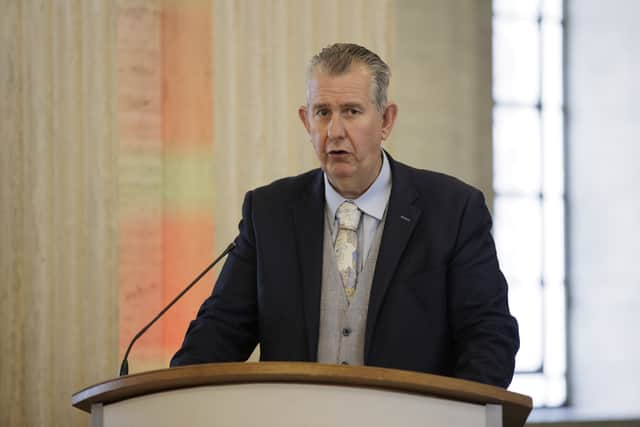
Mr Poots, who selected the question as one that should be answered by Ms O’Neill, suspended proceedings for 15 minutes when the First Minister initially did not appear.
When she was still not present when the Assembly resumed, the speaker accused her of “gross discourtesy”.
“It is unprecedented – unprecedented – for a minister not to come to this House whenever the Speaker’s office has made that call,” he said.
“You may not like the call that the Speaker’s office made, but it is gross discourtesy to everyone in the House that you choose not to do it.”
Mr Poots said ministers were obliged to attend the House when requested by the Speaker under the terms of their pledge of office.
“So, on many fronts, this is just unacceptable,” he said.
He added: “For a minister to refuse to be held to account is showing gross contempt to all of the people who have went out and cast votes to elect members of this Assembly.”
Ms O’Neill said “I don’t agree with the speaker”, after emerging from a meeting with Sir Chris at Hillsborough Castle.
She added: “I’m very confident in my role in supporting a community that’s under siege.
“I can see political mixing in the Assembly chamber. I can see other political opponents trying to use this as an opportunity.
“When I was asked to come to the chamber to answer a question, that would be in my capacity as a First Minister. That was not the capacity in which I was on the Garvaghy Road.
“I was there to represent those people, I am the vice president of Sinn Féin.”

The row has rocked the Stormont devolved institutions, and Ms O’Neill faced claims of “law breaking” for taking part in Sunday’s protest.
The Traditional Unionist Voice (TUV) party has called on the DUP to withdraw the party’s deputy First Minister Ms Little-Pengelly from office – a move that would forcibly remove Ms O’Neill from her post in the joint office.
The DUP has said it cannot be business as usual at Stormont and vowed to take action against Sinn Féin, after senior members, including the First Minister, took part in an unlawful protest against a loyal order parade.
DUP leader Gavin Robinson opted for a different approach on Monday, making clear he did not intend to be “reckless”.
But he said it could not be business as usual at Stormont as he vowed to take action against those politicians who took part in the protest.
However, Mr Robinson said his party would pursue a “pathway” and initiate a “range of actions”.
He said that would include complaints to the Assembly’s Commissioner for Standards, calls for censure and motions of no confidence.
He said there was also a “clear requirement” for the Police Service of Northern Ireland (PSNI) to “prosecute anyone who has broken the law”.
In her statement to the Assembly, Ms O’Neill defended her participation in the protest, telling MLAs she was “proud” to be involved.
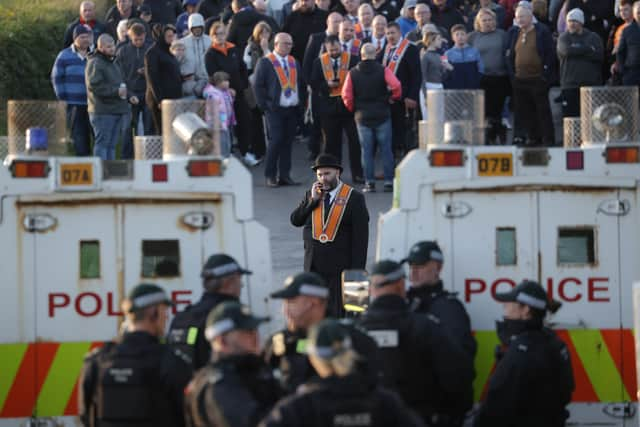
At Hillsborough, the Orange Order’s Portadown District Master Nigel Dawson described an hour-long meeting with Sir Chris as “very constructive and detailed”.
“We are now returning back to Drumcree, where we left this morning,” he added.
Breandán Mac Cionnaith from the Garvaghy Road Residents’ Coalition said he told the Northern Ireland Secretary that the group would be open to a mediation process to resolve the parade dispute.
Speaking after meeting Sir Chris, Mr Mac Cionnaith said he wanted an international mediator to oversee the process.
On Monday, Taoiseach Micheál Martin said the Irish Government remained “very, very concerned” about tensions in Drumcree.
Speaking in Cork, Mr Martin said there was an “obligation on everybody now to stand back and to mediate an outcome” in the best interests of the people of Northern Ireland.
On Monday, the PSNI maintained a low-key presence near Drumcree Parish Church, where a number of loyal order members stayed overnight in the expectation of completing their march.
About a mile away, a small number of protesters, some with their faces covered, gathered on the Garvaghy Road.
At the height of the blockade on Sunday, more than a thousand people congregated on the road to prevent the parade from the Drumcree Church from passing along the route.
SDLP leader Claire Hanna and party colleague Justin McNulty also attended the protest.
It was organised after Orangemen managed to overturn a long ban on them parading down the road.
The blockade continued through the day on Sunday and late into the night, as Orangemen assembled at the church waiting to start their parade.
Orange members made several attempts, including in the early hours of Monday, but were prevented by police.
The protest on the Garvaghy Road largely dispersed just after midnight, after Mr Mac Cionnaith told demonstrators that a process to resolve the stand-off would begin on Monday.
Ms O’Neill and other ministers in the Stormont Executive are bound by a pledge of office that contains a commitment to uphold the law.
DUP leader Mr Robinson said politicians who took part in the protest needed to face consequences for their actions.
Ms O’Neill and Ms Hanna have both defended their attendance on the Garvaghy Road on Sunday.
SDLP MP Ms Hanna said she believed the gathering was lawful as there had not been sufficient time to notify the Parades Commission about the protest, and there were provisions in human rights laws that permitted protests.
“I am very comfortable that I acted within the law,” she told reporters at Stormont.
A ruling by the Parades Commission permitting the Orange Order march from Drumcree Church and along the Garvaghy Road was upheld in an “unprecedented” late-night sitting of the High Court in Belfast in the early hours of Sunday.
The Drumcree parade down the Garvaghy Road has been banned since 1998.
The stand-off in the late 1990s led to violent clashes for several summers and political tension necessitated major security operations.
The Orange Order has unsuccessfully applied for more than a quarter of a century to complete its 1998 walk along its traditional route.
On Friday, the commission reversed its long-running determination and granted permission for the parade – a decision welcomed by unionist parties and met with outrage from nationalist and republican parties.
Permission was granted for a parade subject to strict restrictions, including a limit of 35 participants and an 8am start time.