

Dundalk World Irish dancing champ takes on Joseph Mary Plunkett role

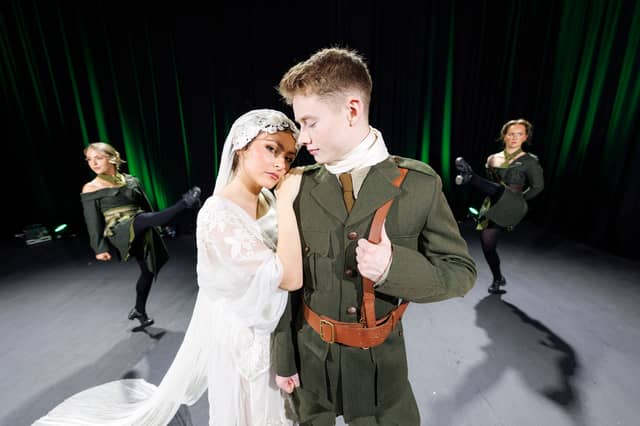

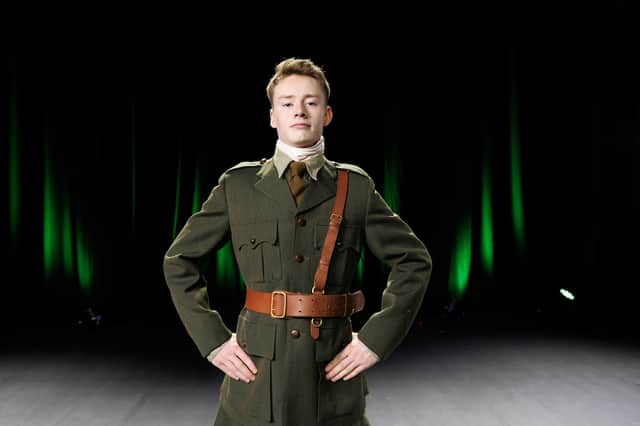
Dundalk World Irish dancing champion Daragh Roddy from Ravensdale, Dundalk, is taking on the role of Joseph Mary Plunkett in a new production coming to Dublin’s Ambassador Theatre this October
World and Ulster Irish dancing champion Daragh Roddy from Ravensdale, is taking on the role of Joseph Mary Plunkett in a new production coming to Dublin’s Ambassador Theatre this October.
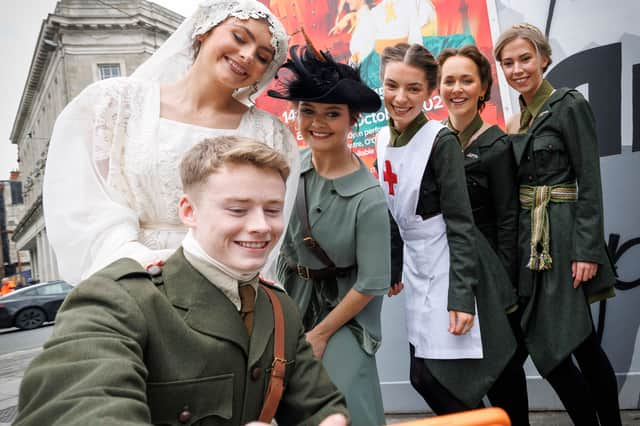
Mná na hÉireann, a powerful new Irish dance theatre production celebrating the extraordinary women who helped shape modern Ireland will take to the stage at Dublin’s Ambassador Theatre this October.
Running from 14th to 16th October 2026 at the historic O’Connell Street venue, Mná na hÉireann will bring together traditional Irish dance, original music, song, poetry, narration and striking visual design to tell the stories of women whose courage, sacrifice and contribution to Ireland’s revolutionary period were, for generations, too often left in the shadows.
Mná na hÉireann traces a defining period between 1912 and 1918, when women fought not only for social and political change, but also to preserve and strengthen Ireland’s cultural identity.
It was created and produced by former Riverdance Irish Dance Director and three-time World Irish Dancing Champion Carol Leavy Joyce from Ardee and now living in Blackrock,
Carol is an Irish dance teacher, adjudicator, examiner, producer and choreographer. During her competitive dancing career she won three World titles, three All-Ireland titles and nine Ulster titles.During an eight-year career with Riverdance, she served as Irish Dance Director and Assistant Director and contributed choreography to the production.
In 2003 she was part of the creative team that staged Riverdance at the Great Hall of the People in China and arranged the Riverdance line of 100 dancers for the Opening Ceremony of the Special Olympics World Games at Croke Park.
Carol was Irish dance choreographer on Boublil and Schönberg’s Broadway musical The Pirate Queen. Her work, created in collaboration with Graciela Daniele, received an Outer Critics Circle Award nomination.
Carol holds an Honours Master’s degree in Ethnochoreology from the University of Limerick and lectures part-time in Musical Theatre at Dundalk Institute of Technology.
Years of work and research has gone into the production and preparation for the show, including an exploratory presentation that was created in 2018, followed by a full workshop production at An Táin Arts Centre in Dundalk in 2019.
Dundalk composer and musician, Áine McGeeney. will also perform as fiddle player, whistle player and singer in Mná na hÉireann. Áine is an award-winning traditional fiddle player, singer and composer and a founding member of acclaimed traditional group Goitse.
She holds a BA in Irish Music and Dance and an MA in Irish Music Performance from the University of Limerick and has toured extensively throughout the world.
Áine has also performed as lead fiddle player with Lord of the Dance and was named Female Vocalist of the Year by Irish American News in 2016. Her compositional work includes commissioned music marking the centenary of the Easter Rising and the centenary of the end of the First World War.
Mná na hÉireann focuses on women from different backgrounds and classes whose lives became intertwined with the cultural and political upheaval of the period, among them Countess Markievicz, Nurse Elizabeth O’Farrell, Julia Grenan, Dr Kathleen Lynn, Winifred Carney and Grace Gifford.
O’Farrell, who carried the surrender from Pádraig Pearse to Brigadier-General William Lowe following the Easter Rising in April 1916, is a particular focus of the production.
Through dance, music and theatre, Mná na hÉireann seeks to step beyond the familiar historical narrative and bring audiences closer to the women themselves: their friendships, determination, loyalty, courage, loss and enduring influence.
The production takes inspiration from the words spoken by Mary Robinson on becoming Ireland’s first female President in 1990: “I want women who have felt themselves outside history to be written back into history.” For Carol Leavy Joyce, those words echo a creative journey that began almost a decade ago.
On Easter Sunday 2016, Carol stood on O’Connell Street with her husband Kevin and their son Ruadhán during the centenary commemorations of the Easter Rising. While deeply moved by the occasion, she was struck by how little she heard about many of the women whose actions had been central to the revolutionary period.
Visits to Kilmainham Gaol and Richmond Barracks followed. At Richmond Barracks, confronted by a tapestry recording the names and images of the approximately 70 women interned there following The Rising, the seeds of Mná na hÉireann were firmly planted.
What followed was years of research, archive visits, workshops, rehearsals, fundraising and setbacks, including the complete interruption of the project during the Covid-19 pandemic.
An exploratory presentation was created in 2018, followed by a full workshop production at An Táin Arts Centre in Dundalk in 2019. The production subsequently faced years of uncertainty before new investment finally allowed Carol and her creative team to take the next step. Now, eight years after that first exploratory presentation, the production is ready to make its Dublin debut.
Carol Leavy Joyce, creator, producer and co-choreographer of Mná na hÉireann, said: “Mná na hÉireann has lived with me for almost a decade. It began with a very simple question: where were the women? The more I researched, the more extraordinary their stories became.
“These were women of immense courage and conviction who were working, organising, nursing, campaigning, fighting, protecting our language and culture and supporting one another through an incredibly turbulent period in Irish history.
“There have been many moments over the years when I wondered whether we would ever reach this stage, but I could never quite let the story go. I kept coming back to these women and to the feeling that they deserved to be seen, heard and remembered.
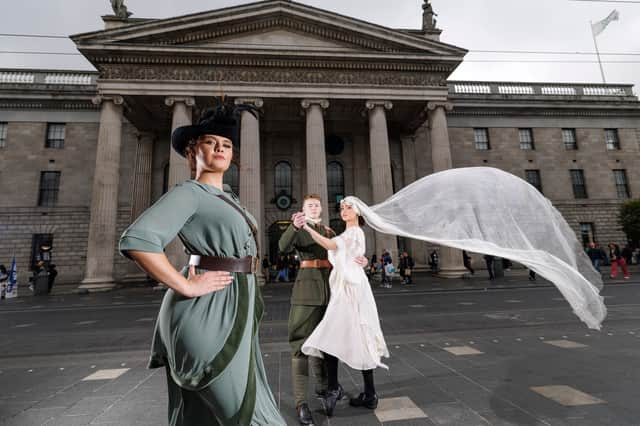
“To now bring Mná na hÉireann to The Ambassador Theatre, on O’Connell Street where so much of this history actually unfolded, feels incredibly special. In many ways, the story is coming home.
“There are moments of enormous strength and exhilaration, but also great sadness and sacrifice. Above all, I hope audiences leave knowing more about these remarkable women and understanding just how much we owe them.”
Carol is joined as co-choreographer by two-time World Champion and former Riverdance principal dancer Michael Patrick Gallagher.
Speaking about approaching history through Irish dance, Michael Patrick Gallagher said: “Irish dance has an extraordinary ability to communicate energy, pride and emotion without a single word being spoken.
“With Mná na hÉireann, our challenge has been to use that vocabulary in service of the story rather than simply creating dance for dance’s sake. Every step has to mean something. We are drawing on the power and precision of traditional Irish dance while allowing the choreography to respond to the courage, tension, loss and resilience within these women’s stories.”
The production features an original musical score by award-winning traditional musician, singer and composer Áine McGeeney, a founding member of Goitse who has also toured internationally as lead fiddle player with Lord of the Dance.
Áine McGeeney said: “Music has always been inseparable from Ireland’s history and identity, so composing for Mná na hÉireann offered a wonderful opportunity to connect those traditions with the emotional journeys of these women.
“The score moves between moments of hope, determination, upheaval and loss, and my aim has always been to create music that supports the storytelling while still having its own voice.”
Movement direction is by Dr Ella Clarke, whose extensive theatre credits include work for the Abbey Theatre, Gate Theatre, Wexford Festival Opera and CoisCéim Dance Theatre.
Dr Ella Clarke said: “What is particularly interesting about Mná na hÉireann is the meeting point between traditional Irish dance and theatrical storytelling. We are looking at how movement can reveal character, relationships and atmosphere, and how bodies on stage can carry history in a way that feels immediate rather than remote.”
Playwright, director and theatre-maker Declan Gorman serves as dramaturg, Declan Gorman said: “One of the most compelling aspects of this project is the opportunity to bring historical experience out of the archive and into a living theatrical space. Mná na hÉireann is not trying to present a textbook account of the revolutionary period.
“It is theatre, and its strength lies in the combination of dance, music, poetry, narration and imagery. Our task has been to ensure that the historical material remains clear and truthful while allowing audiences to connect emotionally with the people behind the events.”
Together, the contributions of Carol Leavy Joyce, Michael Patrick Gallagher, Áine McGeeney, Dr Ella Clarke and Declan Gorman bring five distinct creative disciplines into step, creating a production in which history is not simply recounted but physically, musically and dramatically brought to life.
The visual world of Mná na hÉireann will be created by French audiovisual specialists COSMO AV, with lighting design by Sonya Fossett and costume design by award-winning designer Thérèse McKeone
The cast includes Siobhan Phelan, Enya Higgins, Jade Judge Ryan, Zoe Talbot, Michaela McBride O’Donoghue, Cara Flannagan Walsh, Emily Hunt O’Reilly, Seoda Wang, Chloe Kenna, Laura-Jane Leggett, Daragh Roddy, James Fox, Scott Judge Ryan and Éamonn Smyth, with Aoibhinn O’Hagan and Erinn McGuinness as Dance Captains.
Composer Áine McGeeney will also perform as fiddle player, whistle player and singer alongside musicians Michael Biggins on piano, Danny McGuinness on accordion and whistles, Kaitlín Cullen-Verhauz on cello and vocals, and Kieran Leonard on percussion.
For Carol, the response to the original workshop production demonstrated that the subject resonated far beyond the stage.
Following performances in Dundalk, audience members regularly remained afterwards to share stories of mothers, grandmothers and other relatives who had been members of Cumann na mBan or involved in events surrounding Easter Week 1916.
It is that connection between national history and individual family memory that Mná na hÉireann hopes to rekindle when it reaches Dublin.
And few venues could provide a more resonant setting. The Ambassador Theatre stands on O’Connell Street, at the heart of the city landscape in which so many of the events explored in the production unfolded.
For three nights this October, the women who once walked those streets will take centre stage just metres from where history was made.
Mná na hÉireann runs at The Ambassador Theatre, O’Connell Street, Dublin 1, on 14, 15 and 16 October 2026 at 7.30pm. Tickets are available through Ticketmaster, online ticket price: €39 including all booking fees. Running time: approximately 1 hour 45 minutes plus interval.